In brief
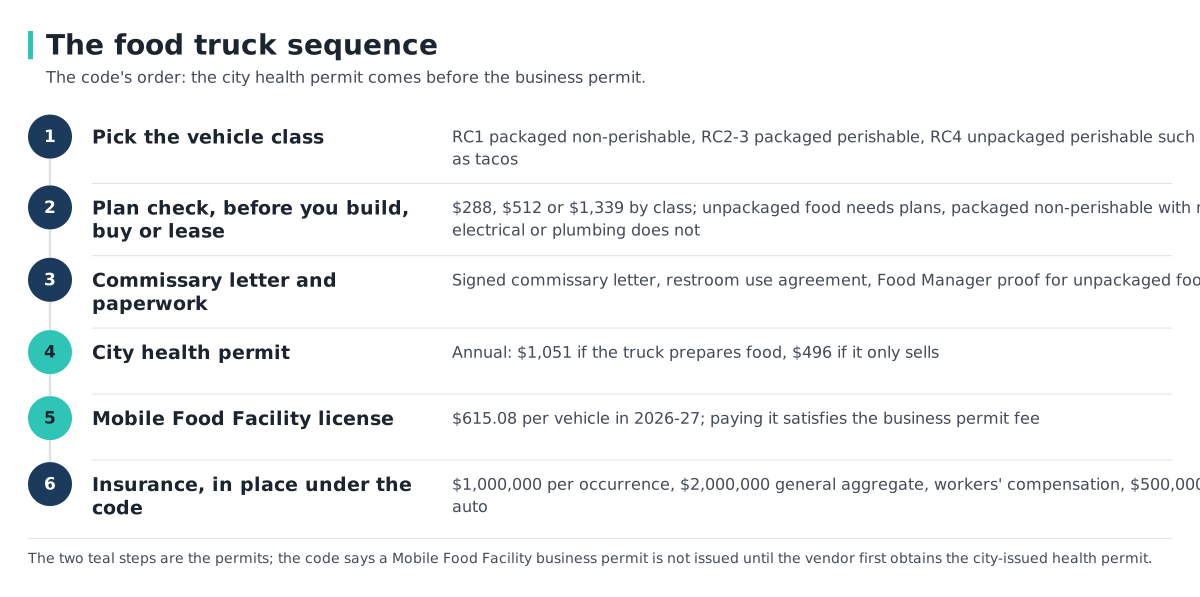
A Long Beach food truck needs three things before it operates: a health permit issued by the city’s own Health Department after plan check, a Mobile Food Facility business license ($615.08 per vehicle in 2026-27), and the insurance the code requires; the code says the health permit must come first. In the fee year that ended September 30, 2026, plan check cost $288, $512 or $1,339 by vehicle class and the annual permit was $1,051 for a truck that prepares food or $496 for one that only sells it.
- Municipal Code chapter 5.37 requires a business license, a Mobile Food Facility permit, a seller’s permit “to the extent required by law” and “a valid health permit from the City Department of Health and Human Services”1.
- The license tax is $615.08 per vehicle for 2026-27, and paying it “shall satisfy the fee for a Mobile Food Facility Business Permit”15.
- Insurance under the code: $1,000,000 per occurrence, $2,000,000 general aggregate, workers’ compensation and $500,000 auto1.
- Permitted operators in good standing may extend metered parking time “by up to twice the designated duration, with a cap of 4 hours” provided that the meter is paid for the entire period of occupancy; in the Downtown Dining and Entertainment District the limit is 8 hours1.
- One city sheet still says the health permit comes from Los Angeles County; the code and the Health Department say the city167.
Long Beach’s food-truck rules sit in chapter 5.37 of the Municipal Code (ordinance ORD-26-0011), and the city’s pages do not all agree with it1. The result is that the permit sequence is clear in the code and the Health Department’s pages, and less clear on the license division’s forms sheet. This page follows the code’s order: vehicle class and plan check, the city health permit, then the license, with the parking rules the ordinance sets. Carts that roll on sidewalks are a different permit, covered in Sidewalk Vending in Long Beach; the section pillar How to Open a Food Business in Long Beach compares them with restaurants, home kitchens and cottage food.
The short answer
| If you are… | Do this |
|---|---|
| Buying or building a new truck | Get Health’s plan approval before building, buying or leasing it; the Bureau’s guide says “plan check approval prior to building, purchasing or leasing a truck or cart”4 |
| Running a truck permitted by Los Angeles County | Ask the Bureau for the plan check consultation route to a City of Long Beach health permit6 |
| Selling only prepackaged, non-perishable food, with no electrical or plumbing | The guide says such carts and trucks are not required to submit plans; the health permit still applies4 |
| Selling tacos, burgers or other unpackaged perishable food | The highest vehicle class (RC4): plan check $1,339 and at least one person with a Food Manager certificate38 |
| Choosing where to park | Chapter 5.37 lets operators vend on public rights-of-way that meet its definition of a Street, in named lots and park lots, within its hour and distance rules; confirm private-property locations with Planning14 |
Official pages disagree Municipal Code chapter 5.37 requires “a valid health permit from the City Department of Health and Human Services”, and says a Mobile Food Facility business permit “shall not be issued for operation unless the vendor first obtains a valid City-issued health permit”1. The Bureau of Environmental Health’s page says a truck with a Los Angeles County permit “may obtain a City of Long Beach health permit by completing a plan check consultation”6. The Business License Division’s “Required Forms and Permits” sheet still says a food truck needs “a valid heath permit issued by the County of Los Angeles Public Health Department”7. Plan around the city permit: it is what the code requires, and the Bureau’s page describes how to get it. If a county permit is all you hold, call the Bureau at (562) 570-4132 before you pay for a license.
Step 1. Pick the vehicle class
Health sorts mobile food facilities into classes by what they sell, and the plan-check fee follows the class. The schedule’s descriptions, with its examples3:
| Class | What it sells | Plan check |
|---|---|---|
| RC1 | Packaged non-perishable food, such as candies, chips and chocolate | $288 per vendor |
| RC2-3 | Packaged perishable food and unpackaged non-perishable food, such as churros, Italian ice and popcorn | $512 |
| RC4 | Unpackaged perishable food, such as tacos and hamburgers | $1,339 |
Source:3, fee year ending September 30, 2026. A plan revision after approval is $4083.
The Bureau’s mobile-food page names five categories of vehicle it permits: unpackaged perishable (catering trucks, soft-serve and scoop ice cream trucks), unpackaged non-perishable (produce trucks, churro carts), packaged frozen ready-to-eat foods and seafood, packaged non-perishable (fruit carts, snack carts) and packaged perishable (grocery trucks)8.
Step 2. Plan check, the commissary and the paperwork
The Bureau’s Food Truck and Cart guide gives the sequence: decide what you will sell; check licensing, Planning and Environmental Health before buying; build or buy a truck that meets the California Retail Food Code; and submit plans if the truck sells unpackaged food4. Then, at the inspection stage, the guide lists what the Bureau wants4:
- Book an inspection appointment for the truck or cart.
- Submit a signed letter from a licensed commissary where the vehicle will be stored and serviced. The Bureau keeps an approved commissary listing8.
- Provide a restroom use agreement.
- Show proof of Food Manager certification, for operators of unpackaged food.
- Complete the health permit application.
The Bureau’s page sets the certification rule by food type. A vehicle selling unpackaged perishable food needs at least one person with a Food Managers certificate and a food handler’s card for every other employee; non-perishable, non-prepackaged food needs only handler cards; prepackaged-only vehicles need neither8.
For a truck that already holds a Los Angeles County permit, the Bureau’s page offers a plan check consultation in place of the full plan check. It says the consultation fee was waived “through July 31, 2026, provided that the mobile facility’s construction and operation meet all minimum requirements”, and gives no figure for after that date, so ask the Bureau what applies now6.
Step 3. The city health permit
The permits are annual, and the Bureau issues a decal in a different color each year so that the current year’s approval is visible on the vehicle9. The fee schedule’s lines for vehicles3:
| Annual permit | Fee |
|---|---|
| Vehicle: mobile food preparation | $1,051 |
| Vehicle: food retail, no preparation | $496 |
| Grocery vehicle with refrigeration | $539 |
| Tricycle mobile food | $320 |
Source:3, fee year ending September 30, 2026.
Other charges on the same schedule: a missed routine inspection $46, a water resample $107, a permit reinstatement $203, a change of licensing information $46, and a food-cart or mobile-food impound $498 (the repeat-impound fee is listed at $992.40 and “doubles with each occurrence”)3. Inspections of vehicles with plumbing happen twice a year, scheduled in February and August; vehicles selling prepackaged food are inspected once a year, in August8.
The council approved updated city fee schedules effective October 1, 202611. The city’s August 2026 memo proposed Health fee adjustments in which “no individual fee is increasing to over $100 per month, and the average increase across all adjusted fees is kept to 39 percent”10. The Bureau’s home page still links the FY26 mid-year schedule above14, and the city’s fee-schedules page lists new building, fire and other schedules but no Health one11; the figures here are the schedule in force through September 30, 2026, so confirm the current amount at the Bureau before you budget.
Step 4. The business license, the seller's permit and insurance
The code’s order is explicit: the city health permit first, then the business permit. The license tax for a mobile food vendor is $615.08 per vehicle in the 2026-27 table, and “payment of the Mobile Food Facility business license tax shall satisfy the fee for a Mobile Food Facility Business Permit”15. The division’s general rule is that “all businesses operating within the City of Long Beach need to obtain a business license”2.
The code also asks for a seller’s permit from the state tax agency “to the extent required by law”. The permit is free, though the agency “may require a security deposit under certain circumstances”112.
The insurance the code names is $1,000,000 per occurrence and $2,000,000 in general aggregate, workers’ compensation, and $500,000 in auto coverage1.
Operating rules in the same chapter: operators may not use “amplified or non-amplified sound-making devices”, such as speakers, microphones, public address systems, bells and chimes (ice cream trucks may use them only while the vehicle is moving), and may not sell food or merchandise that requires an age check, such as alcoholic beverages, tobacco, cannabis or firearms1.
Where you can park
Chapter 5.37.090 says operators “may vend on any public right-of-way that meets the definition of a Street”, and names three more places: the Shoreline Aquatic Park Surface Lot (212 Golden Shore, first come, first served), select city park parking lots in the Park Parking Lot Program (designated spots for up to five operators at each park, two at Granada Beach) and the dedicated portions of Ocean Boulevard parking1. Within those places the chapter sets hours and distances.
- Hours. In the public right-of-way, 7 a.m. to 10 p.m. on non-residential and mixed-use blocks (to 11:30 p.m. in the Downtown Dining and Entertainment District) and 9 a.m. to 8 p.m. on residential blocks. Within one block of school grounds, no vending Monday to Friday from 7 a.m. to 5 p.m. unless the school permits or invites it. Park lots follow park hours, no later than 10 p.m.1
- Distances. Not within 10 feet in front of or behind a marked bus zone or Metro stop; 15 feet of a fire hydrant, fire lane or fire department connection; 20 feet of a driveway, alley approach, intersection or marked crosswalk; 25 feet of a beach access point or pier; 50 feet of a railroad crossing; or 100 feet of the vehicle entrance of a fire station, police department, hospital or lifeguard headquarters1.
- Concessions and events. Not within 500 feet of a concessionaire that holds an exclusive agreement with the city. At permitted swap meets, certified farmers’ markets and special-permit areas where you are not contracted to vend, the buffer is 250 feet for events under 5,000 attendees at a limited venue and 500 feet for all others1.
- Space. A pedestrian path of at least five feet must stay open (eight feet in high-volume pedestrian zones), a truck may occupy up to two on-street stalls, and no truck may stay parked overnight on a public street or lot between 2 a.m. and 6 a.m.1
- Meters. A permitted operator in good standing may “extend the posted parking time limits in metered stalls by up to twice the designated duration, with a cap of 4 hours”, provided that the meter is paid for the entire period of occupancy; in the Downtown Dining and Entertainment District a metered stall may be used for up to 8 hours on the same condition1.
- Planning. The Bureau’s guide says to check with the Planning Bureau “to make sure your proposed operation location(s) are allowed” before you buy, and the Planning line is (562) 570-6194413.
- Forms. The Bureau’s mobile-food page links a restroom agreement and a route-stops schedule form8.
Anything on private property, at a market or at an event is a separate permission; Special Event Permits in Long Beach covers the city’s event rules.
What the city's charges add up to
For a taco truck, the city’s recurring charges in the fee year that ended September 30, 2026 are the health permit at $1,051 and the license at $615.08, about $1,666 a year before insurance, commissary rent and the state seller’s permit (free)35. A new RC4 build adds plan check at $1,3393. A prepackaged snack truck would pay $496 for the permit and $288 for plan check3. The truck, the commissary and the general liability and auto insurance cost more than any of these; the city’s figures are the part you can fix before you buy. The site earns a commission on some links to business services, which does not affect what is recommended.
Frequently Asked Questions
Who issues the health permit for a food truck in Long Beach?
How much is a food truck license in Long Beach?
How much is the health permit for a food truck?
In the fee year that ended September 30, 2026, $1,051 a year for a truck that prepares food and $496 for one that only sells food, plus plan check of $288, $512 or $1,339 by vehicle class3.
Do I need a commissary?
Can I park a food truck anywhere in Long Beach?
No. Chapter 5.37 lets operators vend on public rights-of-way that meet its definition of a Street, in the Shoreline Aquatic Park Surface Lot, in park lots in the city’s program and in the dedicated Ocean Boulevard parking, and it limits hours (7 a.m. to 10 p.m. on non-residential blocks, 9 a.m. to 8 p.m. on residential ones), distances from hydrants, crosswalks, bus stops, schools and events, and overnight parking. Permitted operators may extend metered time up to twice the posted limit, capped at 4 hours (8 in the Downtown Dining and Entertainment District), if the meter is paid for the whole period. The guide tells you to confirm each location with Planning14.
How much insurance does a Long Beach food truck need?
The code names $1,000,000 per occurrence, $2,000,000 general aggregate, workers’ compensation and $500,000 in auto coverage1.
Can a food truck sell alcohol in Long Beach?
No. Chapter 5.37 bars a permitted truck from selling food or merchandise that requires an age check, such as alcoholic beverages, tobacco, cannabis and firearms. It also bars “amplified or non-amplified sound-making devices”, such as speakers, microphones, public address systems, bells and chimes; ice cream trucks may use them only while the vehicle is moving1.
Related Articles
Sources
- Long Beach Municipal Code, Chapter 5.37 Mobile Food Facilities — Municode. Accessed 2026-10-01.
- General Business License — City of Long Beach. Accessed 2026-10-01.
- Environmental Health fees and charges, FY26 mid-year schedule (June 16, 2026) — City of Long Beach, Health and Human Services. Accessed 2026-10-01.
- Food Trucks and Carts: A Guide Through the Permitting Process — City of Long Beach, Bureau of Environmental Health. Accessed 2026-10-01.
- Business License Rates Effective July 1, 2026 – June 30, 2027 — City of Long Beach, Financial Management. Accessed 2026-10-01.
- Permitted Mobile Food Facilities — City of Long Beach, Bureau of Environmental Health. Accessed 2026-10-01.
- Required Forms and Permits — City of Long Beach, Business License Division. Accessed 2026-10-01.
- Mobile Food Facility — City of Long Beach, Bureau of Environmental Health. Accessed 2026-10-01.
- Unpermitted Food Vendors — City of Long Beach, Bureau of Environmental Health. Accessed 2026-10-01.
- Memo: Processes and Fees for Food Safety Program, August 25, 2026 — City of Long Beach, City Manager. Accessed 2026-10-01.
- Fee Schedules — City of Long Beach, Community Development. Accessed 2026-10-01.
- Publication 73: Your California Seller’s Permit — California Department of Tax and Fee Administration. Accessed 2026-10-01.
- Planning Bureau — City of Long Beach, Planning Bureau. Accessed 2026-10-01.
- Environmental Health Bureau — City of Long Beach, Health and Human Services. Accessed 2026-10-01.