
In brief
A sidewalk vendor in Long Beach needs a Sidewalk Vendor business license, a sidewalk vending permit issued with it, and, if selling food, a Compact Mobile Food Operation (CMFO) health permit from the city’s Health Department; the rules have been in Municipal Code chapter 5.73 since February 26, 2024. The city’s FAQ puts the license at $300 (page updated September 15, 2024), and in the fee year that ended September 30, 2026 the Health schedule listed food-service cart permits at $325 without plumbing and $800 with it.
- Stationary vendors must keep set distances: 10 feet from a driveway or crosswalk, 15 feet from an outdoor dining area, 5 feet from a bus stop, 1 block from a school on weekdays 7 a.m. to 5 p.m.4.
- Exclusively residential areas allow only roaming vending, between 8 a.m. and 8 p.m. or sunset, whichever is later; non-residential areas run 6 a.m. to 10 p.m.5.
- A CMFO cart is limited to limited food preparation: it can slice and chop washed non-hazardous foods or reheat food made at an approved facility, but cannot thaw or cook hazardous foods for later use6.
- Enforcement of the vending ordinance is administrative: education, notices of violation, then administrative citations with fines of up to $100 for a first violation, with impoundment possible; the city says there is “no criminal enforcement” under it. For food vendors, the Health route can end in a “Notice of Violation”, an office hearing and “a referral to City Prosecutor”69.
- Two city pages give different spacing rules for food carts; plan around the larger distance47.
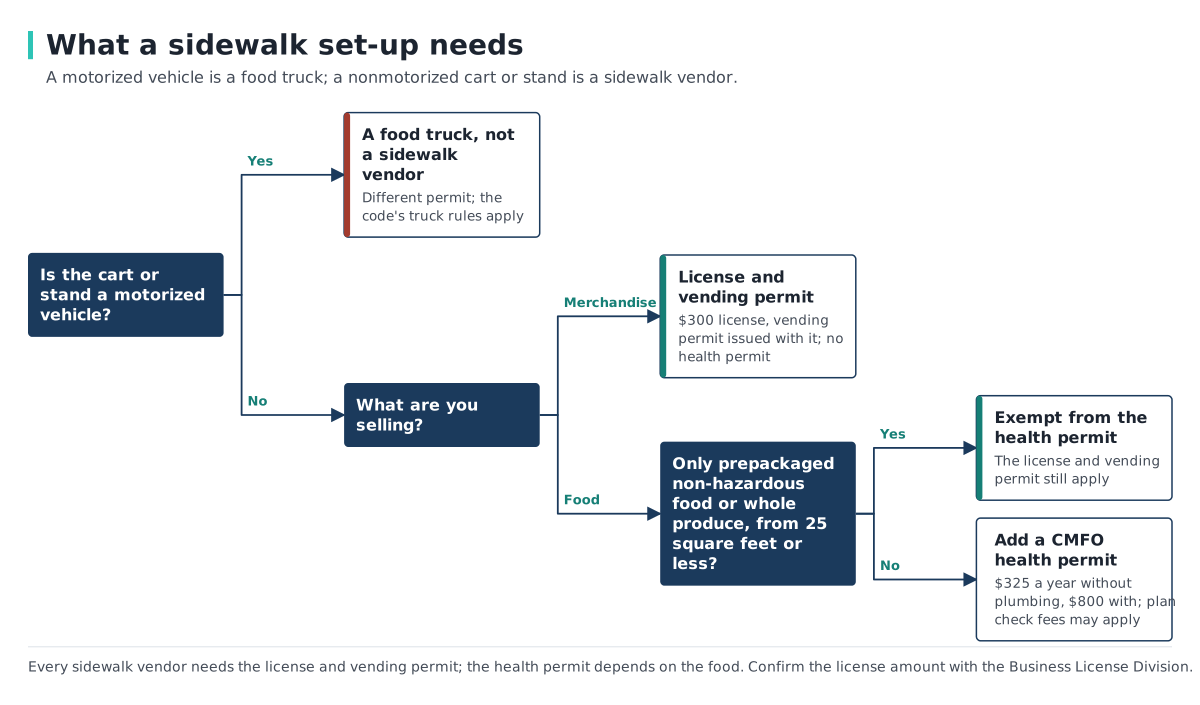
Long Beach’s sidewalk vending ordinance, adopted after changes in state law including the Safe Sidewalk Vending Act (SB 946), took effect February 26, 202412. The city’s guidance is split between the Business License Division and the Health Department, and the two sets of pages do not always agree. This page puts the licenses, the health rules for carts and the where-and-when rules in one place. A cart that is a motorized vehicle is not a sidewalk vendor at all; that is a food truck, covered in Food Truck Permits in Long Beach. The section pillar, How to Open a Food Business in Long Beach, compares every food path.
The short answer
| If you are… | Do this |
|---|---|
| Selling merchandise from a stand, rack or cart | Get the Sidewalk Vendor business license and sidewalk vending permit; no health permit12 |
| Selling food from a nonmotorized cart | Add a CMFO health permit from Environmental Health, (562) 570-4132; plan check fees may apply28 |
| Selling only prepackaged non-hazardous food or whole uncooked produce from 25 square feet or less | The code exempts this from the health permit; the license and vending permit still apply9 |
| Selling from a truck or trailer | A different permit; see Food Truck Permits in Long Beach |
| Selling in a residential neighborhood | Roaming only; no stationary vending in areas zoned exclusively residential45 |
The two licenses
All sidewalk vendors need a Business License, and food vendors need a health permit1. The Business License Division’s FAQ says vendors must have “a business license, which costs $300” and “a sidewalk vending permit, issued at the same time as the business license”2. The FAQ is dated September 15, 2024, so check the current amount with the division at (562) 570-6211 before you apply2.
The code adds a seller’s permit from the state tax agency “to the extent required by law”9. A sidewalk vendor is defined as a person who sells “food or merchandise from pushcart, stand, display, pedal-driven cart, wagon, showcase, rack or other nonmotorized conveyance” or from one’s person on a public sidewalk or pedestrian path15.
The health permit for a cart
A food cart sells under a CMFO permit, which the FAQ says is “for limited food preparation that can support food safety practices during sidewalk food vending operations”2. The Health Department’s enforcement FAQ is more specific: a CMFO is “restricted to Limited Food Preparation only”, so you can slice and chop non-hazardous foods that were washed at an approved facility or reheat food prepared at an approved facility, but you cannot thaw or cook potentially hazardous foods for later use6. A pop-up restaurant is not a CMFO and is not eligible for the permit; the FAQ says such operators can use a Temporary Food Facility permit with an approved community or special event6.
State law, as the city’s April 2026 memo puts it, “requires food vendors to secure a commissary”10.
What the cart must carry
The Health Department sets equipment by food type7:
| If you sell | You need |
|---|---|
| Prepackaged frozen desserts, sandwiches or pre-sliced fruit and vegetables | Wastewater tank, overhead structure, cold holding, hot holding, thermometers |
| Brewed coffee or tea, popcorn, cotton candy, nuts, pretzels | Potable water, wastewater tank, overhead structure, ventilation |
| Fried or grilled sausages, hamburgers, tacos, eggs, gyros | Potable water, sinks for washing food and tools, hand wash sink, wastewater tank, overhead structure with food compartment and sneeze guard, ventilation, mechanical refrigeration, hot holding, thermometers |
| Boiled hot dogs, sausages, knishes | Potable water, wastewater tank, ventilation, thermometers, overhead structure, cold and hot holding |
| Sandwiches, raw fruit, salads, smoothies, soft-serve | Potable water, sinks for washing tools, hand wash sink, wastewater tank, overhead structure, ventilation, cold and hot holding, thermometers |
Source:7. Cold food must stay below 41 degrees F and hot food above 140 degrees F7. Anyone handling unpackaged food needs a food handler card within 30 days of the health permit’s approval, and the permit and decal must be displayed on the unit7. A change to the cart’s size or accessories after the final plan check requires reinspection7.
What it costs
The Health fee schedule (the version stamped June 16, 2026, still within the fee year that ended September 30, 2026) lists these cart lines3:
| Item | Fee |
|---|---|
| Food service cart permit, without plumbing | $325 a year |
| Food service cart permit, with plumbing | $800 a year |
| Water resample; permit reinstatement | $107; $203 |
| Missed routine inspection; change of licensing information | $46; $46 |
| Food cart impound | $498 (the repeat fee, $992.40, “doubles with each occurrence”) |
Source:3. The schedule does not use the CMFO name, and the FAQ says only that “health permit fees vary depending on the type of food being sold and how it is prepared” and that vendors “may also need to pay plan check fees”23. The schedule’s mobile-facility plan-check lines run $288, $512 and $1,339 by food type; ask Health which applies to your cart3. The FAQ puts the cost of a food cart at “about $5,000 to $25,000”2.
Financial help, and its dates
The Sidewalk to Success program “covers the required business license and permit fees, as well as health permit fees, for operating during the first year of business”, plus up to $450 reimbursement for required insurance, “as long as program funds are available”11. The FAQ page says the same help is “available through February 26, 2025”, while an April 2, 2026 city memo says the city “is no longer accepting new applications for the Free Cart Program” and that fee coverage continues “while this funding lasts”210. Whether money remains for a new applicant is a question for the Health and Business License lines, or BizCare at (562) 570-42491.
Where and when you may vend
The FAQ says “sidewalk vendors are allowed throughout the City”, and the rules below are what that sentence is subject to2.
Hours. The city’s operating-conditions sheet5:
| Area | Hours |
|---|---|
| Zoned exclusively residential | Roaming only, 8 a.m. to 8 p.m. or sunset, whichever is later |
| Non-residential (not parks) | 6 a.m. to 10 p.m., or the hours of other businesses on the same block, whichever is least restrictive |
| Parks | 8 a.m. to closing time, or sunset if none is posted |
Space and equipment. A set-up may take no more than 100 square feet; umbrellas must be 8 feet or taller and secured; one secured canopy up to 10 by 10 feet is allowed. No speakers or amplified sound (bells and chimes only for roaming vendors), no red or blue flashing signs, and the vendor must clear trash within 10 feet and may not use public receptacles5.
Distances for stationary vending. The city’s distancing guide4:
| Keep this far from | Distance |
|---|---|
| Edge of the curb | 18 inches |
| Clear sidewalk or pedestrian path to leave | 4 feet |
| Driveway, alley or marked crosswalk | 10 feet |
| Entrance or exit to a building, structure or facility; fire escape or emergency exit | 10 feet |
| Bus or Metro stop and high-traffic pedestrian areas | 5 feet |
| Public restroom (food vendors only) | 15 feet |
| Street intersection, ADA curb or ramp | 15 feet |
| Outdoor dining area, sidewalk dining area, permanent parklet | 15 feet |
| City monument, statue, memorial or art installation | 15 feet |
| Another stationary vendor; a single-family home in a mixed-use zone | 20 feet |
| Beach access or LA County waterway or flood-control fencing | 25 feet |
| Railroad crossing | 50 feet |
| Posted sidewalk or street closure; vehicle entrance of a fire station, police station, hospital or lifeguard tower | 100 feet |
| Freeway on- or off-ramp; city property with a concession agreement | 500 feet |
| School, Monday to Friday 7 a.m. to 5 p.m. | 1 block |
Source:4. The guide adds that there is no vending in areas zoned exclusively residential4.
Official pages disagree The Health Department’s food-setup page says the unit must be “at least 20 feet” from the nearest building entrance and “at least 10 feet” from a crosswalk or bus stop, must stand on the street no more than 6 inches from the sidewalk edge, and must not be placed on any sidewalk “less than 12 feet wide”7. The Business License Division’s distancing guide, which cites chapter 5.73, gives 10 feet from an entrance or exit to a building (the code reads “Within ten (10) feet of an entrance or exit to a building/structure/facility, fire escape, or emergency exit”), 5 feet from a bus stop and 4 feet of clear sidewalk49. Health’s 20 feet is measured from the nearest building entrance, so the two pages differ by 10 feet at a doorway. Plan around the larger distances and confirm with Health at (562) 570-4132 when your plan check is scheduled.
Where vending is not allowed. A separate city sheet lists places with no sidewalk vending: private or leased city-owned property, including the convention and entertainment center, Shoreline Village, the Pike Outlets, the Rainbow Harbor Esplanade, Rancho Los Alamitos, city golf courses and community gardens; protected habitat such as Colorado Lagoon, El Dorado Nature Center and the Los Cerritos Wetlands; and, in the sheet’s words, “Within 500ft of the event, but may be closer depending on the size and type of event” for a farmers’ market, swap meet or special event area12. The code sets the buffer by event size: 250 feet from an event with fewer than 5,000 attendees where limited venue access and egress is not a factor; for a larger event where it is not a factor, 500 feet from any entrance or exit or 250 feet from the perimeter; and 500 feet for all other events9. Vending age-restricted goods (alcohol, tobacco, cannabis, weapons), adult material, animals and unattended set-ups is also barred12. The city’s operations page links an interactive vending map and a map of high-volume pedestrian zones13.
Enforcement
The ordinance’s enforcement is limited to administrative remedies: site inspections, repeat visits, additional notices, then administrative citations with fines, and in limited cases license suspension or revocation or impounding of equipment6. The city’s FAQ, last updated October 7, 2024, says enforcement began the week of July 22, 2024, after an education-first period6. The Health Department separately can order a food vendor without a permit to cease operations, impound equipment and food, and suspend or revoke a health permit; continued violations “can lead to issuance of a Notice of Violation, scheduling of an Office Hearing”, and “a referral to City Prosecutor when applicable”6. The fines are set in chapter 5.73.160: administrative fines not exceeding $100 for a first violation, $200 for a second within one year and $500 for each additional violation within a year, and the city may revoke the vending permit on the fourth violation. Vending without a valid permit carries fines not exceeding $250, $500 and $1,000 on the same schedule9. Complaints go through the Go Long Beach app, the Business License Division at (562) 570-6211 or Health at (562) 570-41326.
Frequently Asked Questions
Do I need a permit to sell food from a cart on a Long Beach sidewalk?
How much is a sidewalk vending license in Long Beach?
The city’s FAQ, updated September 15, 2024, says the business license costs $300; confirm the current amount with the Business License Division2.
How much is the health permit for a food cart?
In the fee year that ended September 30, 2026, the Health schedule listed food service carts at $325 a year without plumbing and $800 with plumbing3. The council approved updated city fee schedules effective October 1, 202615; the Health Department’s page still links the FY26 mid-year schedule16, and the city’s memo proposed an average increase of 39 percent for adjusted fees14. The figures here are the schedule in force through September 30, 2026.
Can I vend in a residential neighborhood?
Can I sell in the Pike Outlets or near the Aquarium?
The city’s sheet lists the Pike Outlets, Shoreline Village and the Rainbow Harbor Esplanade among private or leased city-owned properties where sidewalk vending is not allowed; business there “may be allowed if authorized by the property owner”, under different requirements12. The enforcement FAQ adds that many areas south of Ocean near the convention center and Rainbow Harbor are leased to private organizations and do not permit sidewalk vending, including the Pike Outlet and the Aquarium of the Pacific areas6.
Is there help paying for the license and permits?
What happens if I vend without a license or permit?
Related Articles
Sources
- Sidewalk Vending — City of Long Beach, Financial Management. Accessed 2026-10-01.
- Sidewalk Vending FAQs (updated as of 9/15/24) — City of Long Beach, Financial Management. Accessed 2026-10-01.
- Environmental Health fees and charges, FY26 mid-year schedule (June 16, 2026) — City of Long Beach, Health and Human Services. Accessed 2026-10-01.
- Stationary Sidewalk Vending: Operating Distances — City of Long Beach, Business License Division. Accessed 2026-10-01.
- Sidewalk Vending operating conditions (Ver 1, 2/23/24) — City of Long Beach, Business License Division. Accessed 2026-10-01.
- Sidewalk Vending Enforcement Related FAQs (last updated October 7, 2024) — City of Long Beach, Financial Management. Accessed 2026-10-01.
- Sidewalk Food Vending Steps for Success: Make Sure Your Food Setup is Safe — City of Long Beach, Bureau of Environmental Health. Accessed 2026-10-01.
- Mobile Food Facility — City of Long Beach, Bureau of Environmental Health. Accessed 2026-10-01.
- Long Beach Municipal Code, Chapter 5.73 Sidewalk Vending — Municode. Accessed 2026-10-01.
- Memo: Sidewalk to Success Program Update, April 2, 2026 — City of Long Beach, City Manager. Accessed 2026-10-01.
- Sidewalk Vendor Business License — City of Long Beach, Financial Management. Accessed 2026-10-01.
- Sidewalk Vending: No Sidewalk Vending and Do Not list — City of Long Beach, Business License Division. Accessed 2026-10-01.
- Sidewalk Vending Operations — City of Long Beach, Financial Management. Accessed 2026-10-01.
- Memo: Processes and Fees for Food Safety Program, August 25, 2026 — City of Long Beach, City Manager. Accessed 2026-10-01.
- Fee Schedules — City of Long Beach, Community Development. Accessed 2026-10-01.
- Environmental Health Bureau — City of Long Beach, Health and Human Services. Accessed 2026-10-01.