In brief
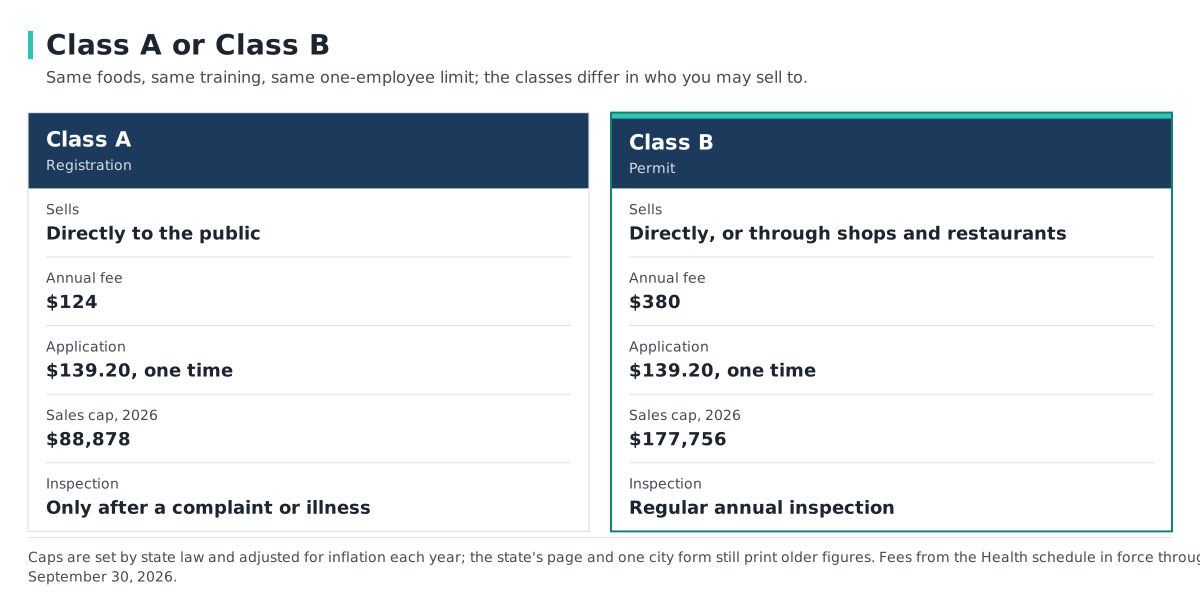
Cottage food in Long Beach is registered with the city’s Bureau of Environmental Health, not the state: Class A (direct sales only) is a $124 annual registration, Class B (direct and indirect sales) is a $380 annual permit, and both pay a one-time application fee of $139.20, in the fee year that ended September 30, 2026. The sales caps are set by state law and adjusted for inflation each year: $88,878 for Class A and $177,756 for Class B in 2026.
- Only foods on the California Department of Public Health’s approved list may be made, in ten categories from baked goods without cream or custard to dried foods, candy, jams and vinegars4.
- The state’s cottage-food page still prints $75,000 and $150,000 as the current caps, its 2026 table gives the adjusted figures, and one of the city’s forms prints $50,000235.
- Operators must complete the state’s cottage food operator training within three months of registration or permitting25.
- Labels must say “Made in a Home Kitchen” in 12-point type and carry the operator’s registration or permit number5.
- The Health page sends applicants to the Business License Division, (562) 570-6211, for “possible additional requirements”1.
- The council approved updated city fee schedules effective October 1, 2026; the Health Department’s page still links the FY26 mid-year schedule, and the city’s memo proposed an average increase of 39 percent. The Health fees above are the schedule in force through September 30, 20269101516.
A cottage food operation (CFO) is the lightest food business the city regulates: a home kitchen, a short list of non-hazardous foods and a registration instead of a build-out. The state decides what may be sold and how much; the city’s Health Department takes the application, bills the fee and inspects. This page covers both classes, the limits, the foods, the labels and the license questions, with the dates the figures belong to. For hot meals from home, the permit is different; see Selling Meals From a Home Kitchen in Long Beach: The MEHKO Permit. The section pillar, How to Open a Food Business in Long Beach, compares every path.
The short answer
| If you are… | Do this |
|---|---|
| Selling baked goods, candy or dried foods at markets, bazaars or online | Class A: self-certification checklist, registration, $124 a year15 |
| Also supplying a café, shop or restaurant | Class B: a permit with an annual inspection, $380 a year16 |
| Making cakes with cream cheese, cream or custard fillings, or salsa | Not cottage food; those are not on the approved list47 |
| Making full meals | A MEHKO, not cottage food; see Selling Meals From a Home Kitchen in Long Beach |
| Outgrowing the cap | The operation must become permitted in a commercial facility; see How to Open a Restaurant in Long Beach56 |
Class A and Class B
The state’s cottage-food page defines the two classes2:
- Class A operators sell home-kitchen foods “directly to the public”, which includes transactions “made via the phone, internet, and any other digital method”. A direct sale may be fulfilled in person, by mail or through a third-party delivery service2.
- Class B operators sell directly or “indirectly through restaurants and food markets”2.
The city’s page describes the same split with examples: Class A is direct sale at farmers’ markets, farm stands, holiday bazaars and in person at the operation; Class B adds sales through retail shops and food facilities1.
The state does not permit or register cottage food operations. Its page tells applicants to contact “your local Environmental Health Department”, which in Long Beach is the Bureau of Environmental Health at 2525 Grand Avenue, Room 220, (562) 570-413221.
Official pages disagree The state sets the sales caps in the Retail Food Code: $75,000 for Class A and $150,000 for Class B, “annually adjusted for inflation based on the California Consumer Price Index”, which its 2026 table puts at $88,878 and $177,7563. The state’s cottage-food page, meanwhile, still calls $75,000 and $150,000 the “current” caps2. The city’s Class B form (revised November 29, 2023) prints $75,000 and $150,000 for 2023 and adds the inflation note6. The city’s Class A form, the version posted under a September 15, 2026 file name, still prints the older schedule of “$35,000” in 2013, “$45,000” in 2014 and “$50,000” in 2015 “and in subsequent years”5. Plan around the state’s current figures, and ask the Bureau which cap its registration will recite.
The employee limit is the same in both forms and the statute: “no more than one full-time equivalent cottage food employee, not including a family member or household member”356.
What you may sell
The approved list is kept by the state; it was last reviewed in April 2026. It has ten categories4:
- Baked goods without cream, custard or meat fillings (bread, cookies, cakes, cupcakes, pastries, fruit-only pies, tortillas, waffle cones)
- Candy and confections (fudge, brittle, caramels, chocolate, cotton candy)
- Extracts of at least 70 proof or 35 percent alcohol, from a listed set of flavors
- Dried, dehydrated and freeze-dried foods (granola, roasted coffee, tea, spice mixes, trail mix, pasta, popcorn)
- Frostings, icings, fondants and gum pastes “that Do Not Contain Eggs, Cream, or Cream Cheese”; a footnote allows meringue powder, powdered eggs or pasteurized eggs
- Honey and sorghum syrups, pure, with no added ingredients
- Fruit butters, preserves, jams and jellies that comply with 21 CFR Part 150, using only the fruits that regulation lists
- Nuts, nut mixes and nut butters, roasted or pasteurized
- Powdered beverage bases and mixes
- Vinegars and mustards, including fruit-infused vinegars from a listed set of high-acid fruits
The city’s forms put the exclusion plainly: “Foods containing cream, custard, or meat fillings are potentially hazardous and are NOT ALLOWED”5. The state’s FAQ explains why two popular items are out: salsa because cut tomatoes have an inconsistent pH and canning risks botulism, and pepper jelly because peppers are low-acid and only the fruits listed in the federal jam regulation are allowed7.
Changes take effect 30 days after the state posts a notice4. A notice posted in 2026 proposes adding a chocolate and nut spread to the nut category; comments were due by October 1, 2026, and the new list is to be posted “on or about November 16, 2026”8.
How to apply, and what it costs
The city’s application is a form, the California Homemade Food Act (AB 1616) registration and permitting form, emailed to the Bureau at [email protected]6. It asks for the products you will make, the labeling you will use, your water source (public, or a private supply with lab results), the waste-disposal method (sewer or septic) and your agreement to the conditions: the training course, the one-employee limit, the sales cap and the inspection terms56. Class A operators also complete a self-certification checklist5.
The form’s warning: “DO NOT BEGIN PROCESSING FOODS UNTIL YOU RECEIVE YOUR REGISTRATION OR PERMIT FROM THE HEALTH DEPARTMENT”. The fee is billed after the application is approved56.
| Item | Fee |
|---|---|
| Application, Class A and B | $139.20 per application, plus the fully allocated hourly rates for all personnel involved |
| Class A annual registration | $124 |
| Class B annual permit | $380 |
| Cottage food facility consultation | $278 per consultation, plus hourly rates |
| Complaint investigation | $270 per investigation, plus hourly rates for any time over |
Source:19, the Health fee schedule stamped June 16, 2026, in the fee year that ended September 30, 2026. The council approved updated city fee schedules effective October 1, 202615; the Health Department’s page still links the FY26 mid-year schedule16, and the city’s August 2026 memo proposed an average increase of 39 percent across adjusted fees10. The figures here are the schedule in force through September 30, 2026, so ask the Bureau for the current amounts.
Inspections. A Class A operation is inspected “in the event of a consumer complaint or reported food-borne illness”; a Class B operation “for regular annual facility inspections” and in the event of a complaint56.
Training. The forms give three months from approval to provide proof of the state’s cottage food operator course; the state page says the training must be completed within three months of registration or permitting256.
Labels
The forms list what every label must carry6:
- The words “Made in a Home Kitchen” in 12-point type
- The common name of the food
- The operation’s city, state and ZIP code (and a street address if the firm is not in the telephone directory)
- The registration or permit number, and for Class B the name of the county that issued it
- Ingredients in descending order by weight, and the net quantity in both pounds and grams
- Plain-language allergen declarations for the eight major allergens, and a Nutrition Facts statement if the label makes nutrient or health claims
Official pages disagree The state says a direct sale “may be fulfilled in person, via mail delivery, or using any other third-party delivery service”2. Both city forms ask the operator to agree that “all ‘Class A’ & ‘Class B’ CFO products must be delivered directly (in person) to the customer”56. Ask the Bureau how it applies that line to shipped orders before you take them.
The license and the zoning rules
The Health page does not say a business license is required; it directs applicants to the Business License Division, (562) 570-6211, for “possible additional requirements”1. The city’s general rule is that “all businesses operating within the City of Long Beach need to obtain a business license, including out-of-city or home-based businesses”11.
The zoning code lists “cottage food” among the allowed home occupations, and the 2026-27 home-based business license is $299.54 plus $12.66 per employee1213. Planning’s schedule lists a “Business License Zoning Review – Home Occupation” at $52.00, or $58.24 with surcharge, as of October 2026, for home occupations in a residence14. The home-occupation conditions include no visible signs, no more than two business visitors an hour and eight a day, storage under 128 cubic feet with the garage off-limits, and “no advertisement shall be placed in any media containing the address of the property”12. A cottage food label may need a street address, and the city’s pages do not say whether a label counts as an advertisement; ask Health and Planning together.
Frequently Asked Questions
Do I need a permit to sell baked goods from home in Long Beach?
What is the difference between Class A and Class B cottage food?
How much can a cottage food business earn in California?
The state caps are $75,000 for Class A and $150,000 for Class B, adjusted for inflation; in 2026 they are $88,878 and $177,7563.
What foods can I make as a cottage food operator?
Can I sell cottage food online?
Do I need food training?
Yes: the state’s cottage food operator training within three months of registration or permitting2.
Do cottage food fees change in October 2026?
The council approved updated city fee schedules effective October 1, 202615. The Health Department’s page still links the FY26 mid-year schedule16, and the city’s memo proposed an average increase of 39 percent across adjusted fees10; the figures here are from the schedule in force through September 30, 20269.
Related Articles
Sources
- Cottage Foods — City of Long Beach, Bureau of Environmental Health. Accessed 2026-10-01.
- Cottage Food Operations — California Department of Public Health, Food and Drug Branch. Accessed 2026-10-01.
- Cottage Food Operation Adjusted Gross Annual Sales Limit — California Department of Public Health. Accessed 2026-10-01.
- Approved Cottage Foods (last reviewed April 2026) — California Department of Public Health. Accessed 2026-10-01.
- Class A cottage food registration and permitting form — City of Long Beach, Bureau of Environmental Health. Accessed 2026-10-01.
- Class B cottage food registration and permitting form (revised November 29, 2023) — City of Long Beach, Bureau of Environmental Health. Accessed 2026-10-01.
- Frequently Asked Questions About Cottage Food — California Department of Public Health. Accessed 2026-10-01.
- Notice to Amend the Approved Cottage Food List — California Department of Public Health. Accessed 2026-10-01.
- Environmental Health fees and charges, FY26 mid-year schedule (June 16, 2026) — City of Long Beach, Health and Human Services. Accessed 2026-10-01.
- Memo: Processes and Fees for Food Safety Program, August 25, 2026 — City of Long Beach, City Manager. Accessed 2026-10-01.
- General Business License — City of Long Beach. Accessed 2026-10-01.
- Long Beach Municipal Code, Chapter 21.51 Accessory and Temporary Uses (section 21.51.235 Home Occupations) — Municode. Accessed 2026-10-01.
- Business License Rates Effective July 1, 2026 – June 30, 2027 — City of Long Beach, Financial Management. Accessed 2026-10-01.
- Planning Bureau Fee Schedule, revised October 1, 2026 (FY27 fees version) — City of Long Beach, Community Development. Accessed 2026-09-30.
- Fee Schedules — City of Long Beach, Community Development. Accessed 2026-10-01.
- Environmental Health Bureau — City of Long Beach, Health and Human Services. Accessed 2026-10-01.