In brief
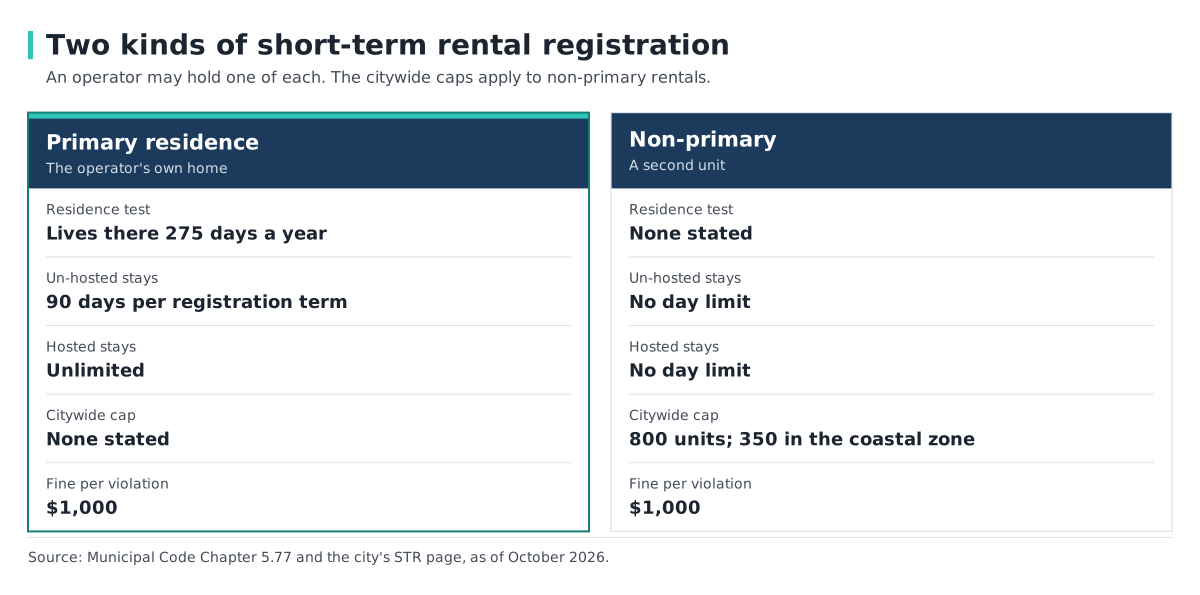
No one may advertise, rent or operate a short-term rental in Long Beach without a registration, and the code limits each operator to one primary-residence rental and one non-primary rental under caps of 800 dwelling units citywide and 350 in the coastal zone. A primary-residence rental requires living there at least 275 days a year, allows no more than 90 un-hosted days per registration term, and a violation carries a $1,000 fine.
- The city’s review fee is $500.00 per its STR page; the FY27 fee proposal lists $545, and the adopted figure is not confirmed23.
- Per residential development the cap is 1 rental in a 2-to-10-unit building, then 10, 12 and 15 percent as buildings grow1.
- Occupancy is “two (2) persons per bedroom, plus two (2) up to an absolute maximum of eight (8)”, with an emergency contact answering “within one (1) hour”1.
- Registration lasts one year, is not transferable, and is not renewed after three or more citations in 18 months1.
- The city says it “is currently reviewing its Short-Term Rental ordinance for possible updates”2.
Chapter 5.77 of the municipal code, is the rulebook (the code page lists ORD-25-0001 and ORD-26-0004), and the city’s Code Enforcement page restates it. This page is part of the sequence for starting a business in Long Beach, since a rental is a business use with its own tax, and it describes the rules as of October 2026 without recommending how to meet them. A related page covers home-based businesses, which are not the same thing.
The short answer
| If you are… | Do this |
|---|---|
| Renting out the home you live in | A primary-residence registration; you must “reside there for a minimum of two hundred seventy-five (275) days during the calendar year”, and un-hosted stays are capped at 90 days per registration term1 |
| Renting a second unit you do not live in | A non-primary registration, which has no day limit but counts against 800 units citywide and 350 in the coastal zone12 |
| Hosting while you are present | Hosted stays are unlimited2 |
| Planning to list an ADU, JADU, deed-restricted unit, or a space such as a garage or pool house | Not eligible; see the list below1 |
| Operating before a registration is issued | A violation; the fine is $1,000 for each violation1 |
| In a condo or HOA building | Registration does not override condo or HOA rules1 |
Registration
“No person or entity shall advertise, rent, or operate a short-term rental in the City unless a short-term rental (STR) registration has been issued.” Every listing must show the registration number and expiration date. A registration is valid “for one (1) year” and “may not be transferred or assigned and does not run with the land” (Sections 5.77.030 and 5.77.040)1.
Operators must also authorize platforms to share listing data with the city1. A condominium’s or homeowners association’s own rules still apply: the chapter does not override them1.
The primary-residence rule
The code defines a primary residence as a permanent residence or usual place of return, documented by at least two of five items: a motor vehicle registration, a driver’s license, voter registration, tax documents, or a utility bill from the last three months. The person “must reside there for a minimum of two hundred seventy-five (275) days during the calendar year” (Section 5.77.020)1.
Un-hosted stays in a primary-residence rental are limited “to a maximum of ninety (90) days per the annual term of registration” (Section 5.77.050). Hosted stays are unlimited, a non-primary registration has no day limit, and the primary-residence unit must be on the same parcel as the applicant’s residence, according to the city’s page12.
The caps
An operator may hold one primary-residence rental and one non-primary rental. The citywide and coastal-zone caps apply to non-primary registrations1.
| Residential development | Cap on short-term rentals |
|---|---|
| 2 to 10 units | 1 |
| 11 to 50 units | 10 percent |
| 51 to 100 units | 12 percent |
| 101 or more units | 15 percent |
Source:1, Section 5.77.030, as of October 2026. Non-primary registrations are also capped at “eight hundred (800) dwelling units” across the city and “three hundred fifty (350)” in the coastal zone, “reviewed by the City Council on an annual basis”. If the non-primary cap is reached, a renewal must be filed at least 30 days before the registration expires (Section 5.77.040)1. Section 5.77.080 provides for block-group petitions to prohibit un-hosted rentals1.
What cannot be registered
The code bars an ADU or JADU, a “deed restricted affordable housing unit”, a special group residence, a single room occupancy, a unit with active or pending code enforcement, and a unit with citation fees owed (Sections 5.77.030 and 5.77.040). Section 5.77.050 also bars use of “a vehicle parked on the property, a recreation vehicle, pool house, rumpus room, casita, a storage room/shed, trailer, garage” as the rental1.
Operating rules
| Rule | What the code says |
|---|---|
| Occupancy | “two (2) persons per bedroom, plus two (2) up to an absolute maximum of eight (8)”; a studio counts as 2 |
| Emergency contact | 24-hour contact responding “within one (1) hour” |
| Insurance | liability insurance of “not less than One Million Dollars ($1,000,000)” or a platform equivalent |
| Guest notice | posted notice with occupancy, parking, trash, contact and evacuation plan |
| Events | beyond the occupancy limit, an occasional event permit; “four (4)” per registration year |
| Pools and spas | closed 10 p.m. to 7 a.m. (city page) |
| Signs | no exterior sign advertising the rental (city page) |
Source:12, Section 5.77.050. Transient Occupancy Tax applies to all short-term rentals1. The city’s tax page gives the hotel TOT rate as “13% of the rent”, and the enforcement page says STR operators file monthly on gross receipts24. Occasional event permits are covered in Special Event, Occasional Event and Film Permits in Long Beach.
The fee
The Chapter 5.77 text leaves fees to Council resolution (Section 5.77.100)1. The city’s STR page states: “The fee for the City to review your STR application or any subsequent renewal application is $500.00”2.
Official pages disagree The enforcement page says $500.002. The city’s page of new and proposed fees for FY27, the fee year that began October 1, 2026, lists the registration fee moving from $500 to $545 and adds an expedite fee of $545, both labeled proposed3. The adopted resolution was not read, so the $545 figure is unconfirmed. Treat $500.00 as the figure the city’s own STR page prints, and confirm the current fee with the city.
Renewal, citations and the fine
A registration is not renewed after “three (3) or more citations during any contiguous eighteen (18) month timeframe”, and an inspection may be required at renewal (Section 5.77.040)1. Violations “may not need a cure period and will result in an immediate citation”. The code says “the fine shall be one thousand dollars ($1,000) for each violation”, and one event can produce several citations. Violence-related violations count double toward the three-citation limit. After three citations in 18 months the registration may be revoked or suspended after a 14-day response window, and a revoked or disallowed parcel cannot be registered for 12 months (Section 5.77.090)1.
The city's own notice
The enforcement page says the city “is currently reviewing its Short-Term Rental ordinance for possible updates”. It also says existing law prohibits evicting tenants “for the purposes of re-listing a unit as a short-term rental”2. The first statement means the rules above may change.
Frequently Asked Questions
Do I need a registration to rent my home on Airbnb in Long Beach?
Yes. “No person or entity shall advertise, rent, or operate a short-term rental in the City unless a short-term rental (STR) registration has been issued”1.
How many nights can I rent my home when I am away?
What is the 275-day rule?
The primary-residence operator “must reside there for a minimum of two hundred seventy-five (275) days during the calendar year”1.
How many short-term rentals are allowed in Long Beach?
Non-primary registrations are capped at 800 dwelling units citywide and 350 in the coastal zone, reviewed annually by the City Council1.
What is the fine for an illegal short-term rental in Long Beach?
$1,000 for each violation, with multiple citations possible for one event1.
How much does an STR registration cost in Long Beach?
Related Articles
Sources
- Long Beach Municipal Code, Chapter 5.77 Short-Term Rentals — Municode. Accessed 2026-10-02.
- Short-Term Rentals — City of Long Beach, Community Development. Accessed 2026-10-02.
- New or Proposed Fees — City of Long Beach, Financial Management. Accessed 2026-10-02.
- Transient Occupancy Tax — City of Long Beach, Financial Management. Accessed 2026-10-02.