In brief
Long Beach’s Coastal Zone covers “over 3,100 acres, stretching from the Los Angeles River to the San Gabriel River”, and you check a property against the city’s Coastal Zone map or the Zoning and Land Use GIS map. Inside it, all development needs either a local coastal development permit (LCDP) or a coastal permit categorical exclusion (CPCE), issued before work starts and in addition to any building permit.
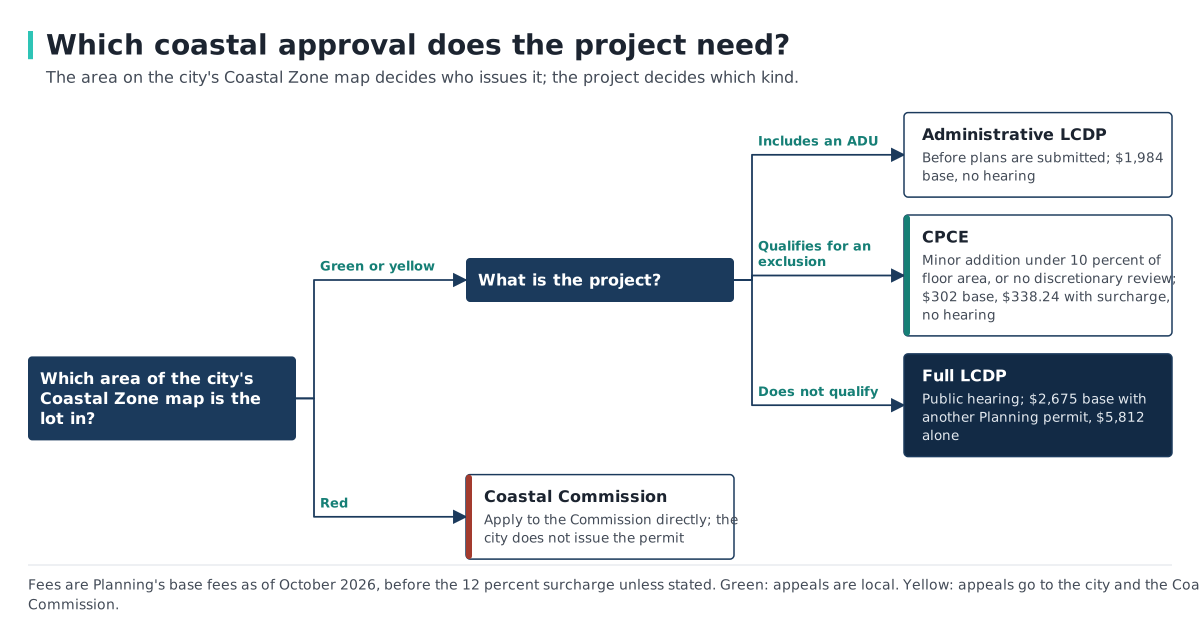
- Three areas: green (the city decides), yellow (the city decides and appeals go to the city and the Coastal Commission), red (the Coastal Commission decides directly)1.
- A CPCE is the small-project route: $302 base, $338.24 with the city’s 12 percent surcharge, as of October 20264.
- A full LCDP costs $2,675 base when another Planning permit is needed and $5,812 when it stands alone, and it requires a public hearing14.
- Any application that includes an accessory dwelling unit (ADU) needs an administrative LCDP: $1,984 base, no hearing134.
- The city’s pages publish no processing time for a CPCE or an LCDP1.
A property in the Coastal Zone carries a second layer of approval that has nothing to do with the building permit: a coastal permit, or a written finding that the project is excluded from needing one. This page shows how to find out whether an address is inside the zone, which of the three coastal areas it is in, and what each kind of coastal approval adds. The wider process is in the section pillar, Permits in Long Beach.
The short answer
| If you are… | Do this |
|---|---|
| Not sure the lot is in the Coastal Zone | Look it up on the city’s Coastal Zone map (PDF or interactive GIS) or the Coastal Zone layer of the Zoning and Land Use GIS map16 |
| Planning a small project that fits the zoning and needs no discretionary review | Apply for a CPCE: $302 base, $338.24 with surcharge; Planning staff approve it and no hearing is held14 |
| On the first lot by the water with an addition of 10 percent or more of the floor area, or a new story | Apply for an LCDP, which needs a public hearing123 |
| Adding an ADU anywhere in the green or yellow areas | Get an administrative LCDP before submitting plans: $1,984 base, no hearing14 |
| In the red area | Apply to the Coastal Commission directly1 |
What the Coastal Zone is
The city says its Coastal Zone covers “over 3,100 acres, stretching from the Los Angeles River to the San Gabriel River”1. The California Coastal Act of 1976 requires local governments to adopt a Local Coastal Program (LCP), and the Commission “certified the City’s LCP in 1980”1. Because Long Beach has a certified program, the city, not the Commission, issues most coastal permits here. The Commission’s own page puts it the same way: after certification “most coastal development permit authority is delegated”, and the Commission keeps permit jurisdiction over specified lands such as tidelands and public trust lands and appellate authority over specified categories of development8.
The page defines the zone by map, from the Los Angeles River to the San Gabriel River, so the map is the answer.
Where to check Start on the city’s Coastal Planning page, which links the Standard Coastal Zone Map (PDF) and an interactive, searchable GIS map. The Zoning and Land Use GIS map has layers for “Zoning District, General Plan PlaceType, Historic District and Coastal Zone”, and the city’s Zoning and Land Use Maps page lists “Long Beach Coastal Zone” as its own entry167. The Planning phone line, 562.570.6194, is open Monday through Thursday6.
The three areas on the city's map
The city colors the zone by who issues the permit and who hears appeals13:
| Area | Who issues the permit | Appeals |
|---|---|---|
| Green: Coastal Zone | City of Long Beach | Local, under the Zoning Regulations |
| Yellow: Appealable Area | City of Long Beach | Both the city and the California Coastal Commission |
| Red: Coastal Commission Permit Jurisdiction | California Coastal Commission | “You must receive approval directly from the Commission”; questions go to its South Coast District Office |
An aggrieved person has 10 days after a decision to file an appeal application with the city, and for projects in the yellow and red areas the city sends people to the Commission’s South Coast District Office1. Developments on tidelands and submerged lands need a permit issued by the Commission under the code section that governs the whole process, Long Beach Municipal Code 21.25.9032.
Permit, exclusion and exemption: three different words
The code’s rule is a single sentence: “All development in the coastal zone shall be required to obtain either a coastal permit … or a coastal permit categorical exclusion”, and the approval “must be issued prior to the start of development and shall be required in addition to any other permits or approvals required by the City”2. The state’s definition of development is wide: it includes construction and also “changes in the intensity of use of land or water, even where no construction is involved”8.
The code’s section on projects that skip the full permit is headed “Exemptions”, but the exemption is conditional: such projects “are exempt from the coastal permit requirement. However, a coastal permit categorical exclusion (CPCE) shall be obtained”2. In practice there are two routes in the city’s own jurisdiction:
| Route | What it is | Hearing |
|---|---|---|
| CPCE | A staff review confirming the project qualifies as an exclusion | None; Planning staff review and approve1 |
| LCDP | The full local coastal development permit | Public hearing1 |
| Administrative LCDP | The ADU version of the LCDP | None; no local appeal in the green area1 |
What qualifies for a CPCE
The code’s exclusions, as printed on the city’s CPCE application, are2:
- Minor additions to an existing single-family residence on the first lot by the water that are “less than ten percent (10%) of the existing floor area” and do not create an additional story or loft.
- Projects “consistent with the Zoning Regulations” that “do not require any discretionary review (e.g., conditional use permit, subdivision map)”.
- Traffic improvements that do not change roadway or intersection capacity by more than 10 percent, decrease parking, or impair access to the coast.
- Public works projects, other than traffic improvements, estimated at “$49,999.00 or less”.
The city posts its CPCE approvals weekly. The filings for August and September 2026 show what passes: replacement of a porch, door, stairs and deck; a ground-mounted air-conditioning unit; a like-for-like HVAC replacement; a French drain; a 45-square-foot addition; and a like-for-like rebuild of a two-story house after fire damage5. The city’s FAQ is blunt about the limit: if the property is the first lot across from the water and the addition is too large for a CPCE, “you will need to apply for a Local Coastal Development Permit (LCDP) instead”1.
A CPCE does not mean work can start the day it is approved. The application states that the CPCE “is subject to appeal to the California Coastal Commission” and that work may not begin until notice arrives that the appeal period has closed with no appeals, “or 15 days has elapsed with no appeals filed, whichever occurs first”2.
What triggers a full LCDP
The city’s flow chart and the code list the projects that need a full coastal permit from the city23:
- Development on the first lot on, adjacent to, across the street from, or abutting the beach, bay, ocean or tidelands, except a minor addition that qualifies for a CPCE.
- Any project that needs additional discretionary review, such as a conditional use permit, subdivision map or standards variance.
- Traffic improvements that do not qualify for exclusion.
- Public works projects of “$50,000.00” or more.
- Any extension of an existing facility into tidelands, environmentally sensitive areas, coastal waterways or public parkland, or “within fifty (50) feet of a coastal bluff edge”.
- Applications to restrict short-term rentals, to convert a hotel or motel to supportive or transitional housing, or to legalize a dwelling unit under the unpermitted dwelling unit amnesty program.
- “Any application including an Accessory Dwelling Unit (ADU)”.
The ADU rule is the one homeowners meet most often. In the green area and the yellow Appealable Area alike, the city says an ADU needs an administrative LCDP before plans are submitted, with no hearing; in the green area the decision cannot be appealed locally, and in the yellow area it can be appealed only to the Coastal Commission1. State law sets a clock for this approval: the Department of Housing and Community Development’s handbook describes the requirement that a coastal development permit application for an ADU be approved or denied “within 60 days of receiving a completed application”10. The city’s own coastal pages do not state that clock. How the city applies ADU rules generally is in ADUs in Long Beach.
What a coastal permit costs
The Planning Bureau’s fee schedule for the fee year that begins October 1, 2026 prints each base fee and the fee with the department surcharge. Its text: “All fees are subject to an 12.0% surcharge. Base fee and fee with surcharge are shown. Fee with surcharge applies.”4 The city’s fee page confirms that the new schedule takes effect October 1, 202611.
| Approval | Base fee | With 12% surcharge |
|---|---|---|
| Coastal Permit Categorical Exclusion (CPCE) | $302.00 | $338.24 |
| LCDP, with another Planning permit required | $2,675.00 | $2,996.00 |
| LCDP, no other Planning permit required | $5,812.00 | $6,509.44 |
| LCDP, administrative only (for ADUs) | $1,984.00 | $2,222.08 |
| CDP submitted to the California Coastal Commission (approval in concept) | $7,516.00 | $8,417.92 |
Fees as of October 2026. Source:4 for every row.
These are Planning’s fees only. They do not include building permit fees, impact fees or other assessments, and the schedule says a project’s fees “are based on the fee schedule in effect at the time the application submittal is completed”4. The city notes that an LCDP “has a higher planning application fee” than a CPCE1.
How long it takes
The city’s coastal pages and flow chart publish no processing time for a CPCE or an LCDP13. The only published clock is the state’s 60 days for ADU coastal permits, above10. The city advises applicants to “submit the application early”1. For an LCDP, staff review construction methods, vegetation modification, staging, timing and detours1.
What a coastal permit adds beyond the application
Replacement of lower-income housing. Chapter 21.61 of the Zoning Regulations aims to maintain very low, low and moderate-income units in the zone. The city says anyone applying for a coastal development permit “must replace existing units of this kind on a one-to-one basis”, and that this is a condition of the permit1.
Street trees. In the zone, public trees must be trimmed or removed “according to local and state coastal permit rules”; the city’s contact is Public Works Tree Maintenance at 562.570.27701.
Enforcement. The Coastal Commission can require “the removal of unpermitted development and the restoration of sites” and can seek judicial penalties9; see Unpermitted Work in Long Beach.
Other layers on the same lot
A coastal permit is separate from the building permit; the building process is in How a Long Beach Building Permit Runs. A lot can also sit in a historic district, which adds its own approval: see Is My Property in a Long Beach Historic District?.
Frequently Asked Questions
How do I know if my Long Beach property is in the Coastal Zone?
What is the difference between a CPCE and an LCDP?
A CPCE is an exclusion for qualifying small projects, reviewed and approved by Planning staff without a hearing. An LCDP is the full local coastal development permit, with a public hearing and a higher planning fee1.
Do I need a coastal permit if I already have a building permit?
The code requires the coastal permit or exclusion “in addition to any other permits or approvals required by the City”, issued before development starts2.
Do I need a coastal permit for an ADU in the Coastal Zone?
Can I appeal a coastal permit decision?
An aggrieved person can file an appeal application with the city within 10 days after a decision. In the yellow Appealable Area, permits can be appealed to both the city and the Coastal Commission1.
How long does a Long Beach coastal permit take?
Does a CPCE let me start work immediately?
No. The application says work cannot begin until the Coastal Commission’s appeal period has closed with no appeals, or 15 days have passed with none filed2.
Related Articles
Sources
- Coastal Planning — City of Long Beach, Community Development. Accessed 2026-10-01.
- Coastal Permit Categorical Exclusion (CPCE) Application, with excerpts of Chapter 21.25, Division IX, LBMC — City of Long Beach, Planning Bureau. Accessed 2026-10-01.
- Guide to Permits in the Coastal Zone (Coastal Permitting Process Flow Chart) — City of Long Beach, Planning Bureau. Accessed 2026-10-01.
- Planning Bureau Fee Schedule, fees effective October 1, 2026 — City of Long Beach, Community Development. Accessed 2026-10-01.
- Coastal Permit Categorical Exclusions Status — City of Long Beach, Community Development. Accessed 2026-10-01.
- Zoning and Land Use Maps — City of Long Beach, Community Development. Accessed 2026-10-01.
- Zoning Regulations & Design Guidelines — City of Long Beach, Community Development. Accessed 2026-10-01.
- Coastal Development Permit Applications & Appeal Forms — California Coastal Commission. Accessed 2026-10-01.
- Enforcement — California Coastal Commission. Accessed 2026-10-01.
- Accessory Dwelling Unit Handbook (update) — California Department of Housing and Community Development. Accessed 2026-10-01.
- Fee Schedule Information for October 1, 2026 — City of Long Beach, Community Development. Accessed 2026-10-01.