In brief
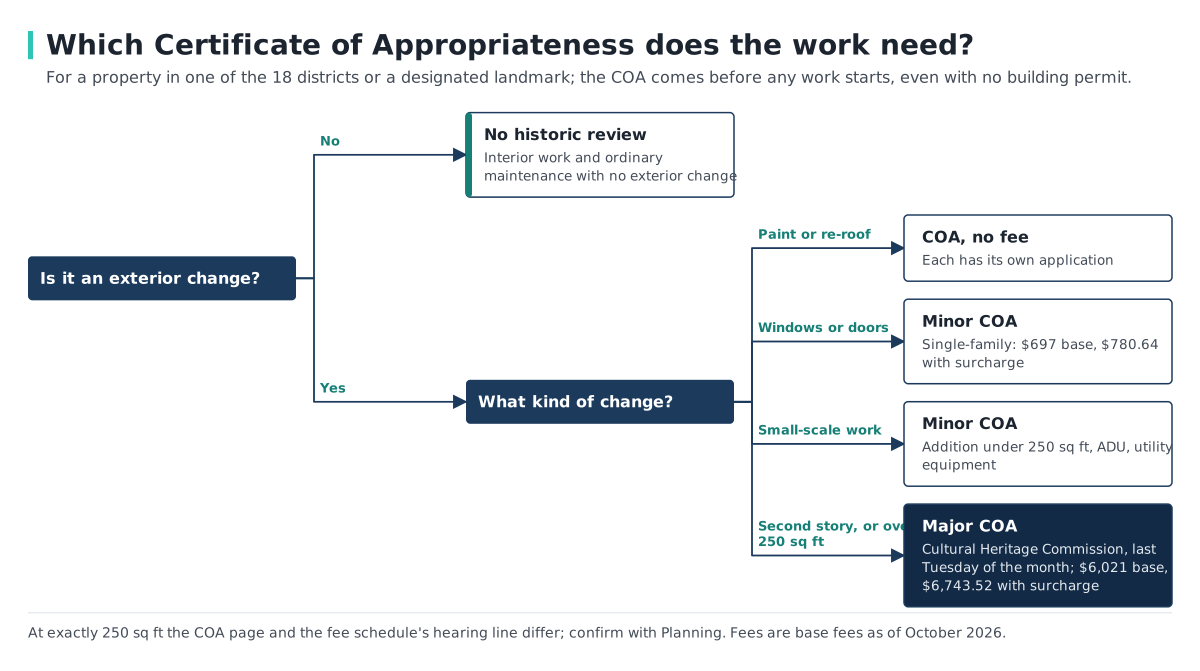
Long Beach has 18 city-designated historic districts, and any exterior change to a property in one, or to a designated landmark, needs a Certificate of Appropriateness (COA) before work starts, “even if a building permit is not required”. Check an address on the city’s Historic Districts & Landmarks map.
- 18 districts, designated between 1982 (Bluff Park) and 2019 (Grant Neighborhood); the city also counts “over 150” historic landmarks16.
- A COA covers windows and doors, repairs and additions, repainting, re-roofing and solar; interior work and ordinary maintenance with no exterior change do not need historic review2.
- Paint and re-roof COAs carry no fee; a minor COA for windows and doors on a single-family house starts at $697 base in the fee year that begins October 1, 202624.
- Major projects, such as a second story or an addition over 250 square feet, go to the Cultural Heritage Commission, which meets the last Tuesday of each month at 5 p.m.23.
- The Mills Act application window for 2026 has closed; the next opens in early January 20275.
A historic district adds a design review on top of whatever the building permit and zoning already require. The extra step is easy to learn about late, because the rule applies to work that needs no permit at all, such as a new front door or a different roof material. This page lists the 18 districts with the dates the city printed, shows how to check an address, and explains the COA and the Mills Act window in brief. It sits in the permits section, whose pillar is Permits in Long Beach.
The short answer
| If you are… | Do this |
|---|---|
| Checking whether a lot is in a district | Use the city’s Historic Districts & Landmarks GIS map, or the Historic District layer of the Zoning and Land Use GIS map278 |
| Repainting the exterior or re-roofing | File a COA application with Planning; the city charges no fee for paint or re-roof reviews2 |
| Replacing windows or doors on a single-family house | Minor COA: $697 base ($780.64 with surcharge) for up to four units, as of October 202624 |
| Adding a second story or an addition over 250 square feet | Major COA, heard by the Cultural Heritage Commission: $6,021 base ($6,743.52 with surcharge)234 |
| Only working inside, or doing ordinary maintenance | No historic review for interior work or repairs with no physical exterior change2 |
What a district is
The city describes a historic district as a designated neighborhood “that contain[s] groups of older, unaltered houses that preserve the visual qualities and ambience of the past”. A neighborhood can qualify even if individual buildings would not be landmarks, and “even if the area is interspersed with some non-historical structures, it may qualify for historic district status if at least two-thirds of the houses are original older homes”1. A landmark is a single property; the city counts “over 150” of them, and the Cultural Heritage Commission reviews nominations6.
The 18 districts and when they were designated
The city’s districts page opens with “a list of 18 neighborhoods that the City Council has so far designated as historic districts”. Each entry gives the date the council adopted the district’s ordinance; the table below follows those dates in order1.
| District | Ordinance adopted |
|---|---|
| Bluff Park | July 29, 1982 |
| Minerva Place | Nov. 7, 1989 |
| Wrigley Area | Dec. 12, 1989 |
| Carroll Park | July 24, 1990 |
| Sunrise Boulevard | Dec. 20, 1990 |
| Lowena Drive | Feb. 11, 1992 |
| Hellman Street Craftsman | Oct. 27, 1992 |
| Brenner Place | Jan. 1, 1994 |
| Linden Avenue | April 5, 1994 |
| Wilton Street | Aug. 1, 1995 |
| Rose Park | Sept. 9, 1997 |
| Drake Park / Wilmore City | April 28, 1998 |
| California Heights | Aug. 29, 2000 |
| Rose Park South | Aug. 7, 2001 |
| Belmont Heights | May 7, 2002 |
| Eliot Lane | Sept. 9, 2003 |
| Bluff Heights | July 13, 2004 |
| Grant Neighborhood | Oct. 15, 2019 |
Source:1 for every row, dates as the city prints them.
Good to know The city’s page labels the California Heights ordinance of August 29, 2000 as an expansion, and prints the Brenner Place date as January 1, 1994. The page also says California Heights is “the City’s largest historic district” with “nearly 1,500 homes”, and Brenner Place a one-block district of 10 identical houses1. For exact boundaries, use the map, not the district name.
How to check an address
The city’s COA page tells owners: “To find out if your property is in a historic district, please view our Historic District and Landmarks GIS map”2. The Zoning and Land Use Maps page lists a Historic Districts PDF and “Historic Districts & Landmarks” as separate entries, and the Zoning and Land Use GIS map has a Historic District layer78. The city’s zoning guidance puts the question in the first research step: “Is the property in a historic district, or is it a designated historic landmark?”8
Where to check The city’s Historic Districts & Landmarks GIS map, linked from the Certificate of Appropriateness page and the Zoning and Land Use Maps page. Historic Preservation staff take questions at 562.570.6194 and [email protected], at 411 W. Ocean Blvd., 3rd Floor27.
What needs a Certificate of Appropriateness
The city’s rule: “Any exterior changes to a historic landmark or property located within a historic district must be approved through a Certificate of Appropriateness (COA) before starting any work, even if a building permit is not required.” Common triggers listed are changes to windows and doors, building repairs and additions, re-painting, re-roofing and solar panel installations. The exclusion is also stated: “Interior alterations, ordinary maintenance and repairs with no physical exterior changes do not require historic review”2.
Applications are filled out on the city’s forms and submitted to [email protected], after reviewing the Historic District and Architectural Design Guidelines2. The city lists a separate memo on substitute materials: within districts, substitutes such as fiberglass or aluminum windows or fiber cement siding can be used on non-contributing buildings outside the period of significance and on detached new construction, “subject to review for compatibility of materials”2.
Minor and major: who decides
Paint and re-roofing. Each has its own application. Painting requires review “to ensure historically and architecturally compatible colors”, and the city provides sample palettes for Colonial Revival, Craftsman and Victorian styles. “There is no fee” for paint or re-roofing reviews2.
Minor COA. Small-scale alterations: “additions of less than 250 square feet, Accessory Dwelling Units (ADUs) and utility enclosures and equipment such as solar panel installation”2. The fee schedule lists a “CoA for Staff Review” line4.
Major COA. “Adding a second story or new addition over 250 square feet.” The Cultural Heritage Commission considers and issues these under Chapter 2.63 of the municipal code2. The commission “meets on the last Tuesday of each month at 5 p.m.” at the Civic Chambers, 411 W. Ocean Blvd., in person, with public comment in person or by Zoom3.
Official pages disagree The COA page puts the minor-or-major line at 250 square feet: minor is “less than 250 square feet” and major is “over 250 square feet”2. The fee schedule’s hearing line reads “CHC Hearing for CoA for addition of 250 sq. ft. or more, or visible changes – all other projects”4. An addition of exactly 250 square feet is covered by neither word on the COA page but falls in the fee schedule’s hearing line. Confirm with Planning which review applies at exactly 250 square feet.
What a COA costs
Planning’s fee schedule for the year beginning October 1, 2026 prints a base fee and a fee with the department surcharge: “All fees are subject to an 12.0% surcharge. Base fee and fee with surcharge are shown. Fee with surcharge applies.” The city’s fee page confirms the schedule takes effect on that date49.
| COA type | Base fee | With 12% surcharge |
|---|---|---|
| Pre-application review (credited to the COA when filed) | $952.00 | $1,066.24 |
| Utilities | $93.00 | $104.16 |
| Signs and other minor exterior features | $396.00 | $443.52 |
| Minor: windows, doors, other exterior materials, single-family to four units | $697.00 | $780.64 |
| Minor: accessory buildings and structures | $2,046.00 | $2,291.52 |
| Staff review | $2,231.00 | $2,498.72 |
| CHC Hearing for CoA for addition of 250 sq. ft. or more, or visible changes – all other projects | $6,021.00 | $6,743.52 |
| Demolition | $8,433.00 | $9,444.96 |
Fees as of October 2026. Source:4 for every row. Planning’s fees do not include building permit fees or other assessments, and a COA is separate from the building permit24.
The Mills Act window
The Mills Act program gives property tax relief “in exchange for property owners’ commitment to undertaking restoration, rehabilitation or maintenance of a designated historic property” under a contract with the city. The city’s page states: “The 2026 Application submittal period has closed. Next year’s application period will open early January 2027.” The 2026 processing fee was $1,026.75, with applications due by 3 p.m. on March 20, 20265. The fee schedule that takes effect October 1, 2026 lists a Mills Act Application at $3,239 base, $3,627.68 with surcharge4. Who qualifies, what the savings look like and how the contract runs are in The Mills Act in Long Beach.
Frequently Asked Questions
How many historic districts does Long Beach have?
The city lists 18 neighborhoods that the City Council has designated as historic districts, from Bluff Park in 1982 to Grant Neighborhood in 20191.
Do I need a Certificate of Appropriateness to repaint my house in a historic district?
Yes. Painting the exterior of a home or accessory structure in a district requires historic review, and the city charges no fee for it2.
Do I need a COA if I do not need a building permit?
Yes. The city says exterior changes must be approved “before starting any work, even if a building permit is not required”2.
Does interior work need historic review?
No. Interior alterations, ordinary maintenance and repairs with no physical exterior change do not require historic review2.
How do I find out if my property is in a historic district?
When does the Cultural Heritage Commission meet?
On the last Tuesday of each month at 5 p.m., at Long Beach City Hall, 411 W. Ocean Blvd.3.
Is a historic landmark the same as being in a district?
Related Articles
Sources
- Historic Districts — City of Long Beach, Community Development. Accessed 2026-10-01.
- Certificate of Appropriateness — City of Long Beach, Community Development. Accessed 2026-10-01.
- Cultural Heritage Commission — City of Long Beach, Community Development. Accessed 2026-10-01.
- Planning Bureau Fee Schedule, fees effective October 1, 2026 — City of Long Beach, Community Development. Accessed 2026-10-01.
- Mills Act Property Tax Abatement Program — City of Long Beach, Community Development. Accessed 2026-10-01.
- Historic Landmarks — City of Long Beach, Community Development. Accessed 2026-10-01.
- Zoning and Land Use Maps — City of Long Beach, Community Development. Accessed 2026-10-01.
- Zoning Regulations & Design Guidelines — City of Long Beach, Community Development. Accessed 2026-10-01.
- Fee Schedule Information for October 1, 2026 — City of Long Beach, Community Development. Accessed 2026-10-01.