In brief
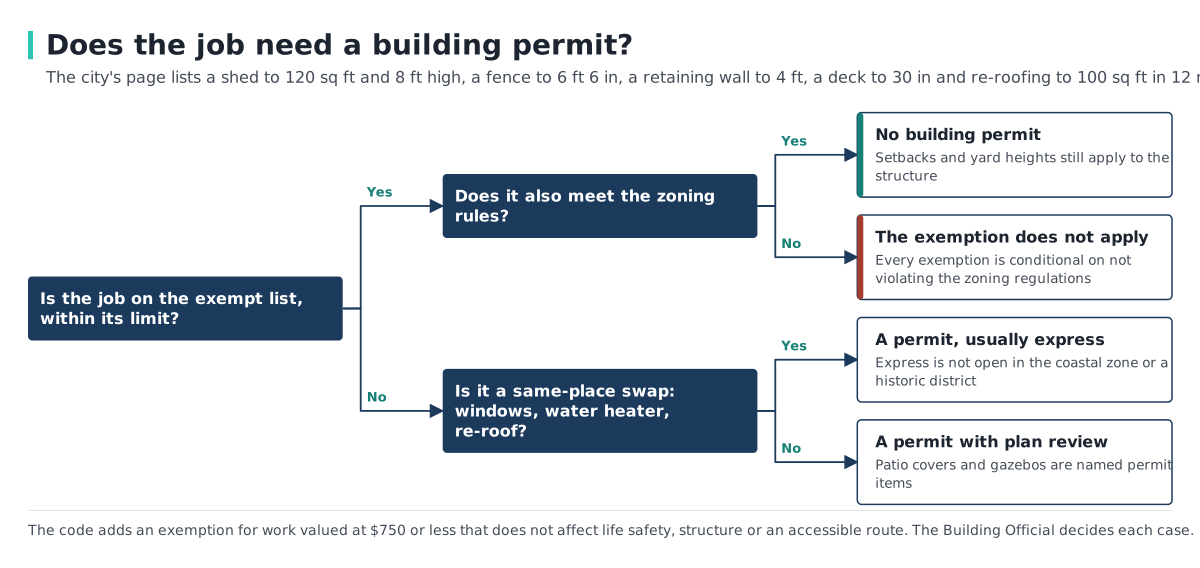
Long Beach says most construction, alteration, replacement and repair work in dwellings needs a permit, and then lists minor jobs that “may be exempt”, as determined by the Building Official: a shed up to 120 square feet, a fence up to 6 feet 6 inches, re-roofing up to 100 square feet in 12 months, a retaining wall up to 4 feet, a deck up to 30 inches above grade. The city’s older FAQ prints different numbers, and a building-permit exemption never settles the zoning rules for the same structure.
- Exempt per the city’s current page: shed or playhouse to 120 sq ft and 8 ft high with no plumbing, electrical or mechanical work; fence to 6 ft 6 in; retaining wall or planter to 4 ft; deck or driveway to 30 in above grade1.
- Not exempt: patio covers, gazebos, replacement windows, and replacing sinks, toilets or dishwashers1.
- The municipal code adds its own exemptions, including work valued at $750 or less that does not touch life safety, structure or an accessible route2.
- Every exemption carries the condition that the work does not violate the zoning regulations, and historic districts and the coastal zone add requirements12.
- The city’s older FAQ gives 64 sq ft for sheds and 500 sq ft for roofing; the current page gives 120 and 10013.
Before you pour, frame or replace anything on a Long Beach property, the first question is whether the work needs a building permit at all. The city answers it in two places that do not agree: a short “Do I need a permit?” page and the municipal code’s own list of exemptions. This page sets them side by side, flags where they differ, and shows the routes the common projects take once a permit is needed. The process after that is in Permits in Long Beach, the section pillar, and in How a Long Beach Building Permit Runs.
This page describes how the city’s rules read as of October 2026. It is not legal advice, and the Building Official decides each case.
The short answer
| If you are… | What the city’s pages say |
|---|---|
| Putting up a backyard shed of 100 square feet with no power | Within the 120 sq ft, 8 ft threshold on the current page; the older FAQ says 64 sq ft13 |
| Building a wood or vinyl fence | No building permit up to 6 ft 6 in on the current page; Planning still approves location, height and material14. See Fences and Walls in Long Beach |
| Replacing a window, a water heater or a panel | A permit, usually by an express or online route56 |
| Adding a patio cover or gazebo | A permit; the city names both1 |
| Re-roofing | A permit above 100 sq ft in any 12-month period1 |
| In a historic district or the coastal zone | Express permits are unavailable in either5; additional requirements may apply, and the city tells owners in a historic district to contact Planning before starting work1 |
What the city's page exempts
The city’s page opens with the rule and then the exceptions: “most construction activities, including alterations, replacements, and repair work in dwellings require permits and inspections. The following minor installations, repairs, or replacements may be exempt from obtaining construction permits, as determined by the Building Official”1.
| Item | Threshold, in the city’s words |
|---|---|
| Sheds, playhouses | “should not exceed 120 square feet and 8 feet in height from floor to roof; and should not include any plumbing, electrical, or mechanical installations” |
| Fences | “Wood, vinyl, wrought iron, or similar fences up to 6 feet and six 6 inches in height” (the page’s own wording) |
| Retaining walls, planters | “up to 4 feet in height, not supporting a surcharge or sloping earth” |
| Paths, driveways, decks | “Private concrete pathways, driveways, and decks up to 30 inches above adjacent ground level” |
| Re-roofing | “roofing up to 100 square feet on an existing building or structure within any 12-month period” |
| Tile | on floors, countertops or walls “up to 48 inches in height” |
| Drywall | “Plaster/drywall patch or repair up to 10 square yards in totality of the building” |
| Awnings | window awnings that “do not project more than 54 inches from the exterior wall and do not require additional support” |
| Interior finish | “Painting, wall treatments, floor and wall coverings, and similar minor interior decoration” |
Source:1 for every row.
The same page exempts some small trade work. Electrical: low-voltage installations such as doorbells, sprinklers and thermostats, and like-for-like replacement of items such as garbage disposals, bath exhaust fan motors, battery-operated smoke and carbon monoxide detectors, light fixtures and dimmers, “but not the outlet”. Plumbing: leak and valve repairs, replacing exposed traps, faucets and ball cocks, and gas piping of not more than 6 feet between an approved outlet and an appliance in the same room. Mechanical: a listed and approved portable heating, ventilating or cooling unit1.
What clearly needs a permit
The page is explicit about the projects people most often assume are do-it-yourself: “certain DIY projects, such as the construction of patio covers or gazebos; installation of replacement windows; and the replacement of sinks, toilets, or dishwashers require permits to ensure occupant safety”1. Replacing a water heater, as opposed to repairing one, also needs a permit: the permit FAQ answers “Yes, you must first obtain a plumbing permit before replacing your residential water heater”3, and IB-058 lists a same-location, same-type replacement as an express item (P8)5. Repairs such as a thermocouple or igniter are exempt, “provided that the water heater is connected”1.
For jobs that need a permit but little design review, the Permit Center runs an express list. Express permits cover items such as same-size, same-location window replacement, in-place kitchen and bath fixture replacement, re-roofing, a service upgrade to a maximum of 200 amps, up to two EV chargers, rooftop solar and a same-location water heater to 200,000 BTU/hr, but “except for those projects that are located within a Coastal Zone or a Historic District or on a qualified historical building”5. Residential patios and minor storefront alterations go to over-the-counter plan review6.
Official pages disagree The city’s current “Do I need a permit?” page exempts a shed up to 120 square feet and re-roofing up to 100 square feet1. The city’s older permit FAQ says a shed is exempt at “sixty-four (64) square feet” and roofing at “five hundred (500) square feet”3. Fences are not part of that disagreement: the FAQ’s Q2 says fences under 4 feet need no permit, but its Q3(b) exempts “wood, chain link, wrought iron, and other similar materials” at 6 feet 6 inches or less and masonry at 4 feet or less, which matches the current page13. The code itself, in the section below, sits closer to the current page. Plan from the current page and the code, and ask the Permit Center before relying on a number that appears only in the FAQ.
What the code adds
The city posts its Building Standards Code (Title 18 of the municipal code) as a PDF headed with an effective date of January 1, 2023. Section 18.04.020 lists exemptions the web page leaves out, each “provided the work is not in violation of Title 21 Zoning Regulations”2:
| Code exemption | The code’s limit |
|---|---|
| Small jobs | Work “valued at seven hundred and fifty dollars ($750.00) or less, unless it affects the fire life-safety, structural stability or required accessible route” |
| Fences | “not over four (4) feet in height above grade” in any material; non-masonry fences “not over six (6) feet and six (6) inches”; masonry over 4 ft needs a permit |
| Retaining walls | Measured “from the bottom of the footing to the top of the wall”; the exemption does not apply to walls of any height built on slopes steeper than 20 percent |
| Decks | Up to 200 sq ft, no more than 30 in above grade at any point, “not attached to a dwelling and do not serve the exit door” |
| Plaster | “not in excess of one hundred (100) square feet” |
| Grading | Exempt if “less than two (2) feet in depth” or without a steep cut over 5 ft, but not if over 50 cubic yards or if it changes drainage |
Source:2 for every row.
Two things follow from reading the web page and the code together. The code adds conditions the page does not print: for decks, the 200 sq ft and detached tests, and for fences, a 4 ft limit for masonry. The page gives no dollar threshold at all. The code copy the city posts is the 2023 compilation, so ask the Permit Center before treating a code figure as current.
Exempt from the building permit is not exempt from zoning
The page’s framing sentence ends with a warning: “Additional requirements may apply in historic districts and coastal zones, in accordance with the City’s Zoning Regulations”1. The code’s exemptions are conditioned on the work not violating Title 212. A shed under 120 square feet still has to meet setbacks, and a fence under 6 feet 6 inches may still exceed what Planning allows in a front yard. That split is the subject of Fences and Walls in Long Beach.
Where to check The “Do I need a permit?” page gives 562.570.LBCD (5223) for that question1. The Permit Center is at 411 West Ocean Boulevard, 2nd floor6. In a historic district, the city tells owners to contact Planning at 562.570.6194 first1. To see whether an address sits in a historic district or the coastal zone, see Is My Property in a Long Beach Historic District? and Is My Property in the Long Beach Coastal Zone?.
Common projects at a glance
| Project | Building permit? | Note |
|---|---|---|
| Shed to 120 sq ft | No, per the current page | Zoning setbacks still apply1 |
| Fence, non-masonry to 6 ft 6 in | No, per the page and the code | Zoning heights are lower in front yards124 |
| Retaining wall to 4 ft | No | Not with a surcharge or sloping earth; the code adds the 20 percent slope limit12 |
| Deck to 30 in | No | The code adds under 200 sq ft and detached2 |
| Patio cover, gazebo | Yes | The city names both as permit items1; the Permit Center lists residential patios among over-the-counter plan review items6 |
| Replacement windows | Yes | Express if same size, opening type and location5 |
| Water heater replacement | Yes | Express if same location and type, up to 200,000 BTU/hr5 |
| Re-roof | Yes above 100 sq ft in 12 months | Express item15 |
| Pool or spa | Yes | Combination permit; exempt only if not over 2 ft deep and 250 sq ft, among other conditions7 |
Pools are covered in Pools, Spas and Decks in Long Beach, re-roofs and water heaters in Re-Roofs, Water Heaters and Small Jobs in Long Beach, and solar and EV chargers in Solar and EV Charger Permits in Long Beach.
If the work needs a permit, who can pull it
Licensed contractors need a state license and an active City of Long Beach business license; an owner may pull the permit for work on their own property under conditions the city sets out. Those conditions are in Pulling Your Own Permit in Long Beach. Work that has already been done without a permit is in Unpermitted Work in Long Beach.
Frequently Asked Questions
Do I need a permit to build a fence in Long Beach?
What projects do not require a building permit in Long Beach?
Sheds to 120 sq ft, fences to 6 ft 6 in, retaining walls to 4 ft, decks to 30 in above grade, re-roofing to 100 sq ft, and minor interior finish work, among others, as the Building Official determines1.
Do I need a permit to replace a water heater in Long Beach?
Do I need a permit to replace windows?
Why do the city's pages show a 64 square foot shed and a 120 square foot shed?
Does a $750 job need a permit?
The code exempts work “valued at seven hundred and fifty dollars ($750.00) or less” unless it affects fire and life safety, structural stability or a required accessible route2.
Does an exempt project still have to follow zoning?
Yes. The code’s exemptions apply only where the work “is not in violation of Title 21 Zoning Regulations”2.
Related Articles
Sources
- Permit Exemptions: Do I Need a Permit? — City of Long Beach, Development Services. Accessed 2026-10-01.
- Long Beach Building Standards Code, Title 18 (2023 compilation, section 18.04.020) — City of Long Beach, Development Services. Accessed 2026-10-01.
- Permit Frequently Asked Questions — City of Long Beach, Development Services. Accessed 2026-10-01.
- Information Bulletin BU-041: Fence and Garden Wall (rev. 05-29-2018) — City of Long Beach, Development Services. Accessed 2026-10-01.
- Information Bulletin IB-058: Express Permits (rev. 07-9-2025) — City of Long Beach, Development Services. Accessed 2026-10-01.
- Permit Center — City of Long Beach, Development Services. Accessed 2026-10-01.
- Information Bulletin IB-022: Swimming Pools and Spas — City of Long Beach, Development Services. Accessed 2026-10-01.