In brief
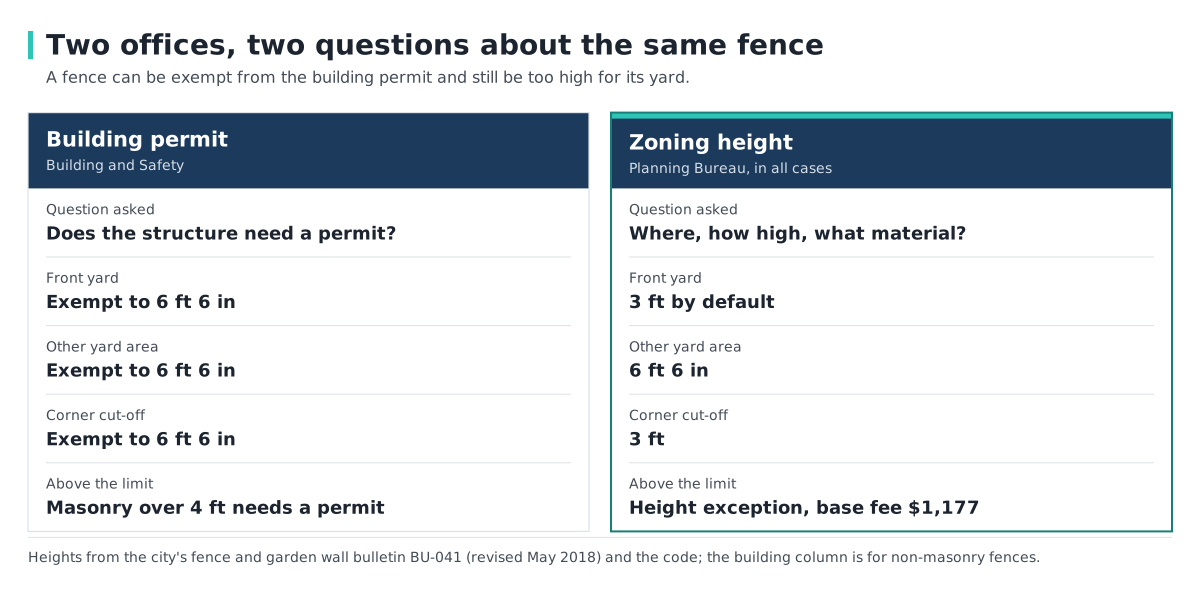
In Long Beach, a wood, vinyl or wrought iron fence up to 6 feet 6 inches does not need a building permit, but the Planning Bureau still approves its location, height and material, and a residential front-yard fence is limited by default to 3 feet. Heights run from 3 feet at a corner cut-off to 10 feet outside the required yards, so the permit exemption and the zoning limit answer two different questions.
- Building permit: not required for fences up to 6 ft 6 in on the city’s current page; the code exempts any fence up to 4 ft and a non-masonry fence up to 6 ft 6 in13.
- Zoning: “In all cases, the Planning Bureau’s review and approval is required to approve the location, height, and material of fence and garden walls”2.
- Residential limits in the city’s bulletin: 3 ft front yard by default (the bulletin lets front-yard height exceed 3 ft in high crime areas through an administrative use permit), 6 ft 6 in other yard areas, 3 ft in the corner cut-off, 8 ft abutting nonresidential, or for the rear or side line abutting an alley or major arterial2.
- A fence height exception costs a base fee of $1,177 as of October 2026, before the 12 percent surcharge4.
- “Overheight fence” is on the city’s list of common code violations5.
The city’s building rules and its zoning rules measure a fence differently, and most confusion about fences in Long Beach comes from reading one and stopping. Building and Safety says a fence of ordinary materials needs no permit up to a height; Planning says how high a fence may stand in each part of a residential lot. This page separates the two, gives the zoning heights from the city’s own bulletin, and shows what the city charges if a fence needs an exception. The wider map of permits is in Permits in Long Beach, and the building-permit thresholds for everything else are in What Needs a Building Permit in Long Beach.
This page describes the city’s published rules as of October 2026. It is not legal advice.
The short answer
| If you are… | What the city’s pages say |
|---|---|
| Building a 6-foot wood fence along a side or rear yard | No building permit; within the 6 ft 6 in limit for other yard areas12 |
| Building a 4-foot wrought iron fence in the front yard | No building permit; zoning limits the front yard to 3 ft by default, with 4 ft in a council-designated special fence height area if the extra foot is wrought iron or chain link, and more in high crime areas only through an administrative use permit2 |
| Building a masonry wall over 4 ft | A building permit; the code’s exemption stops at 4 ft for masonry3 |
| Wanting a fence higher than the zoning limit | A fence height exception from Planning, base fee $1,177 as of October 20264 |
| In a historic district | A Certificate of Appropriateness for the fence2 |
| Near a street corner | A 3 ft limit inside the corner cut-off2 |
The building-permit side
The city’s current page lists “Wood, vinyl, wrought iron, or similar fences up to 6 feet and six 6 inches in height” among the items that “may be exempt from obtaining construction permits, as determined by the Building Official”1. Retaining walls and planter boxes are exempt “up to 4 feet in height, not supporting a surcharge or sloping earth”1.
The municipal code is more detailed. Section 18.04.020 exempts fences “not over four (4) feet in height above grade” in any material, and non-masonry fences “not over six (6) feet and six (6) inches”; a masonry fence over 4 feet needs a permit. Retaining walls are measured “from the bottom of the footing to the top of the wall”, and the exemption does not apply to walls of any height on slopes steeper than 20 percent. All of it is “provided the work is not in violation of Title 21 Zoning Regulations”3.
The city’s FAQ gives two answers The older permit FAQ gives both statements: its Q2 says “A permit is not required for any type of fence under 4′-0″ in height above grade”, while its Q3(b) gives 6 feet 6 inches for wood, chain link and wrought iron and 4 feet for masonry6. The current “Do I need a permit?” page says 6 feet 6 inches for wood, vinyl, wrought iron or similar fences1, and the code (any material to 4 feet, non-masonry to 6 feet 6 inches) matches Q3(b)3. The code copy the city posts is headed with a January 1, 2023 effective date; plan from the current page and the code, and confirm with the Permit Center for a masonry wall.
The zoning side: where the height is actually decided
The city’s fence and garden wall bulletin, BU-041 (revised May 2018), states the controlling sentence: “In all cases, the Planning Bureau’s review and approval is required to approve the location, height, and material of fence and garden walls.” Its residential limits are2:
| Residential location | Maximum height |
|---|---|
| Front yard | 3 ft by default; 4 ft in a council-designated special fence height area if the extra foot is wrought iron or chain link; footnote (e) says front-yard height “may exceed three feet (3′) … in high crime areas, through approval of an administrative use permit” |
| Other yard area | 6 ft 6 in |
| Outside the required yard | 10 ft |
| Abutting nonresidential; for a rear or side lot line, abutting an alley (other than a street); for a rear line (or a reverse corner lot’s side), abutting a major arterial | 8 ft |
| Corner cut-off area | 3 ft |
Source:2 for every row. The bulletin describes the corner cut-off as “a minimum of six feet by six feet”.
Read against the building rule, the numbers produce an overlap that surprises owners. A 6-foot wood fence is exempt from a building permit, yet in the front yard it is double the zoning limit. The building exemption says Building and Safety does not need to review structure; it does not say the fence conforms to Planning’s heights. The bulletin also prohibits barbed wire2.
The bulletin is dated 2018, and the zoning code section it applies is in Title 21 of the municipal code. Planning confirms the current section and heights for a given lot.
Historic districts
Fences in a historic district “will require the approval of a Certificate of Appropriateness”2. The city’s permit page tells owners in a historic district to contact Planning at 562.570.6194 before starting work1. To see whether an address is in one of the districts, see Is My Property in a Long Beach Historic District?.
When the fence is taller than the zoning allows
Planning’s fee schedule lists a “Fence Height Exception (AUP or SV)” at a base fee of $1,177 as of October 2026. Planning fees carry a 12 percent surcharge, and “fees are based on the fee schedule in effect at the time the application submittal is completed”4. The fee line names two routes, “AUP or SV”, and the schedule does not say which applies to a given fence. The same schedule lists a Fence Permit at $68.00 base ($76.16 with surcharge)4.
What enforcement looks like
“Overheight fence” appears on the Code Enforcement bureau’s list of common violations5. A written warning may come first. Fines, if they follow, are “not exceeding $100” for a first violation, $200 for a second within a year and $500 for each additional one; appeals must be filed within 30 calendar days with a deposit of “$950.00 per appeal or 50% of the fine amount, whichever is less”7. The process in full is in Unpermitted Work in Long Beach.
Where to check Planning’s offices are listed on the 3rd floor of 411 West Ocean Boulevard8 and its counter is at the 2nd-floor Permit Center9, and the city’s permit page lists 562.570.6194 for historic-district questions1. For the Permit Center itself: 562.570.PMIT (7648)9. For how an address is zoned, see Reading the Long Beach Zoning Map.
Frequently Asked Questions
How tall can a fence be in a Long Beach front yard?
The city’s fence bulletin limits it by default to 3 feet, or 4 feet in a council-designated special fence height area if the extra foot is wrought iron or chain link; it also lets front-yard height exceed 3 feet in high crime areas through an administrative use permit2.
How tall can a backyard fence be in Long Beach?
6 feet 6 inches in other yard areas, 8 feet where the lot abuts nonresidential property or, for the rear or side line, an alley or a major arterial, and 10 feet outside the required yard2.
Do I need a permit for a 6-foot fence in Long Beach?
Does a masonry wall need a permit?
Over 4 feet, yes; the code’s exemption for fences stops at 4 feet in masonry3.
Is a retaining wall exempt?
Is barbed wire allowed on a Long Beach fence?
The city’s bulletin prohibits it2.
What does a fence height exception cost?
A base fee of $1,177 as of October 2026, plus the 12 percent surcharge; the same schedule lists a Fence Permit at $68.00 base ($76.16 with surcharge)4.
Related Articles
Sources
- Permit Exemptions: Do I Need a Permit? — City of Long Beach, Development Services. Accessed 2026-10-01.
- Information Bulletin BU-041: Fence and Garden Wall (rev. 05-29-2018) — City of Long Beach, Development Services. Accessed 2026-10-01.
- Long Beach Building Standards Code, Title 18 (2023 compilation, section 18.04.020) — City of Long Beach, Development Services. Accessed 2026-10-01.
- Planning Bureau Fee Schedule, effective October 1, 2026 — City of Long Beach, Development Services. Accessed 2026-10-01.
- Code Enforcement — City of Long Beach, Development Services. Accessed 2026-10-01.
- Permit Frequently Asked Questions — City of Long Beach, Development Services. Accessed 2026-10-01.
- Code Enforcement Fines — City of Long Beach, Development Services. Accessed 2026-10-01.
- Historic Landmarks — City of Long Beach, Planning Bureau. Accessed 2026-10-01.
- Permit Center — City of Long Beach, Development Services. Accessed 2026-10-01.