In brief
Long Beach issues a certificate of occupancy “pursuant to a building permit for new construction, additions, and changes of occupancy” once the inspector has approved all the construction. The city publishes no definition of “change of occupancy”, no fee for the certificate itself and no turnaround; its one trigger list, Information Bulletin BU-040, names “Changing the use or occupancy” among four triggers for a building permit with a business license application. The only certificate fee on its October 1, 2026 building schedule is for a temporary one, $44 per $100,000 of valuation with a $328 minimum.
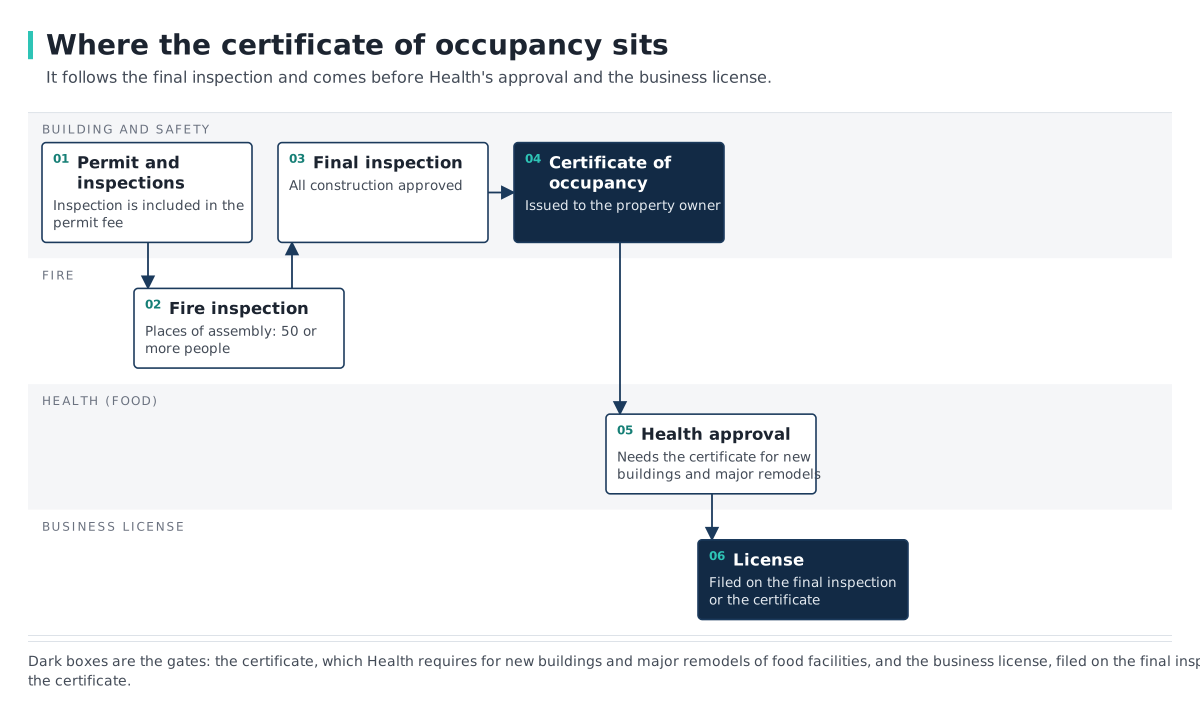
- The certificate comes after the final inspection and before the business license; the city’s brochure says to request it “when inspection sign-offs for all construction work are received and outstanding fees are paid”2.
- Health requires it “prior to health department approval for any new buildings or major remodels” of a food facility3.
- Fire inspects when a business produces hazardous conditions or is a place of assembly, “occupancy of 50 or more people”5.
- A temporary certificate is at the building official’s discretion, and costs a minimum of $328 as of October 202616.
- The Inspection FAQ says the certificate is issued “to the property owner”1.
This page answers whether a new tenant in an existing Long Beach building needs a certificate of occupancy. The answer sits between zoning, which decides whether the use is allowed, and the business license, which comes last. It sets out what the city says about the certificate of occupancy, which department asks for it and when, how to find the one a building already has, and what the city does not publish. It is part of the section on starting a business in Long Beach.
Fees below are the Building and Safety Bureau schedule the city marked “Last Updated: 10/1/2026”6.
The short answer
| If you are… | Do this |
|---|---|
| Moving into a space with the same use as the last tenant, no construction | Ask Building whether any permit is needed; the city ties the certificate to a building permit. Look up the building’s existing certificate in the permit records18 |
| Changing the use of a space and building out | Expect plan review, permits, inspections, a certificate, then the license21 |
| Opening a food business in a new building or a major remodel | Health plan check first; the certificate must be in hand before Health’s final approval3 |
| Needing to open before every item is finished | Ask Building about a temporary certificate; $328 minimum as of October 202616 |
| Running a place of assembly (50 or more people) | Plan for a Fire inspection as well5 |
What the city says a certificate is
The Building Bureau’s Inspection FAQ defines it: “A Certificate of Occupancy (CofO) is issued pursuant to a building permit for new construction, additions, and changes of occupancy after all the necessary construction has been approved by the inspector. It is evidence that the Community Development Department has determined that the construction was done in accordance with the requirements of the code for the given occupancies”1.
The same FAQ describes the last step. At the final inspection the inspector reviews “all work completed to ensure safety for occupancy and connection of utility services”, approves the work, authorizes utility connection and issues the certificate “to the property owner”1. The inspection itself carries no separate charge: “The cost of a building inspection is included in the permit fee”, with reinspection fees for visits where the work is not ready1.
Where the certificate sits in the sequence
Two city documents put it near the end, in slightly different words:
| Department | What its page says |
|---|---|
| Building and Safety (retail brochure, November 2024) | “Request approval for use and occupancy of the building (e.g., Certificate of Occupancy) when inspection sign-offs for all construction work are received and outstanding fees are paid”2 |
| Business License (same brochure) | “Upon receiving a final building inspection or Certificate of Occupancy, file for a business license”2 |
| Health (food facility plan guide) | Final approval needs proof that “the Building and Fire Departments have approved/inspected the facility”, and “A certificate of occupancy must be obtained prior to health department approval for any new buildings or major remodels”3 |
The license application also asks whether the business property “will be modified through construction or remodeling”, and says some businesses need inspections or investigations before the license issues; “for most businesses, this takes two weeks or less”11. Why the order matters for a food business is in How to Open a Restaurant in Long Beach.
What counts as a change of use
The city does not define “change of occupancy”. What its pages do say:
- The certificate follows “changes of occupancy” under a building permit1.
- Information Bulletin BU-040 (rev. 04-04-2017), “When a Building Permit is Required for Business License Application”, says the city may require a building permit if any of four things apply: “Opening a new business; Changing the use or occupancy; Proposing new construction; or Proposing additions, alterations, remodel, and/or repair”. Its flowchart runs through “Inspections and Certificate of Occupancy Issued” to the license13.
- Fire notes that “many buildings are older and have changed use numerous times over the years – often times far different than the original intended use”, and that it is “imperative for the Bureau of Fire Prevention to stay current with these changes”4.
- Zoning is a separate gate and comes first. In the commercial districts “Any use not specifically permitted … shall be prohibited”10. How to check is in The Zoning Check Before You Sign a Long Beach Lease.
The pages the city publishes contain no definition of “change of occupancy”, no fee line named certificate of occupancy or change of use, and no turnaround for either; BU-040 is the one trigger list. Whether your work is a change of occupancy is a question for the Permit Center at 562.570.PMIT (7648)12.
Official pages disagree Health’s plan guide, headed “REVISED 2003”, ties the certificate to “new buildings or major remodels”3. Building’s FAQ ties it to “new construction, additions, and changes of occupancy”1. The brochure states no trigger; it treats “a final building inspection or Certificate of Occupancy” as alternatives for the license step2. The two triggers differ. Plan on the stricter reading: if your use is changing, ask Building whether your work ends in a certificate, whatever Health calls the remodel.
How big the work is decides the route
The Permit Center sorts construction into over-the-counter plan review and submitted plan review. Over-the-counter review is for “minor tenant improvements or alterations to non-residential buildings with office or retail uses” and for minor fire sprinkler, alarm and hood work7; the Permit Center page lists “new constructions, additions and alterations to buildings” under submitted plan review12. The city publishes no turnaround for either. The Project Review Status page says reviews “will be assigned in the order they are received”14, and the Plan Review Service page says “Projects are assigned and reviewed in the order that it was received”7. What each department does after the permit is in The Commercial Build-Out Sequence in Long Beach.
Finding the certificate a building already has
The city’s permit records archive holds “historical or archival construction document records (e.g., Certificate of Occupancy, Plot Plans, Reports)”, searched by address; architectural plans are not available online and can be viewed at the counter or requested under the Public Records Act8. The Permit Status/History lookup shows project numbers, descriptions and final inspection dates, with the warning that “NOT ALL street addresses or permit statuses are available”9. The Inspection FAQ adds that construction documents the city has not microfilmed “are discarded 1 year after the completion of the work”1. A missing record is therefore not proof that no certificate was issued; it is a reason to ask the Permit Center before the lease is signed.
The temporary certificate
The building official “may issue a Temporary Certificate of Occupancy” for a building or part of one before it is complete, if no substantial hazard will result, satisfactory evidence shows that the work could not have been finished in time “because of its magnitude or because of unusual construction difficulties”, and, where applicable, the City Engineer reports that required public improvements are done. The FAQ cites Long Beach Municipal Code section 18.16.1801.
| Item | Fee as of October 2026 |
|---|---|
| Temporary Certificate of Occupancy | “$44 / each $100,000 of valuation or fraction thereof with a minimum of $328” |
| Renewal of a Temporary Certificate | “50% of the initial fee with a minimum of $177” |
| Temporary Utility Release, gas or electric | “$20 / request, but not less than $104” |
Source:6. By the schedule’s own arithmetic the $328 minimum controls until the valuation passes $700,000.
Frequently Asked Questions
Does a new tenant in Long Beach need a certificate of occupancy?
When the tenant’s work is a change of occupancy under a building permit, yes; the city issues the certificate for “new construction, additions, and changes of occupancy”. Whether a given move-in is one is Building’s decision1.
How much is a certificate of occupancy in Long Beach?
The October 1, 2026 building schedule has no line for the certificate itself. A temporary certificate is $44 per $100,000 of valuation, minimum $3286.
Who receives the certificate?
The FAQ says the final inspection ends with the inspector issuing it “to the property owner”1.
Can I open before the certificate is issued?
Do I need a certificate before the business license?
The city’s brochure says to file for the license “upon receiving a final building inspection or Certificate of Occupancy”2.
How do I find a building's existing certificate?
Does Fire have to inspect my space?
When the business produces hazardous conditions or is a place of assembly with an occupancy of 50 or more people5.
Related Articles
Sources
- Inspection Questions — City of Long Beach, Community Development. Accessed 2026-10-01.
- Retail Permitting Guidelines (brochure, November 2024) — City of Long Beach, Community Development. Accessed 2026-10-01.
- Food Facility Plan Check Guide — City of Long Beach, Bureau of Environmental Health. Accessed 2026-10-01.
- Fire Code Enforcement — Long Beach Fire Department. Accessed 2026-10-01.
- Fire Department FAQs — Long Beach Fire Department. Accessed 2026-10-01.
- Building Plan Review & Permit Fees, effective October 1, 2026 — City of Long Beach, Building and Safety Bureau. Accessed 2026-10-01.
- Plan Review Service — City of Long Beach, Building and Safety Bureau. Accessed 2026-10-01.
- Building Permit Records — City of Long Beach, Community Development. Accessed 2026-10-01.
- Permit Status/History — City of Long Beach, Community Development. Accessed 2026-10-01.
- Long Beach Municipal Code, Chapter 21.32 Commercial Districts — Municode. Accessed 2026-10-01.
- Business License Application Instructions — City of Long Beach. Accessed 2026-10-01.
- Permit Center — City of Long Beach, Community Development. Accessed 2026-10-01.
- Information Bulletin BU-040: When a Building Permit is Required for Business License Application (rev. 04-04-2017) — City of Long Beach, Building and Safety Bureau; listed on the city’s Information Bulletins page. Accessed 2026-10-01.
- Project Review Status — City of Long Beach, Community Development. Accessed 2026-10-01.