In brief
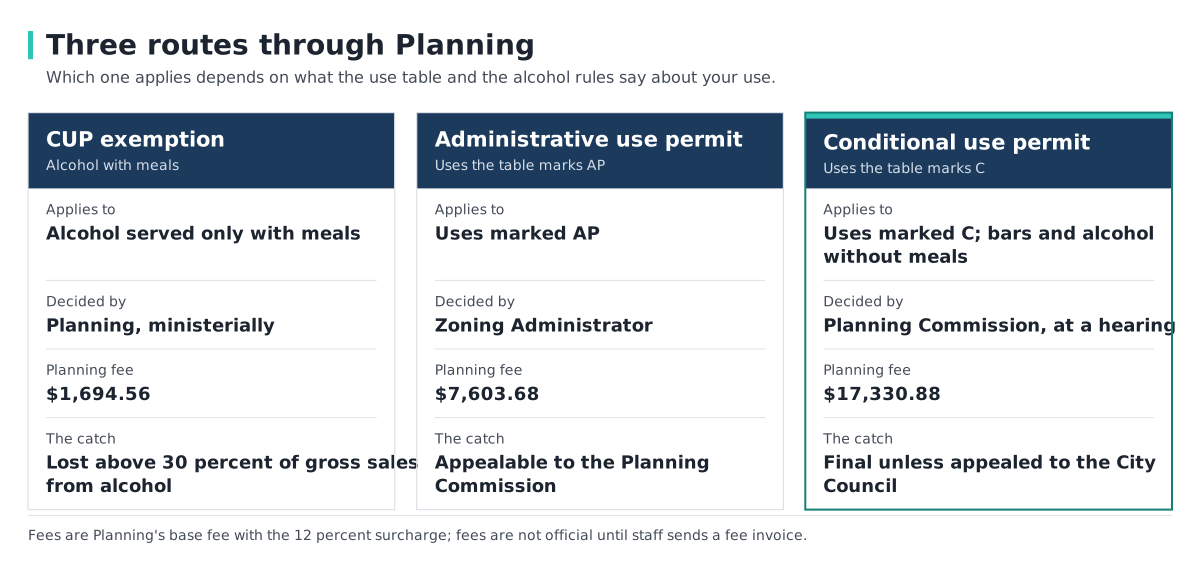
A conditional use permit (CUP) is the Planning Commission’s approval for a use that the zoning table marks “C” in your district, and it costs $17,330.88 in Planning’s fee as of October 2026, about $18,430 with the environmental exemption and the nearest public-notice tier. A restaurant that serves alcohol only with meals can use the CUP exemption instead, at $1,694.56.
- A CUP is decided by the Planning Commission, final unless appealed to the City Council; an administrative use permit (AUP), $7,603.68, is decided by the Zoning Administrator23.
- The city’s own timeline, labeled “general estimates”, runs from one to three weeks to submit through a hearing “typically held within 60 days” of a complete application; environmental review alone is “2 weeks to 15 months”1.
- Alcohol CUPs must not be “within five hundred feet (500′) of a public school, or public park”, with exceptions downtown and for large grocers4.
- An approved permit is subject to an annual reinspection, for which the schedule lists an Annual Zoning Compliance fee of $1,680.0023.
- Only “affected property owners or their agents” may apply3.
Plenty of Long Beach businesses never need one. The ones that do find it out at the zoning table; the fee is $17,330.88 as of October 2026, and the city’s estimates run from one to three weeks to submit through a hearing “typically held within 60 days” of a complete application12. This page is part of the sequence for starting a business in Long Beach and covers what the code says needs a CUP, the exemption for meals-only alcohol, what each step of the process is by the city’s own account, and what the fees are as of October 2026, the first month of the city’s FY27 schedule2.
The short answer
| If you are… | Do this |
|---|---|
| Opening a restaurant without a drive-through and without alcohol | No CUP; the use is a Y in all eight neighborhood, community and regional commercial districts5 |
| Serving beer, wine or spirits only with meals | Apply for the CUP exemption, $1,694.56 as of October 2026; it is lost if alcohol is more than 30 percent of gross sales24 |
| Opening a bar, a fixed bar, a cocktail lounge, or serving alcohol without meals | Budget a CUP, $17,330.88 as of October 2026, and a hearing246 |
| Adding a drive-through | A CUP in six of the eight districts; not permitted in the other two5 |
| Opening a use marked AP | An administrative use permit, $7,603.68, decided by the Zoning Administrator235 |
| Transferring a license under a CUP | Planning’s page says businesses transferring a license under a CUP must apply for an Administrative Land Use Review ($586.88), complete a site inspection and show compliance with the conditions26 |
What needs one
The use table in each zoning district marks a use Y (permitted), N (not permitted), C (conditional), AP (administrative use permit), A (accessory) or T (temporary)5. A CUP “may be submitted only for those uses specified as conditional uses in the applicable zone district”3. If the project also fails a development standard, “a separate standards variance application shall also be required”3.
A sample of Table 32-1, across the eight neighborhood, community and regional commercial districts (CNP, CNA, CNR, CCA, CCP, CCR, CCN, CHW):
| Use | Where the table says C |
|---|---|
| On-premises alcohol sales | all eight (see the exemption route below) |
| Restaurant with a drive-through | CNA, CCA, CCP, CCR, CCN, CHW; N in CNP and CNR |
| Hotel | CCA, CCP, CCR, CCN, CHW |
| Pawn shop | CCA, CCP, CCR, CCN, CHW |
| Check cashing and payday loans | CCA, CCP, CCR, CCN, CHW |
| Veterinary clinic with boarding | CCA, CCP, CCR, CCN, CHW |
| Car wash | CCA, CCP, CCR, CCN; AP in CHW |
| Fitness facility over 25,000 sq. ft. | CCA, CCR, CCN, CHW; N in the other districts of the eight |
Source:5. Industrial, institutional and park districts have their own tables3; Planning’s forms page lists “sensitive uses (like bars or clubs)” among the projects that need a planning permit before a permit to build or operate8. How to read the table for an address is in The Zoning Check Before You Sign a Long Beach Lease.
The exemption route for alcohol
The code lets some alcohol sales skip the CUP. A restaurant with service “only with meals” qualifies; which the code says “generally means” that fixed bars are not exempt, though a service bar is not a fixed bar and a sushi bar that serves meals at the same bar counts as meal service. A cocktail lounge without a bar that serves “primarily … only hors d’oeuvres and alcoholic beverages” is not exempt, and “any restaurant with more than thirty percent (30%) of gross sales consisting of alcoholic beverages shall lose its exemption”4. The code also exempts florists with accessory sales and existing legal nonconforming uses4. Planning describes the exemption as ministerially approved, filed on a CUP Exemption application6.
If you do need the CUP, the code attaches conditions to every alcohol use. The operator must maintain parking at the lesser of the existing spaces or the spaces normally required (21.52.201.A), provide night lighting and security “to the satisfaction of the Chief of Police”, and prevent loitering. The use may not be in a reporting district over the state’s recommended concentration of licenses or with a high crime rate, and may not be within 500 feet of a public school or park; downtown locations and grocery stores over 20,000 square feet with fresh produce and meat are excepted from the last two4. A restaurant selling alcohol of any kind must also prevent loitering in its parking areas and provide parking under Chapter 21.41 whatever the previous use’s parking status, with limited exceptions4. The state license is a separate step, covered in Serving Alcohol in Long Beach; Planning’s page says you may apply to the city and the state at the same time, but the state “will not issue your license until the required City approval is obtained”6.
Who decides, and on what findings
The Planning Commission considers CUP applications, and its decision “shall be final unless the decision is appealed to the City Council”3. The Zoning Administrator decides administrative use permits, appealable to the Commission, and may refer one to the Commission instead3. The Zoning Administrator may also approve a minor expansion of an existing conditional use, up to 25 percent and 5,000 square feet of building area, but not for alcohol sales3.
Before approving, the body must find that the approval is consistent with the General Plan and the zoning regulations; that the use “will not be detrimental to the surrounding community including public health, safety or general welfare, environmental quality or quality of life”; that it complies with the special conditions in Chapter 21.52; and, if a related development approval applies, that it meets the city’s green building standards3. The body must impose the Chapter 21.52 conditions for the use unless it waives them “with written findings”, and may add others it deems “reasonable and necessary”4. Conditions “necessary for the protection of public health, safety and welfare may not be waived under any circumstances”3.
The supplemental application shows what the decision-makers want to see: the zoning, coastal and historic status, outdoor operations, any drive-through, the ABC license type, whether the site is within 500 feet of a school or park, the nearest similar business, parking, employees, hours and an operations plan covering “security measures, employee training, noise control measures, etc.”7. Applications are submitted through the online Planning Permit Application; “in-person submittals are not accepted”7.
How the process runs
The city’s Entitlement Process page gives these estimates, with the caveat that “Timelines are general estimates”1.
| Step | What happens | City’s estimate |
|---|---|---|
| 1. Prepare and submit | Online application, signed copy uploaded, fees invoiced and paid; “allow up to 10 business days for a virtual intake appointment” | 1 to 3 weeks |
| 2. Initial staff review | Planner routes to Fire, Public Works, Utilities and others; a Notice of Incomplete Application if anything is missing | 2 to 5 weeks |
| 3. Environmental review (CEQA) | Staff set the pathway; a categorical exemption or studies | 2 weeks to 15 months |
| 4. Public hearing | Notice to nearby owners; staff report; the body may “approve, partially approve, or deny” | 2 to 6 weeks |
| 5. Appeal period and final decision | Appeal period “usually 10 days”, then a Notice of Final Action | 2 to 8 weeks |
| 6. Plan check and permits | Building permits and plan check after the Notice of Final Action | 4 to 8 weeks |
Source:1. Added end to end, the lower estimates for steps 1 to 5 come to nine weeks; the city does not say whether the stages overlap. An application “shall not be considered in queue for assignment until a signed copy is uploaded” and “Your submission is not considered complete until fees are paid”1.
Official pages disagree The entitlement page says “A public hearing is typically held within 60 days of the submittal of a complete application”1. The code’s wording is that the Zoning Administrator “shall set the matter for public hearing within sixty (60) days of receiving a completed application”, and for an administrative use permit referred to the Commission, the hearing is “within ninety (90) days of the filing of the application”3. The same page puts environmental review at “2 weeks to 15 months”1. Plan around the per-step estimates, and treat 60 days as when the hearing is set, not when you are approved.
Anyone “aggrieved” can appeal within 10 days of a decision, meaning a person who spoke or had someone speak at the meeting, or told staff of their concern in writing before it18. If the site is in the appealable area of the Coastal Zone, final local decisions can also be appealed to the California Coastal Commission1.
What it costs
| Item | Base fee | With 12 percent surcharge |
|---|---|---|
| Conditional Use Permit | $15,474.00 | $17,330.88 |
| Administrative Use Permit | $6,789.00 | $7,603.68 |
| CUP Exemption for alcoholic beverage sales | $1,513.00 | $1,694.56 |
| Standards Variance, first | $7,091.00 | $7,941.92 |
| Categorical Exemption, with another application | $493.00 | $552.16 |
| Public noticing, 300 feet | $488.00 | $546.56 |
| Public noticing, 500 feet | $771.00 | $863.52 |
| Public noticing, 750+ feet | $1,134.00 | $1,270.08 |
| Administrative Land Use Review | $524.00 | $586.88 |
| Annual Zoning Compliance, per application per year | $1,500.00 | $1,680.00 |
| Appeal to Planning Commission, applicant | $7,924.00 | $8,874.88 |
| Appeal to City Council, applicant | $10,164.00 | $11,383.68 |
Source:2, as of October 2026; the schedule says “Fee with surcharge applies”, and its County Recorder line reads “County Recorder Fee (Fixed, based on County) Required for CE and ND. No surcharge.” Fees “are not official until staff sends a fee invoice”2.
By the schedule’s arithmetic, a CUP with a categorical exemption and the 300-foot noticing tier is $17,330.88 + $552.16 + $546.56 = $18,429.60, before the County Recorder fee. In the fee year that ended September 30, 2026, the CUP was $16,722.729. Planning’s pre-application review for a land use question, “where no new building area is proposed”, is $2,290.40 as of October 20262. At that scale, the permit is the reason to check the table before the lease rather than after.
Approved permits are not one-time. Conditions must be “permanently posted” where the public can see them, and “all projects for which a conditional use permit is approved shall be required to undergo an annual reinspection” with an annual fee3.
Frequently Asked Questions
What needs a conditional use permit in Long Beach?
Any use the zoning table marks “C” for the district, such as on-premises alcohol sales, a restaurant drive-through, a hotel or a pawn shop in the commercial districts5.
How much is a conditional use permit in Long Beach?
$17,330.88 as of October 2026, including the 12 percent surcharge, before CEQA, noticing and recorder fees2.
How long does a conditional use permit take in Long Beach?
The city’s estimates for the stages run from one to three weeks to submit through a hearing typically within 60 days of a complete application, with environmental review of 2 weeks to 15 months1.
Who decides a conditional use permit?
The Planning Commission, final unless appealed to the City Council3.
Can I serve beer and wine without a conditional use permit?
Can a tenant apply for a conditional use permit?
The code limits the right to apply to “affected property owners or their agents”3.
Can the decision be appealed?
Related Articles
Sources
- Entitlement Process — City of Long Beach, Planning Bureau. Accessed 2026-10-01.
- Planning Bureau Fee Schedule, revised October 1, 2026 (FY27 fees version) — City of Long Beach, Community Development. Accessed 2026-10-01.
- Long Beach Municipal Code, Chapter 21.25 Special Procedures — Municode. Accessed 2026-10-01.
- Long Beach Municipal Code, Chapter 21.52 Conditional Uses — Municode. Accessed 2026-10-01.
- Long Beach Municipal Code, Chapter 21.32 Commercial Districts (Table 32-1) — Municode. Accessed 2026-10-01.
- Alcohol Regulations — City of Long Beach, Planning Bureau. Accessed 2026-10-01.
- Use Permit Application Supplement (revised 08/11/2026) — City of Long Beach, Planning Bureau. Accessed 2026-10-01.
- Planning Applications & Forms — City of Long Beach, Planning Bureau. Accessed 2026-10-01.
- Planning Bureau Fee Schedule, revised July 30, 2026 (FY26 fees version) — City of Long Beach, Community Development. Accessed 2026-10-01.