In brief
Selling alcohol in Long Beach takes two approvals: one from the city’s Planning Bureau and one from the state’s Department of Alcoholic Beverage Control (ABC), and “ABC will not issue your license until the required City approval is obtained”. The city route is a CUP exemption at $1,694.56 or a conditional use permit at $17,330.88 as of October 2026, and the state’s application fee for a new beer-and-wine or similar license is $1,135.
- Planning lists three tracks: the conditional use permit (CUP), the CUP exemption (CUPEx) and the Alcohol Nuisance Abatement Ordinance (ANAO) for older liquor stores1.
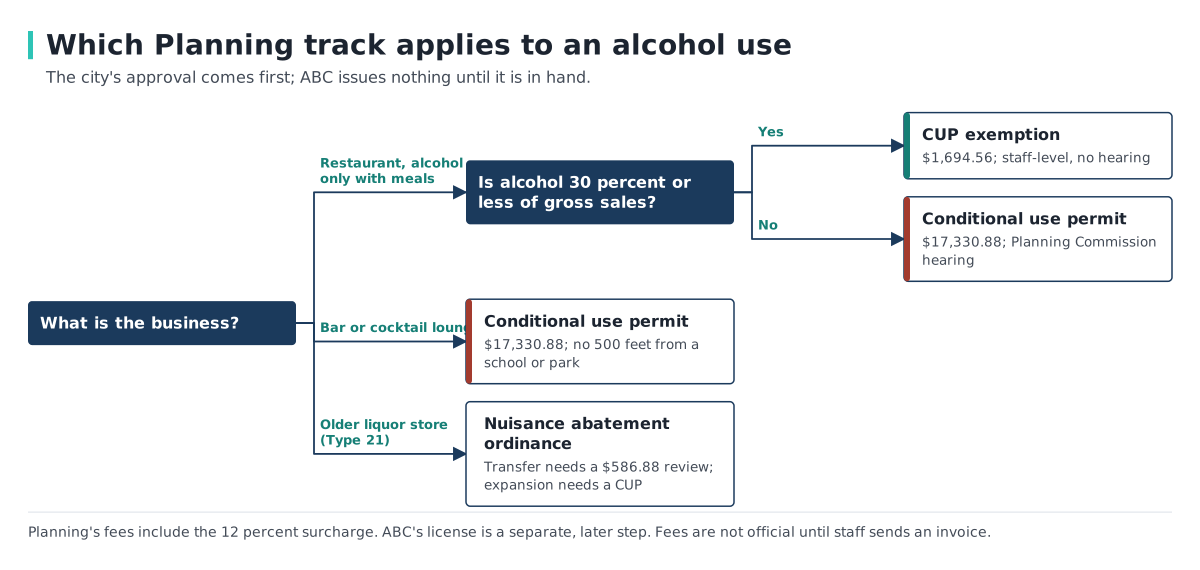
- A CUPEx is staff-level approval for restaurants serving alcohol “only with meals”; “Fixed bars are not exempt”1.
- Conditional alcohol uses may not be “within five hundred feet (500′) of a public school, or public park”, with exceptions downtown and for large grocers3.
- The Police Department reviews background and, for some permits, inspects; the ABC office for Long Beach is in Lakewood at (562) 982-133767.
- ABC’s fees rose 2.72 percent on January 1, 2026 and are scheduled to rise 3.31 percent on January 1, 202710.
Alcohol is the use where the city’s zoning layer does the most work. A new tenant in a former bar gets no automatic right to sell, a restaurant that sells wine with dinner and a bar are different tracks, and the state license cannot be issued until the city has approved the use1. This page is part of the sequence for starting a business in Long Beach. It covers the three Planning tracks, what the Police Department does, the ABC district office and the ABC fee schedules as of October 2026.
The short answer
| If you are… | Do this |
|---|---|
| A restaurant serving beer, wine or spirits only with meals | Apply for the CUP exemption, $1,694.56 as of October 2026; it is lost above 30 percent of gross sales from alcohol123 |
| A bar, a cocktail lounge, or a restaurant above the 30 percent line | A conditional use permit, $17,330.88 as of October 2026, decided at a Planning Commission hearing124 |
| A florist with accessory alcohol sales, or an existing legal non-conforming use | The exemption track13 |
| A legal non-conforming liquor store (ABC Type 21) | The ANAO track: a transfer needs an Administrative Land Use Review ($586.88), an expansion needs a CUP12 |
| A business that manufactures alcoholic beverages and has a tasting room | An Administrative Land Use Review; the tasting room “may not exceed 30% of the gross floor area”1 |
| Taking over a space whose last tenant held an alcohol license | No automatic right to sell: the page says “Do not immediately start selling alcohol after you move in”; a prior CUPEx holder’s successor applies for a new CUPEx, and a transfer under an existing CUP needs an Administrative Land Use Review1 |
Two approvals, in a fixed order
The city’s Alcohol Regulations page states the requirement in two parts: “Alcohol approval from the City of Long Beach” and “An alcohol license from the California Department of Alcoholic Beverage Control (ABC)”. The two applications can run at the same time, but the state license waits for the city’s decision1.
The city side is a Planning matter, separate from the business license in How to Apply for a Long Beach Business License. Planning handles the use at the address; ABC issues the license.
Track 1: the conditional use permit
A CUP is for uses that need “individual review and a public hearing before the Planning Commission”1. Planning’s page cites Section 21.25.206 for the findings and Section 21.52.201 for the conditions. The application is the online planning application, the Use Permit Supplemental Application and plans1. A license transfer under an existing CUP needs an Administrative Land Use Review and a site inspection1.
The code’s conditions for conditional alcohol uses include a location test: not “within five hundred feet (500′) of a public school, or public park”, and not in a reporting district with an over-concentrated number of licenses or a high crime rate; downtown locations and large grocers have exceptions3. The commercial-district chapter adds that “The concentration of existing ABC licenses and the area crime rate are factors considered in reviewing applications for alcohol sales”12. The full set of findings, the hearing and the appeal path are in Conditional Use Permits in Long Beach.
| Item | Fee as of October 2026 |
|---|---|
| Conditional Use Permit | $17,330.88 |
| Administrative Land Use Review | $586.88 |
| Public noticing, 300 feet | $546.56 |
| Annual Zoning Compliance, per application per year | $1,680.00 |
Source:2. Each includes the 12 percent surcharge the schedule applies; the schedule says fees “are not official until staff sends a fee invoice”.
Timing has two published answers. The entitlement page’s “general estimates” put a hearing “typically held within 60 days of the submittal of a complete application”5. Planning’s alcohol FAQ says a CUP “requires a public hearing, may take up to six months and has a higher application fee”1.
Track 2: the CUP exemption
The CUP exemption, called CUPEx, is staff-level approval with no hearing1. Planning lists four kinds of use that qualify1:
- A restaurant serving alcohol “only with meals”.
- A florist with accessory alcohol sales.
- An existing legal non-conforming use.
- A grocery store with accessory alcohol sales in certain Title 22 zones, with at least 70 percent of floor area for food and no more than 30 percent for alcohol.
What does not qualify is as specific. “Fixed bars are not exempt”; cocktail lounges and restaurants with “over 30% of gross receipts for alcohol sales” are not exempt1. The code states the same line for restaurants: “more than thirty percent (30%) of gross sales consisting of alcoholic beverages” loses the exemption3.
The fee is $1,694.56 as of October 20262. The same schedule’s CUP is $17,330.88, so the exemption is about a tenth of the cost2. A prior holder’s successor must apply for a new CUPEx1.
Track 3: the Alcohol Nuisance Abatement Ordinance
The ANAO applies to legal non-conforming liquor stores, meaning ABC Type 21 liquor stores, as of 20131. The page states “There are 118 ANAO locations”1. For those sites a transfer needs an Administrative Land Use Review, and any expansion needs a CUP1. The Planning fee schedule lists an ANAO Registry Fee of $760.48 as of October 2026 and does not say in its notes who pays it2.
The Police Department's role
The Business License Division’s additional-information page says “Certain business licenses and permits require a background investigation and possibly an inspection by the Police Department. These include entertainment permits, and licenses for massage technicians, businesses that sell alcohol, and adult businesses”6. The page describes the entertainment-permit path in detail: a Vice Detective schedules an inspection, the Department reviews ABC and CUP conditions, checks “crime in the area”, speaks with “nearby residents”, and takes “a recommendation from the Police Commander”, which then goes to the City Council. A qualifying business may receive a “temporary entertainment permit that lasts 120 days”6.
The step-by-step detail on that page is for entertainment permits, not for alcohol licenses as such6.
The ABC district office
Long Beach is served by the Lakewood/Long Beach district office at 3950 Paramount Boulevard, Suite 250, Lakewood, CA 90712; phone (562) 982-13377. The city’s own business page gives the same phone and “3950 Paramount Blvd., Lakewood, CA”6. ABC’s license-type page defines these types: Type 20 off-sale beer and wine, Type 21 off-sale general, Type 41 on-sale beer and wine for an eating place (“Must operate and maintain the licensed premises as a bona fide eating place”), Type 42 for bars, Type 47 on-sale general for an eating place and Type 48 on-sale general for public premises. On-sale types require Responsible Beverage Service certification11.
ABC fees as of October 2026
ABC’s schedules in effect since January 1, 2026 print these amounts89.
| Item | Fee |
|---|---|
| New non-general license (Types 20, 41, 42 and most others), application | $1,135, with the annual fee collected at the same time |
| New general license, priority types (21, 47, 48, 57 and others), application | $19,840, “Available only to priority drawing winners” |
| New general license, non-priority types (51, 52, 53, 54, 55, 56, 76, 80) | $1,135 |
| Person-to-person transfer | $1,565 if a general license is included; $420 if not |
| Premises-to-premises transfer | $975 |
| Annual fee, Type 20 | $500 |
| Annual fee, Type 21 | $1,009 |
| Annual fee, Type 41 | $565 |
| Annual fee, Types 47 and 48, column for cities over 40,000 population | $1,545 |
Source:89, effective January 1, 2026. The annual fee for on-sale general licenses is tiered by population (over 40,000, 20,000 to 40,000, and other); the page does not name Long Beach, so the over-40,000 column is read here by the city’s size.
ABC says annual fees “are collected at the time of application submission, in addition to the application fee. The annual fee will cover the first year’s license fee”10. Fees can be adjusted by inflation each year: the 2026 adjustment was 2.72 percent, and ABC’s page lists a 3.31 percent rise on January 1, 202710. The amounts above are the 2026 schedule.
Official pages disagree The entitlement page’s general estimate puts a hearing within 60 days of a complete submittal5; the alcohol FAQ says a CUP may take up to six months1. Neither page reconciles the two.
Frequently Asked Questions
Do I need city approval before an ABC license in Long Beach?
Yes. ABC “will not issue your license until the required City approval is obtained”, though both applications may be filed at the same time1.
What is the difference between a CUP and a CUPEx in Long Beach?
Does a new tenant inherit the previous tenant's alcohol rights?
Not automatically. Planning’s FAQ says “Do not immediately start selling alcohol after you move in”, and a prior CUPEx holder’s successor must apply for a new CUPEx1.
How far must alcohol sales be from a school or park?
Conditional alcohol uses may not be “within five hundred feet (500′) of a public school, or public park”, with exceptions for greater downtown and large grocers3.
How much does an ABC license cost in Long Beach?
Where is the ABC office for Long Beach?
3950 Paramount Boulevard, Suite 250, Lakewood, CA 90712; (562) 982-13377.
Related Articles
Sources
- Alcohol Regulations — City of Long Beach, Planning Bureau. Accessed 2026-10-02.
- Planning Bureau Fee Schedule, revised October 1, 2026 (FY27 fees version) — City of Long Beach, Community Development. Accessed 2026-10-02.
- Long Beach Municipal Code, Chapter 21.52 Conditional Uses — Municode. Accessed 2026-10-02.
- Long Beach Municipal Code, Chapter 21.25 Special Procedures — Municode. Accessed 2026-10-02.
- Entitlement Process — City of Long Beach, Planning Bureau. Accessed 2026-10-02.
- Additional Information, Business Licenses — City of Long Beach, Financial Management. Accessed 2026-10-02.
- District Offices — California Department of Alcoholic Beverage Control. Accessed 2026-10-02.
- Application Fee Schedules — California Department of Alcoholic Beverage Control. Accessed 2026-10-02.
- Annual Fee Schedule — California Department of Alcoholic Beverage Control. Accessed 2026-10-02.
- License Fees — California Department of Alcoholic Beverage Control. Accessed 2026-10-02.
- License Types — California Department of Alcoholic Beverage Control. Accessed 2026-10-02.
- Long Beach Municipal Code, Chapter 21.32 Commercial Districts — Municode. Accessed 2026-10-02.