In brief
Before you sign a Long Beach lease, find the address’s zoning district on the city’s Zoning and Land Use GIS map, look your use up in that district’s use table in Title 21, and ask Planning about anything the table leaves open. The map and the phone line have no fee on the city’s schedule; a written Zoning Confirmation Letter is $1,142.40 as of October 2026.
- The city’s own brochures say to check “before you sign a lease” that the location “is zoned for” your use, and to ask Building whether all improvements have been permitted4.
- The map has layers for zoning district, General Plan PlaceType, historic district and coastal zone1.
- In a commercial district’s use table, “Any use not specifically permitted … shall be prohibited”: a use needs a Y, a C, an AP, an A or a T in its row5.
- As of October 2026 the written answers on the schedule run from the Zoning Confirmation Letter at $1,142.40 to Classification of Use at $16,916.48; the Business License Zoning Review, $213.92, is charged with a license6.
- The Planning and Zoning phone line is (562) 570-6194, open Monday through Thursday2.
A lease is the first commitment in the sequence for starting a business in Long Beach, and it is the one the city cannot undo for you. Planning answers whether the use is allowed at the address; it does not answer whether the building’s past work was permitted or whether the space can be occupied for a new use. This page covers the zoning half: the map layers, the use table, the free and paid ways to get an answer, and what the answer leaves out.
Fees on this page are the Planning Bureau schedule revised October 1, 2026, which the city says is the schedule in force for applications completed on or after that date6. The city adopted the new Master Fee Schedule on September 8, 202613.
The short answer
| If you are… | Do this |
|---|---|
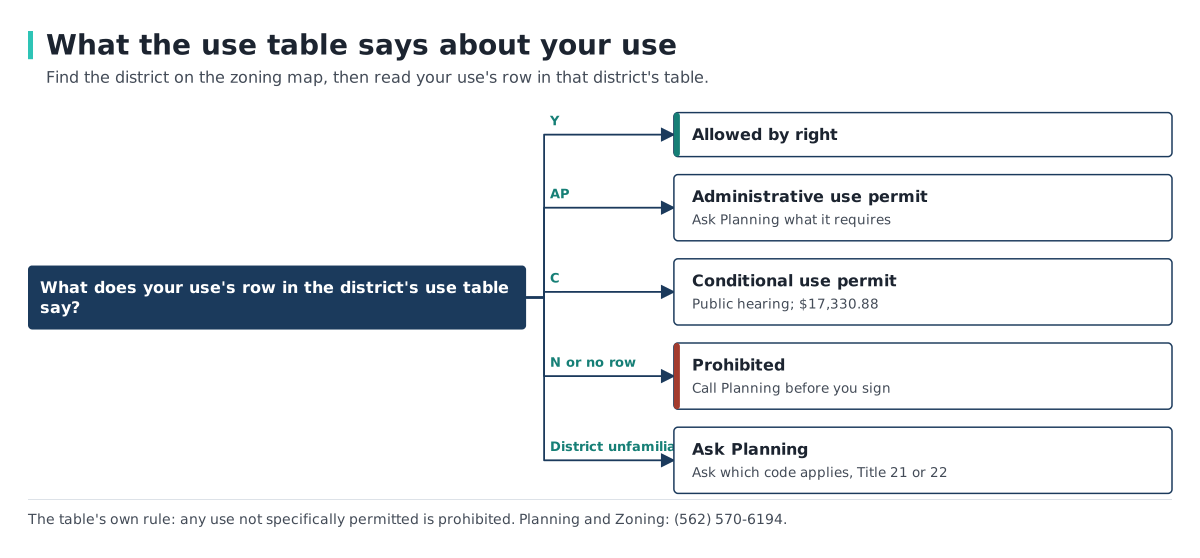
| Choosing between two spaces | Look up each address on the zoning map, then read the use table for each district; a use with a Y is allowed by right, a C needs a conditional use permit15 |
| Sure of the use but not of the district | Use the map; the zoning district is the first of its four layers1 |
| Opening a use the table marks C, AP or not at all | Call Planning before you sign; a C means a public hearing and a fee of $17,330.88 as of October 2026612 |
| Taking over a space that was a different business | Ask Planning about the use and Building whether the earlier work was permitted; zoning does not answer the second question49 |
| Needing a written answer for a landlord, lender or buyer | A Zoning Confirmation Letter, $1,142.40 as of October 202667 |
Step 1. Find the district on the map
The Planning Bureau’s Zoning Regulations page says the first step “is knowing in which zoning district you are located”, and lists the questions to settle for any site: how the property is zoned, how the building is proposed to be used, what the zoning regulations allow, whether an entitlement is needed, what the parking and landscape requirements are, and whether the property is in a historic district or a designated landmark1.
The tool is the Zoning and Land Use GIS Map. Its layers show Zoning District, General Plan PlaceType, Historic District and Coastal Zone1. The zoning district is the layer that governs permits; the PlaceType is the General Plan label. The city’s Zoning and Land Use Maps page also lists a Parking Impacted Areas map, a Special Fence Height Areas map, flood, liquefaction and methane maps, and a BizMap3.
Title 21 is the city’s long-standing zoning code; Title 22 is the new code that will ultimately replace it, and the Planning page keeps handouts for both, including Title 22 standards for mixed-use and commercial zones115. The city’s Zone In program is rezoning the city area by area, and the Bixby area’s rezoning was adopted by the City Council on June 9, 202611. If the map shows a district name you do not recognize from Title 21, ask Planning which code applies.
Where to check “What’s My Zoning District?” and “What Does My Zone Mean?” are two of the quick links on the Planning Bureau’s Zoning & Project Planning page. The first opens the map; the second goes to the regulations for the district2.
Step 2. Read the use table
Chapter 21.32 governs the commercial districts. Its use tables mark each use as permitted (Y), not permitted (N), a conditional use (C), an administrative use (AP), an accessory use (A) or a temporary use (T); an asterisk means the use is permitted subject to the specific standards in Chapter 21.455. The rule that matters most for a tenant: “Any use not specifically permitted … shall be prohibited, and no commercial uses shall be allowed outside of a building unless indicated as an outdoor use”5.
A sample of Table 32-1, across the eight neighborhood, community and regional districts (CNP, CNA, CNR, CCA, CCP, CCR, CCN, CHW):
| Use | What the table says |
|---|---|
| Restaurant without a drive-through | Y in all eight |
| Restaurant with a drive-through | C in six (CNA, CCA, CCP, CCR, CCN, CHW); N in CNP and CNR |
| On-premises alcohol sales | C in all eight; the code exempts some meals-only restaurants from the permit |
| Basic personal services (barber, beauty, nail) | Y in all eight |
| Car wash | C in CCA, CCP, CCR and CCN; AP in CHW; N in the three neighborhood districts |
| Vending carts | AP |
Source:5. The table’s own note: “The concentration of existing ABC licenses and the area crime rate are factors considered in reviewing applications for alcohol sales”5.
Chapter 21.32 covers the commercial districts only; the Planning page lists the industrial districts, the specific plan districts and the planned development districts separately, which is one reason to ask rather than read1. How a C works is in Conditional Use Permits in Long Beach.
Step 3. Ask Planning, and know what each answer costs
The Planning and Zoning phone line is (562) 570-6194; the page says it is open Monday through Thursday during regular business hours. Planning also takes questions through an online inquiry form and books in-person or virtual meetings with a planner2. The city’s brochures list what to ask: whether the location allows your use, “what planning permits, (i.e., Administrative Use Permit [AUP]) might be required”, whether upgrades or remodels are needed, and what the sign regulations are4.
The schedule prints no fee for the phone line or the inquiry form; these are the paid items. The Pre-Development Meeting and Project Navigation Services are a meeting and hourly help, not written answers, and the Business License Zoning Review is charged with a business license:
| Item | Base fee | With 12 percent surcharge | What the schedule says |
|---|---|---|---|
| Pre-Development Meeting | $280.00 | $313.60 | per meeting |
| Project Navigation Services | $110.00 | $123.20 | per hour, outside the scope of estimated entitlement project management |
| Business License Zoning Review | $191.00 | $213.92 | “Review of the zoning of a business for compliance with City codes and standards” |
| Zoning Confirmation Letter | $1,020.00 | $1,142.40 | no description |
| Zoning Administrator Interpretation | $1,429.00 | $1,600.48 | “Per Section 21.10.045” |
| Pre-Application, land use question | $2,045.00 | $2,290.40 | “where no new building area is proposed” |
| Classification of Use | $15,104.00 | $16,916.48 | no description |
Source:6, as of October 2026. “Fee with surcharge applies.” Fees “are not official until staff sends a fee invoice”6.
The Zoning Confirmation Letter has two forms on the application: a Basic Zoning Letter that confirms the zoning designation and describes the nonconforming and “rebuild” rights the code generally gives, and a Zoning Letter with Additional Research that also answers specific questions such as the number of dwelling units legally permitted, permit history and the status of entitlements7. The fee schedule lists one price and does not say whether the two differ, and neither the application nor the Planning pages publish a turnaround. Applications go by email to [email protected] or by mail7.
Official pages disagree The Planning fee schedule and the use permit supplement print the Planning Bureau at 411 West Ocean Boulevard, 3rd Floor; the Zoning Confirmation Letter application’s letterhead says 2nd Floor, while its mailing address says 3rd Floor, and Building’s Permit Center is on the 2nd Floor6781416. Treat Planning as the 3rd floor and the Permit Center as the 2nd, and confirm before a visit; Planning’s entitlement filings are virtual only12.
Step 4. Check what zoning does not tell you
- Whether the building was permitted. The brochure sends this question to Building, not Planning4. The city’s Permit Status/History lookup shows project numbers, descriptions and final inspection dates, and warns “NOT ALL street addresses or permit statuses are available”; the permit records archive holds documents such as a certificate of occupancy, searched by address910. The step that follows a use change is in Certificate of Occupancy and Change of Use in Long Beach.
- Historic districts and the coastal zone. The Cultural Heritage Commission “reviews all changes to a property’s exterior” in historic districts and at landmarks8. In the coastal zone, “A Coastal Permit and encroachment permit are required for all outdoor dining located on public right-of-way”5.
- Parking. Parking requirements are in Chapter 21.41, unless the site is inside the city’s Parking Exempt Area, which has its own page and map1.
- Signs. The brochure says to check with Planning for sign regulations4; the rules are in Business Signs and Awnings in Long Beach.
- Your license. When the business license is processed, the city lists a Business License Zoning Review as its own fee6. The brochure puts the license last, after the final inspection or certificate of occupancy4.
The order of everything after the lease is in The Commercial Build-Out Sequence in Long Beach.
Frequently Asked Questions
How do I find the zoning of a Long Beach address?
Is a Long Beach zoning check free?
The map and the phone line are not priced on the fee schedule. A written Zoning Confirmation Letter is $1,142.40 and a Business License Zoning Review is $213.92 as of October 20266.
Does the zoning table show whether I need a permit to open?
Can I use a space for something the table does not list?
Does zoning tell me if the previous tenant's work was permitted?
Who do I call about zoning in Long Beach?
Planning and Zoning, (562) 570-6194, open Monday through Thursday. Planning also takes online inquiries and books meetings2.
What is Title 22?
Related Articles
Sources
- Zoning Regulations & Design Guidelines — City of Long Beach, Planning Bureau. Accessed 2026-10-01.
- Zoning & Project Planning — City of Long Beach, Planning Bureau. Accessed 2026-10-01.
- Zoning and Land Use Maps — City of Long Beach, Planning Bureau. Accessed 2026-10-01.
- Retail Permitting Guidelines (brochure, November 2024) — City of Long Beach, Community Development. Accessed 2026-10-01.
- Long Beach Municipal Code, Chapter 21.32 Commercial Districts (Table 32-1) — Municode. Accessed 2026-10-01.
- Planning Bureau Fee Schedule, revised October 1, 2026 (FY27 fees version) — City of Long Beach, Community Development. Accessed 2026-10-01.
- Zoning Confirmation Letter (“Rebuild Letter”) Application — City of Long Beach, Planning Bureau. Accessed 2026-10-01.
- Planning Applications & Forms — City of Long Beach, Planning Bureau. Accessed 2026-10-01.
- Permit Status/History — City of Long Beach, Community Development. Accessed 2026-10-01.
- Building Permit Records — City of Long Beach, Community Development. Accessed 2026-10-01.
- Zone In: Citywide Rezoning — City of Long Beach, Planning Bureau. Accessed 2026-10-01.
- Entitlement Process — City of Long Beach, Planning Bureau. Accessed 2026-10-01.
- Fee Schedule Information — City of Long Beach, Community Development. Accessed 2026-10-01.
- Building Plan Review & Permit Fees, effective October 1, 2026 — City of Long Beach, Building and Safety Bureau. Accessed 2026-10-01.
- UPLAN: Title 22 and the new zoning code — City of Long Beach, Planning Bureau. Accessed 2026-10-01.
- Use Permit Application Supplement (revised 08/11/2026) — City of Long Beach, Planning Bureau. Accessed 2026-10-01.