
In brief
Before you sign a Long Beach commercial lease, ask Planning whether your use is allowed at that address and ask Building whether the existing improvements were permitted; the city’s own brochures say to do both “before you sign a lease”. A use that needs a conditional use permit costs $17,330.88 as of October 2026, and a lease signed first leaves you paying rent while it is decided.
- Zoning: “Any use not specifically permitted … shall be prohibited”; Planning answers whether a use is allowed in a given district on (562) 570-619417.
- Entitlements: a conditional use permit goes to the Planning Commission, with a hearing “typically held within 60 days of the submittal of a complete application”89.
- Building: the city’s sequence runs from construction through inspections to a certificate of occupancy, then the business license3.
- Signs: a sign permit is required for an on-premises sign unless exempt; the first sign is $107.00, or $119.84 with surcharge, as of October 2026610.
- Cost rule of thumb: the city says expect “about 2% of your building costs” on plan checks, permits, inspections and other agency fees14.
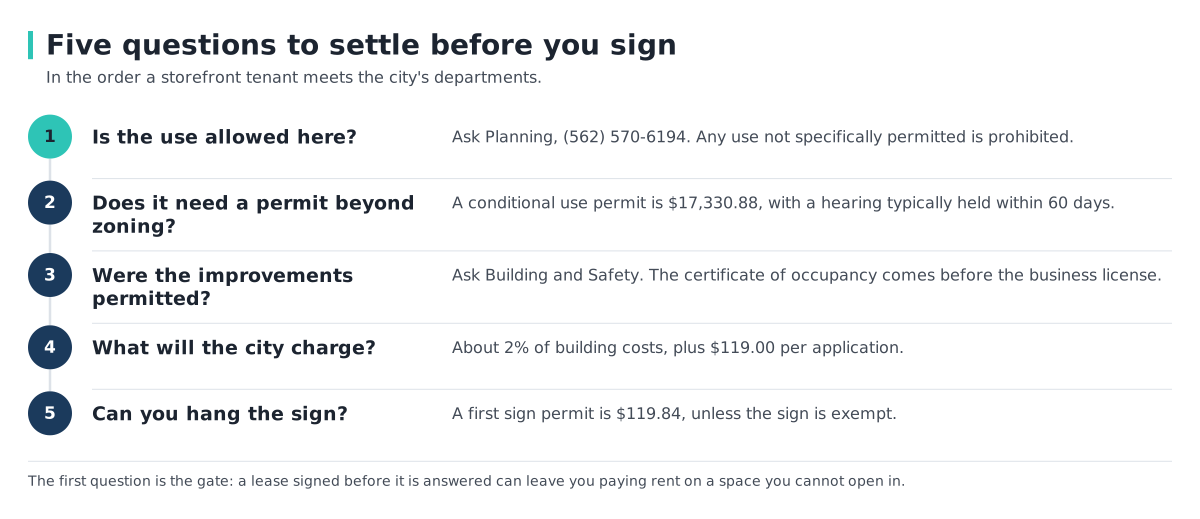
A lease commits you to a monthly payment on a specific address, and a lease signed before the questions below are answered can leave you paying rent on a space you cannot yet open in. The questions follow the order in which a Long Beach storefront tenant meets the city’s departments. A few have fees, listed with their fee year. For the full order of steps after you sign, read the pillar, How to Start a Business in Long Beach.
The short answer
| If you are… | Ask this first |
|---|---|
| Choosing between two addresses | Which zoning district each is in, and whether your use is allowed in it47 |
| Opening a restaurant | Whether the address allows restaurant use, and whether building improvements were permitted2 |
| Serving alcohol | Whether the use needs a conditional use permit or qualifies for the exemption route15 |
| Taking a space last used by a different type of business | What changed use means for the certificate of occupancy; ask Planning and Building312 |
| Counting on a sign | Whether the sign fits the code’s size limits and needs a permit10 |
| Planning outdoor seating | Whether the space is in the Coastal Zone7 |
1. Is your use allowed at this address?
The city’s own brochures say it directly: “Check with the Planning Bureau to make sure that the proposed location allows (is zoned for) your proposed restaurant use before you sign a lease. Ask the Building and Safety Bureau if all building improvements have been permitted.” The retail brochure says the same3. Planning describes its role as helping “understand if a proposed use is allowed in a specific zoning district”; the Planning and Zoning line is (562) 570-61941.
Two city tools answer the first half: “What’s My Zoning District?” and “What Does My Zone Mean?”4. Planning’s forms page also lists a written zoning confirmation letter request5; the October 2026 fee schedule prices the letter at $1,020.00, or $1,142.40 with surcharge6. The use table is strict: “Any use not specifically permitted … shall be prohibited”7. For the eight neighborhood, community and regional commercial districts (CNP, CNA, CNR, CCA, CCP, CCR, CCN and CHW), the use table reads:
| Use | Status in those districts |
|---|---|
| Restaurant, no drive-through | Permitted by right in all eight |
| Restaurant with drive-through | Conditional use permit in six, not allowed in two |
| Basic personal services (barber, beauty, nail) | Permitted by right |
| Mobile food truck on private property | Permitted by right |
| Outdoor dining | Allowed as an accessory use |
Source:7. Downtown and the industrial zones are governed by other tables that this page does not reproduce.
If you need a formal answer before you sign, Planning’s fee schedule lists paid options, as of October 20266:
| Service | Base | With surcharge |
|---|---|---|
| Pre-Application, no new building area (land use question) | $2,045.00 | $2,290.40 |
| Classification of Use | $15,104.00 | $16,916.48 |
| Project Navigation Services, per hour | $110.00 | $123.20 |
2. Does the use need a permit beyond zoning?
Some uses are allowed only after review. The code says “certain types of land use … require individual review by the Planning Commission”, and the Commission “shall consider all applications for conditional use permits”. Administrative use permits go to the Zoning Administrator8. The code’s general rule is that the decision-maker “shall set the matter for decision within sixty (60) days of receiving a completed application”8.
The city’s own timeline estimates 1 to 3 weeks to submit and pay, 2 to 5 weeks of staff review, 2 weeks to 15 months for environmental review, 2 to 6 weeks to a hearing or administrative review, and 2 to 8 weeks for the appeal period and final decision. “A public hearing is typically held within 60 days of the submittal of a complete application”9. Submittals are “virtual only”, and the page says to “allow up to 10 business days for a virtual intake appointment”9.
The fees, as of October 2026, base and with the 12.0 percent surcharge6:
| Item | Base | With surcharge |
|---|---|---|
| Conditional Use Permit | $15,474.00 | $17,330.88 |
| Administrative Use Permit | $6,789.00 | $7,603.68 |
| CUP Exemption for alcohol sales | $1,513.00 | $1,694.56 |
| CEQA categorical exemption, with another application | $493.00 | $552.16 |
| County Recorder fee (set by the county; no surcharge) | Set by the county | n/a |
| Noticing, Tier 1 (300 ft) | $488.00 | $546.56 |
A conditional use permit with a categorical exemption and Tier 1 noticing adds up to $18,429.60, plus the county’s recorder fee, before any Public Works charge. The schedule’s footer adds that fees “are not official until staff sends a fee invoice”6. At that figure, the permit is a reason to compare addresses that need one with addresses that do not.
Alcohol adds its own tests. Conditional alcohol uses “shall not be located within five hundred feet (500′) of a public school, or public park”, with exceptions for greater downtown and large grocers, and not in an over-concentrated or high-crime reporting district. A restaurant serving alcohol “only with meals” is exempt from the permit, but “more than thirty percent (30%) of gross sales consisting of alcoholic beverages” loses the exemption15.
3. Were the existing improvements permitted, and what will the certificate of occupancy need?
The second half of the brochure’s advice is to ask Building “if all building improvements have been permitted”2. The city’s retail brochure sets the order that follows construction: inspection sign-offs, then a request for approval to occupy the building (the certificate of occupancy), and then, “upon receiving a final building inspection or Certificate of Occupancy, file for a business license”3. For food businesses, “a certificate of occupancy must be obtained prior to health department approval for any new buildings or major remodels”11.
The Fire Department says of local buildings that “many buildings are older and have changed use numerous times over the years”12. This page does not state what counts as a change of use that triggers a new certificate; Planning and Building answer that for the address. A change-of-use article is in Certificate of Occupancy and Change of Use in Long Beach.
Good to know The Permit Center takes appointments; “walk-ins … are not accepted from 11:30 a.m. to 1 p.m. or after 3:30 p.m.” The phone line is 562.570.PMIT (7648). Minor storefront alterations can be reviewed over the counter; larger work goes to submitted plan review13.
4. What will the city charge, and when?
The city’s rule of thumb is that “you could expect to spend about 2% of your building costs on plan checks, permits, inspections and other agency fees”, plus a $119.00 processing fee per application14. That figure is from the schedule in force through September 30, 2026. The build-out costs by department are in The Commercial Build-Out Sequence in Long Beach, and the license tax is in What a Long Beach Business License Costs. The license is the last step in the city’s sequence3.
5. Can you hang the sign you are counting on?
“A sign permit is required to display, enlarge, modify, relocate or change in any way … an on-premises sign in any zoning district, unless … expressly exempted”; the permit must be used within 180 days10. The limits are measured differently by sign type: wall signs per linear foot of building wall, banners per linear foot of street frontage, and awning signs as 40 percent of the awning face:
| Sign | Limit |
|---|---|
| Wall sign | “one (1) square foot of sign area per linear foot of building wall”, no more than 100 sq ft facing a residential, local or collector street and 250 sq ft facing an arterial |
| Awning sign | “forty percent (40%) of the total face of the awning … not to exceed one hundred (100) square feet”; any encroachment over public property needs Public Works approval |
| Banner | “one (1) square foot of banner area for each linear foot of building street frontage”, up to 100 sq ft; “valid for only ninety (90) days and shall not be renewable in the same calendar year” |
Source:10. No permit is needed for window signs covering up to 10 percent of the window, interior signs under 25 percent, or “any other non-prohibited sign, if less than 3 sq. ft.”10.
As of October 2026, a first sign permit is $107.00, or $119.84 with surcharge; each additional sign $57.12; a banner permit $38.08 for the first and $19.04 for each additional; a creative sign permit $3,560.486. The permit rules are in Business Signs and Awnings in Long Beach.
6. What about outdoor seating?
On private property, outdoor dining is an accessory use7. On the public right-of-way in the Coastal Zone, “a Coastal Permit and encroachment permit are required for all outdoor dining”7. The temporary pandemic parklets ended on January 31, 2023; for a permanent one, the city points applicants to its Sidewalk Dining and Parklets Handbook and to [email protected]16.
Questions for the landlord
The city’s departments answer the questions above; the lease answers the rest. A lease settles who pulls which permit, who pays the plan-check and permit fees, and what insurance it requires, and those are the questions it raises. A lawyer, not this site, reads the lease.
Where to check Planning and Zoning, (562) 570-6194; the Permit Center, 411 West Ocean Boulevard, 562.570.PMIT (7648); and the city’s zoning district tool1413. The zoning check in detail is in The Zoning Check Before You Sign a Long Beach Lease.
The site earns a commission on some links to business services, which does not affect what is recommended.
Frequently Asked Questions
What should I check before signing a commercial lease in Long Beach?
The city’s brochures say to check with Planning that the address is zoned for your use and to ask Building whether all improvements were permitted, before you sign2.
How do I find out the zoning of a Long Beach address?
How much is a conditional use permit in Long Beach?
$15,474.00, or $17,330.88 with the 12.0 percent surcharge, as of October 20266.
How long does a conditional use permit take?
The city says a public hearing is typically held within 60 days of a complete submittal; its component estimates run longer, and environmental review alone can take 2 weeks to 15 months9.
Do I need a certificate of occupancy before the business license?
Does a sign need a permit?
An on-premises sign does unless the code expressly exempts it; window signs up to 10 percent of the window and signs under 3 sq. ft. are among the exemptions10.
Can I visit the Permit Center without an appointment?
Walk-ins are not accepted from 11:30 a.m. to 1 p.m. or after 3:30 p.m.; the city asks you to book an appointment13.
Related Articles
Sources
- Planning Bureau — City of Long Beach, Community Development. Accessed 2026-10-01.
- Restaurant Permitting Guidelines brochure — City of Long Beach, Building and Safety (November 2024). Accessed 2026-10-01.
- Retail Permitting Guidelines brochure — City of Long Beach, Building and Safety. Accessed 2026-10-01.
- Current Planning — City of Long Beach, Community Development. Accessed 2026-10-01.
- Planning Applications and Forms — City of Long Beach, Community Development. Accessed 2026-10-01.
- Planning Bureau Fee Schedule, revised October 1, 2026 (FY27 fees version) — City of Long Beach, Community Development. Accessed 2026-09-30.
- Long Beach Municipal Code, Title 21, Chapter 21.32 Commercial Districts — Municode. Accessed 2026-10-01.
- Long Beach Municipal Code, Chapter 21.25 Special Procedures — Municode. Accessed 2026-10-01.
- Entitlement Process — City of Long Beach, Community Development. Accessed 2026-10-01.
- Long Beach Municipal Code, Title 21, Chapter 21.44 Signs — Municode. Accessed 2026-10-01.
- Plan Check Guide for Food Facilities — City of Long Beach, Health Department. Accessed 2026-10-01.
- Fire Prevention: Code Enforcement — Long Beach Fire Department. Accessed 2026-10-01.
- Permit Center — City of Long Beach, Community Development. Accessed 2026-10-01.
- Fee Schedules — City of Long Beach, Community Development. Accessed 2026-10-01.
- Long Beach Municipal Code, Title 21, Chapter 21.52 Conditional Uses — Municode. Accessed 2026-10-01.
- Temporary Open Streets — City of Long Beach, GO Active LB. Accessed 2026-10-01.