In brief
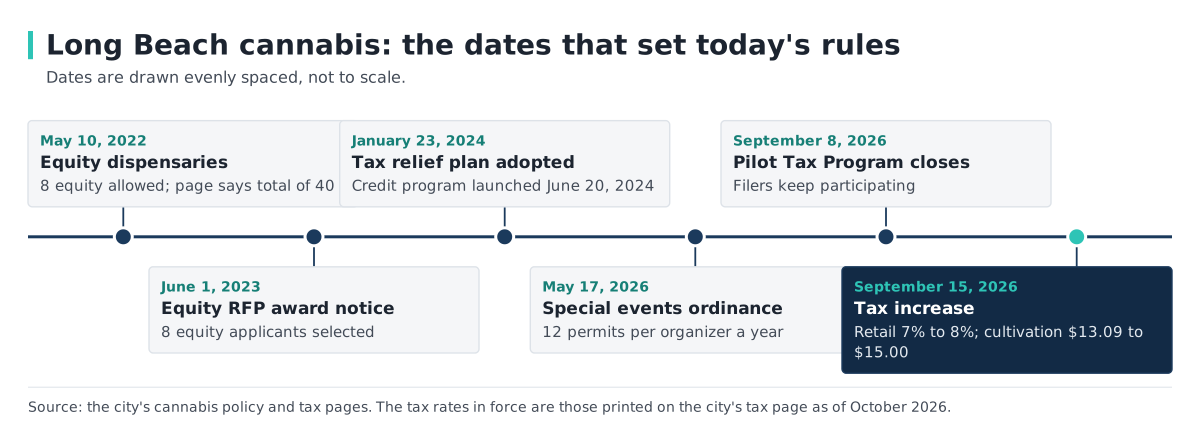
Long Beach licenses cannabis businesses through its Business License Division under Municipal Code Chapter 5.92, with adult-use and medical as separate licenses, and the city’s policy page says an amendment approved on May 10, 2022 allowed eight equity dispensaries, which “would bring the total number of dispensaries in the city to 40”. As of September 15, 2026 the adult-use retail tax rose from 7 percent to 8 percent of gross receipts.
- A dispensary may not be within 1,000 feet of another dispensary or within 600 feet of a school, day care, playground, community center or library4.
- The adult-use application fee page lists $5,881.00 for one owner, with four lines waived for equity businesses; the page is undated3.
- Cultivation tax rose from $13.09 to $15.00 per square foot on September 15, 2026; the minimum tax is $1,000 a year and the city does not accept credit cards5.
- An equity applicant must have family income at or below 80 percent of area median income and a net worth below $250,00010.
- The cannabis special events ordinance took effect May 17, 2026, with a cap of 12 permits per organizer per year6.
The rules sit in three places: the code, the Business License Division’s cannabis pages and the City Manager’s policy pages. This page is part of the sequence for starting a business in Long Beach. It follows the ordinance and the city’s pages only, as of October 2026, and says where a figure is undated or could not be confirmed.
The short answer
| If you are… | Do this |
|---|---|
| Applying for an adult-use cannabis business | Hold a city business license (tax paid), a Chapter 5.92 permit and a state license; the city accepts applications for cultivation, manufacturing, distribution, testing laboratory and shared-use manufacturing137 |
| Applying for a dispensary | Transfers only: the application page limits dispensary applications to current medical dispensary applicants and licensees “when transferring ownership”3 |
| Serving both medical and adult-use customers | Both licenses; “An adult-use cannabis license does not allow the business to serve the medical market”2 |
| An equity applicant | Equity status is verified in two steps, Economic Development then the Business License Division; contact [email protected]8 |
| Planning a cannabis event | A special event permit under Chapter 5.60 (public property) or an occasional event permit (private property), plus state event licenses11 |
Who licenses, and what a license needs
“The Business License Division within the Department of Financial Management licenses all cannabis businesses within the City of Long Beach.” A license covers cultivation, manufacture, distribution, delivery, testing, packaging, labeling and retail1. Chapter 5.92 names the types: dispensary (including delivery-only), cultivation, manufacturing, shared-use manufacturing, distribution and testing laboratory7.
The city’s application page lists the types it is currently accepting: cultivation, manufacturing, distribution, testing laboratory, shared-use manufacturing (principal), and dispensary, which “May be submitted only by current medical dispensary applicants and licensees when transferring ownership”3. Delivery-only businesses appear on the City Manager’s policy page as a policy initiative, and the page read for this article gives no current status6.
For adult-use, Chapter 5.92 requires a city business license tax paid, a permit under the chapter and a state license. “A permit may only be issued for a specific, fixed location within a secured, fully enclosed building”; permits run “for a period not to exceed five (5) years” with renewal and do not confer a vested right; one applicant is allowed per property address7.
How many dispensaries
The policy page says the City Council “approved an ordinance amendment on May 10, 2022, to allow eight (8) equity dispensaries in the City. This would bring the total number of dispensaries in the city to 40”. The 32 is the earlier group: the city’s 2018 FAQ refers to “thirty-two (32) medical cannabis dispensaries”613. The equity RFP produced a Notice of Intent to Award on June 1, 2023 “to select eight equity applicants”6.
Two limits apply to that count. The Chapter 5.92 text read for this page (Sections 5.92.010 to 5.92.360) states no numeric cap, so the 40 comes from the policy page rather than from a code section, and a numeric cap in the code text was not confirmed7. No current count of licensed dispensaries is given6.
Where a cannabis business can be
The location requirements page, citing Section 5.92.420, sets these buffers4:
| Use | Buffer |
|---|---|
| Dispensary | Not within 600 feet of a school, day care, playground, community center or library |
| Dispensary | Not within “An one thousand foot (1,000′) radius of any other Dispensary” |
| Dispensary | Not in a building with a dwelling, except PD-30 downtown ground floors |
| Other cannabis businesses | 1,000 feet from schools and public beaches; 600 feet from parks, libraries and day care |
| Youth centers | “zero-foot (0′) radius buffer” |
Source:4. Dispensaries may open “9:00 a.m. to 9:00 p.m.”; deliveries finish by 10:00 p.m.; the code requires 24-hour uniformed security patrols7. Planning’s fee schedule lists a Cannabis Business Zoning Consultation at $576.80 with the 12 percent surcharge as of October 202612.
Application fees
The city’s application-fee page for adult-use applications (new applications, major transfers of ownership and change of address) lists these amounts3.
| Fee | Amount | Marked as waived for equity |
|---|---|---|
| Adult-Use Cannabis Annual Regulatory Fee | $3,665.00 | Yes |
| Application Review Fee | $491.00 | Yes |
| Social Equity Program Fee | $1,545.00 | Yes |
| Background Investigation Fee | $138.00 per owner | Yes |
| Building Review Fee | $27.00 | Not marked |
| Zoning Review Fee | $33.00 | Not marked |
| Total, one owner (as printed) | $5,881.00 |
Source:3; the page carries no date. “*Fees marked with an asterisk are waived for Equity Businesses.” Medical applications are $212.55 for one owner and business manager, rising $155 for each additional one (two: $367.55; six: $987.55). A minor transfer of ownership is $260.00 and a modification of premises $121.00. Payment is “by check or cash”; “Credit cards will not be accepted”3.
Official pages disagree The page’s own lines add to $5,899.00 ($3,665 + $491 + $1,545 + $138 + $27 + $33), while its printed total for one owner is $5,881.003. The page is undated and gives no reason for the $18 gap. The equity page also says “All zoning, application, plan check, inspection and other applicable City fees are waived for Equity Businesses”, while the fee page marks only four lines as waived38.
The tax, and the September 2026 change
The city’s cannabis tax page says: “As of September 15, 2026, the City Council adopted an emergency and regular ordinance to increase the adult use cannabis retail tax rate from 7% to 8% of gross receipts and cannabis cultivation tax rate from $13.09 to $15.00 per square foot and sunsetting the Pilot Tax Program for all cannabis businesses”5.
| Business | Rate as of October 2026 |
|---|---|
| Adult-use retail | 8 percent of gross receipts |
| Medical retail | 6 percent |
| Manufacturing, distribution and testing | 1 percent |
| Cultivation | $15.00 per square foot |
| Minimum tax | $1,000 a year |
Source:5. “The City will NOT accept payments submitted with a credit card”5.
The Pilot Tax Program “will terminate as of September 8, 2026”, but eligible applicants who filed by that date “may continue participating in the program without interruption”5. An earlier relief plan, adopted on January 23, 2024, with a credit program that launched on June 20, 2024, offered up to “a combined 4 percent in tax relief” with a 2 percent minimum rate, tied to local hiring (40 percent Long Beach residents), wage floors (110 and 115 percent of the state minimum) and equity support6.
The equity program
Chapter 5.92 Division XI defines an equity applicant as a natural person with family income “at or below eighty percent (80%) … Area Median Income” and “a net worth below $250,000”, who has lived in a qualifying Long Beach census tract “for a minimum of five (5) years” (a tract where at least 51 percent of residents are at or below 80 percent of area median income), and who has, or has a parent, sibling or child with, a cannabis arrest, conviction or juvenile-court finding between 1971 and 2016. An equity business needs at least 51 percent equity-applicant ownership10.
The code’s assistance list (Section 5.92.1645) names “expedited Adult-Use Cannabis Business Permit application review; … application and compliance assistance; cultivation business license tax deferrals during the first year; expedited building plan check review; waivers of City permitting fees; and direct grants as provided by the State of California”10. Equity businesses may not transfer majority ownership to a non-equity applicant “for ten years after the issuance” of the license, absent a City Manager exception (Section 5.92.1655), and non-equity adult-use businesses must give equity employees at least 40 percent of annual work hours (Section 5.92.1660)10.
The city page adds that “Fee waivers (except for application fees), direct grants and direct technical assistance are made available through grant funding provided by the State of California. Grant funding will only be available until funds are exhausted”8. Direct grants come at four milestones from securing a location to opening, and the grant page’s own fee-waiver milestones (not Planning’s October 2026 fees) include $59.00 for building and zoning review, $4,713.00 for an Administrative Use Permit and $13,995.00 for a Conditional Use Permit; the city “reserves the right to adjust or change direct grant milestones and grant amounts at any time”9.
Cannabis special events
Chapter 5.92 Division XIII (ORD-26-0006) requires a special event permit under Chapter 5.60 for public property or an occasional event permit for private property, an Equity Plan with the application, and the state’s Cannabis Event Organizer and Temporary Cannabis Event licenses11. The policy page records “May 17, 2026 – The City’s Cannabis Special Events ordinance is now in effect”, with Council setting “twelve (12) as the maximum number of cannabis special event permits that may be issued to each cannabis event organizer per year”6. General event tiers and fees are in Special Event, Occasional Event and Film Permits in Long Beach.
Frequently Asked Questions
How many cannabis dispensaries are allowed in Long Beach?
How much is a cannabis business license in Long Beach?
The adult-use application-fee page lists $5,881.00 for one owner, with the regulatory, review, social equity and background fees waived for equity businesses; the page is undated3.
What is the cannabis tax in Long Beach?
As of September 15, 2026: 8 percent of gross receipts for adult-use retail, 6 percent for medical retail, 1 percent for manufacturing, distribution and testing, and $15.00 per square foot for cultivation, with a $1,000 annual minimum5.
Who qualifies for the cannabis equity program?
A natural person with family income at or below 80 percent of area median income, a net worth below $250,000, five years in a qualifying Long Beach census tract and a qualifying cannabis arrest or conviction in the family record10.
Can a cannabis dispensary be near a school?
Not within 600 feet of a school, day care, playground, community center or library, and not within 1,000 feet of another dispensary4.
Related Articles
Sources
- Cannabis Business Information — City of Long Beach, Financial Management. Accessed 2026-10-02.
- Adult-Use Cannabis Businesses — City of Long Beach, Financial Management. Accessed 2026-10-02.
- Application Fees — City of Long Beach, Financial Management. Accessed 2026-10-02.
- Cannabis Business Location Requirements — City of Long Beach, Financial Management. Accessed 2026-10-02.
- Cannabis Business License Taxes — City of Long Beach, Financial Management. Accessed 2026-10-02.
- New Policy Initiatives — City of Long Beach, City Manager. Accessed 2026-10-02.
- Long Beach Municipal Code, Chapter 5.92 Adult-Use Cannabis Business Activity — Municode. Accessed 2026-10-02.
- Open an Equity Business — City of Long Beach, City Manager. Accessed 2026-10-02.
- Direct Grants Program — City of Long Beach, City Manager. Accessed 2026-10-02.
- Long Beach Municipal Code, Section 5.92.1615 Equity Applicant Eligibility — Municode. Accessed 2026-10-02.
- Long Beach Municipal Code, Section 5.92.1820 Cannabis Special Event Permits — Municode. Accessed 2026-10-02.
- Planning Bureau Fee Schedule, revised October 1, 2026 (FY27 fees version) — City of Long Beach, Community Development. Accessed 2026-10-02.
- Cannabis Business Frequently Asked Questions — City of Long Beach, Financial Management (2018 FAQ). Accessed 2026-10-02.