In brief
Long Beach is one of the California cities with its own health department, so a food business here is permitted by the city’s Bureau of Environmental Health: plan check comes before construction, then inspections, then an annual permit priced by facility type, seats and risk. In the fee year that ended September 30, 2026, restaurant plan check ran $1,547 to $3,019 and the annual restaurant permit $880 to $2,176 by seats and risk, and the Bureau’s pages describe a posted inspection summary and a public closures list rather than letter grades.
- Plan check must be approved before a building permit issues for a food facility; the Bureau asks for three sets of plans at a quarter-inch scale3.
- The annual restaurant permit is $880 (0 to 10 seats, low risk) to $2,176 (401 or more seats, high risk); a reinspection is $437 and a late payment adds 25 percent4.
- The risk category sets the inspection frequency, and “the higher risk facilities will require additional inspections”4.
- The Bureau posts a closures list for the past 12 months; a facility stays closed until the condition is “corrected and verified by an Environmental Health Specialist”9.
- The council approved updated city fee schedules effective October 1, 2026; the Health Department’s page still links the FY26 mid-year schedule, and the city’s memo proposed an average increase of 39 percent. The figures here are the schedule in force through September 30, 2026567.
Every food path in Long Beach ends at the same department, and the department’s rules are scattered across a plan-check guide headed “REVISED 2003”, a fee schedule, an inspection brochure and a closures page. This page joins them: what plan check covers and costs, what each kind of permit costs, how inspections work, and what the public can see afterward. The restaurant sequence around it, including the building and fire steps, is in How to Open a Restaurant in Long Beach; the section pillar, How to Open a Food Business in Long Beach, compares every path.
The short answer
| If you are… | Do this |
|---|---|
| Building, remodeling or expanding a food facility | Get Health plan approval before the building permit; fee $1,547 to $3,019 for a restaurant234 |
| Taking over a closed or inactive facility | Submit plans; the Bureau lists “change of ownership for owners taking over inactive/closed facilities”2 |
| Replacing equipment or changing the menu in a way that needs equipment | Submit plans; a menu or equipment review is $7624 |
| Running a truck, cart or tricycle | Mobile permits and plan check by vehicle class; see Food Truck Permits in Long Beach |
| Cooking or baking from home | A MEHKO or cottage food registration; see Selling Meals From a Home Kitchen in Long Beach and Cottage Food in Long Beach |
Who issues the permit
The Department of Health and Human Services, Bureau of Environmental Health, permits retail food facilities (“restaurants, markets, bakeries, bars, cafeterias … coffee shops, and convenience stores”), temporary facilities, cottage food, mobile food, MEHKOs and plan check1. The Bureau is at 2525 Grand Avenue, Room 220, open Monday to Friday 8 a.m. to 4:30 p.m., (562) 570-4132, [email protected]1. An August 2026 city memo says it oversees “approximately 2,907 permitted food facilities” with “two plan reviewers”5.
Plan check
The Bureau reviews plans for restaurants, markets, bakeries, bars and taverns, school and hospital cafeterias, liquor and convenience stores, food trucks and carts, and cannabis businesses2. The page gives “examples of when a food facility owner may need to submit plans”: a new health permit, new construction, remodeling or expansion, new or replaced equipment, a change of ownership of an inactive facility, and menu changes that need equipment or structural changes2.
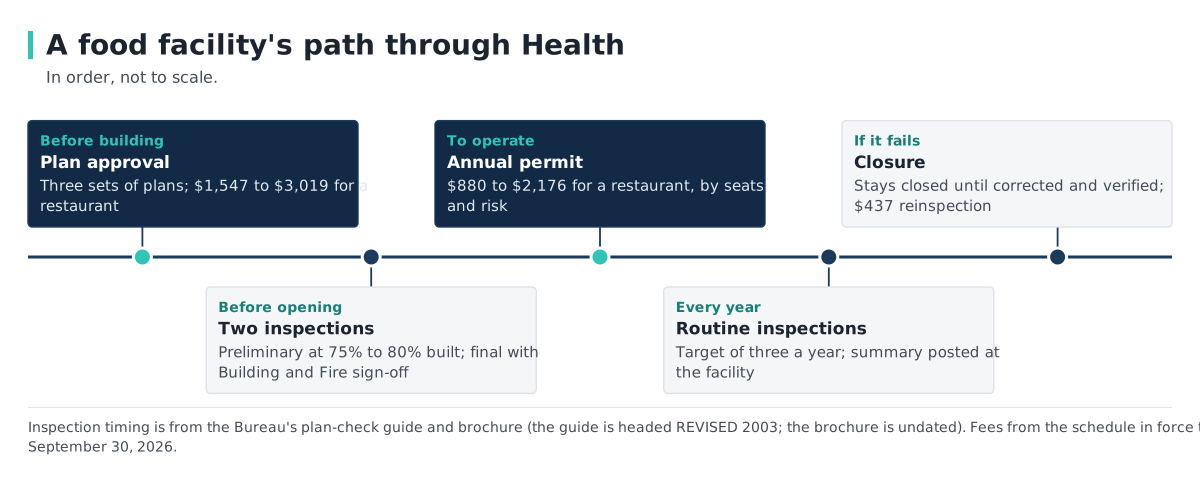
The Bureau’s guide (headed “REVISED 2003”) requires approval “before constructing, enlarging, altering, converting or remodeling any building for use as a food facility”, with “a minimum of (3) sets of detailed plans” at a “minimum scale of 1/4 inch = 1 ft”, and says “building permits for food facilities are not to be issued until plan approval has been obtained”3. It asks for a preliminary inspection when construction is “approximately 75% to 80% completed”, requested “no less than two weeks prior”, and the final inspection “no less than five (5) working days prior” to opening; final approval needs Building and Fire sign-off, working utilities and “a valid Public Health Permit prior to operating”3. The Bureau also posts construction guidelines for retail facilities, mobile facilities and commissaries, and guides on exhaust ventilation, water heater sizing and pest management2.
| Plan check | Fee |
|---|---|
| Restaurant, 0 to 60 seats | $1,547 (low risk); $1,931 (high risk) |
| Restaurant, 61 to 200 seats | $2,363; $2,598 |
| Restaurant, 201 or more seats | $2,742; $3,019 |
| Food market retail: 10 to 50; 51 to 1,999; 2,000 to 5,999; 6,000 or more sq ft | $822; $1,355; $1,755; $2,289 |
| Food processor or shared food facility: 1 to 1,999; 2,000 to 5,999; 6,000 or more sq ft | $1,926; $2,459; $2,811 |
| Commissary, prepackaged; unpackaged | $1,062; $1,382 |
| Shared kitchen | $1,974 per kitchen |
| Mobile facility: RC1; RC2-3; RC4 | $288; $512; $1,339 |
| Minor remodel; very limited remodel | 50 percent; 25 percent of the appropriate fee |
| Expedited review | Double the standard fee |
| Plan revision; menu or equipment review; after-hours inspection | $408; $76; $208 |
Source:4, the Health fee schedule stamped June 16, 2026, in the fee year that ended September 30, 2026. The schedule also lists a HACCP plan review at $160 for the first 1.5 hours and $81 an hour after that4.
The annual permit
A permit is annual and priced by facility type. Restaurants are priced by seats and risk category; the schedule’s heading says each is “categorized by risk category”, and that “the risk assessment will determine the inspection frequency based on the public health risk associated with the food products served and the method of food preparation of the food facility”4. The schedule does not say what puts a menu in category 1 or 2.
| Restaurant seats | Risk 1 (low) | Risk 2 (high) |
|---|---|---|
| 0 to 10 | $880 | $1,152 |
| 11 to 30 | $1,136 | $1,542 |
| 31 to 60 | $1,270 | $1,670 |
| 61 to 100 | $1,467 | $1,862 |
| 101 to 150 | $1,590 | $1,963 |
| 151 to 200 | $1,600 | $1,995 |
| 201 to 400 | $1,638 | $2,064 |
| 401 or more | $1,787 | $2,176 |
Source:4, fee year ending September 30, 2026. Other annual permits on the same schedule:
| Facility | Annual permit |
|---|---|
| Bar or tavern with limited food preparation, 0 to 30 seats | $838 (low); $1,371 (high) |
| Bar or tavern, 31 to 60 seats; 61 or more seats | $1,099 and $1,222 (low); $1,536 and $1,670 (high) |
| Caterer; host facility | $1,403; $645 |
| Food market retail, prepackaged, 25 to 50; 51 to 1,999 sq ft | $411; $816 |
| Food market retail with food preparation, 51 to 1,999; 2,000 to 5,999 sq ft | $1,371; $1,542 |
| Satellite or kiosk food facility: prepackaged; unpackaged, up to 100 sq ft | $500; $619 |
| Mobile food preparation vehicle; retail vehicle with no preparation | $1,051; $496 |
| Food service cart without plumbing; with plumbing | $325; $800 |
| Commissary for 0 to 10 mobile facilities | $992 |
| Cottage food Class A registration; Class B permit | $124; $380 |
| Microenterprise home kitchen (MEHKO) annual registration | $504.51 |
| Temporary food stand, one event: prepackaged; unpackaged | $84; $159 |
Source:4. A reinspection after uncorrected violations is $437, a late payment adds 25 percent of the permit fee, a repeat-violation fee is $187 per documented repeated violation, and adding a partner to a permit is $1304.
Where to check The council approved updated city fee schedules effective October 1, 2026. The Bureau’s page still links the FY26 schedule7, and the city’s fee-schedules page lists the October 1, 2026 schedules for Building, Electrical, Fire, Mechanical, Plumbing and impact fees but no Health schedule6. The city’s August 2026 memo proposed Health fee adjustments in which “no individual fee is increasing to over $100 per month, and the average increase across all adjusted fees is kept to 39 percent”, with temporary food, non-profit, school and senior-feeding fees exempt5. The figures here are the schedule in force through September 30, 2026; call the Bureau for the current figure before you budget.
Inspections
The Bureau’s inspection brochure, which is undated and still gives the city’s old web address, says the food inspection program has “a target frequency of three routine inspections per year for all food facilities, with an optimal goal of four per year”8. Inspectors stress food temperature control, employee practices, sanitation and “verification that at least one person per facility has been certified in safe food handling practices”8. The fee schedule, stamped June 2026, is the more recent document, and it says only that higher-risk facilities get additional inspections4. Mobile vehicles with plumbing are inspected twice a year, in February and August, and prepackaged-food vehicles once a year, in August10.
The brochure describes an Inspection Summary Report: after each routine inspection a summary is “posted at all city food facilities in a location clearly visible to the public”8. Each violation is placed in a category, including food handling, food temperature, food storage, food source and labeling, water supply and temperature, and utensil washing and sanitizing, and every facility needing corrective action gets a reinspection; when the violations are corrected, a transparent “corrective action completed” sticker goes over the categories and stays until the next routine inspection8. The brochure says the system dates from January 1999 and counts “over 2,000” facilities, against the 2,907 in the 2026 memo, so ask the Bureau whether the summary format is unchanged58.
Permitted mobile operators get a permit and a decal in a different color each year11.
Grades and closures
The city’s pages describe no letter grade and no numeric score. What the Bureau publishes is the posted summary at the facility and a closures page. That page lists facilities closed in the past 12 months, with the date closed, the date reopened and the reason; it says a facility “remain[s] closed until the condition resulting in the closure has been corrected and verified by an Environmental Health Specialist”9. The conditions the page says lead to a closure: sewage contamination, lack of potable water, no hot water, unsafe food temperatures, ill employees, vermin infestation, the absence of a valid and current Public Health Permit, and “any other condition that would prohibit the facility from operating in a safe manner”9. The page does not provide a searchable inspection database.
What it adds up to
For a 30-seat, low-risk restaurant in a new build-out, the Health charges in the fee year that ended September 30, 2026 were plan check at $1,547 and a first-year permit of $1,136, a total of $2,683, before the building, fire and license charges covered on the restaurant page4. At high risk, the same restaurant paid $1,931 and $1,542, a total of $3,4734. A reinspection adds $437 each time4.
Frequently Asked Questions
Does Long Beach have its own health department for restaurants?
Yes. The Bureau of Environmental Health permits restaurants, markets, bakeries, bars, coffee shops and other retail food facilities, and runs plan check1.
How much is a restaurant health permit in Long Beach?
In the fee year that ended September 30, 2026, $880 to $2,176 a year, depending on seats and risk category4.
When is plan check required?
Plan check may be needed for a new health permit, new construction or remodeling, new or replaced equipment, a change of ownership of an inactive facility, and menu changes that need equipment or structural changes; the Bureau’s page gives these as “examples of when a food facility owner may need to submit plans”2.
Does Long Beach give restaurants letter grades?
How often are food facilities inspected?
What closes a food facility in Long Beach?
Conditions such as sewage contamination, no potable or hot water, unsafe food temperatures, ill employees, vermin infestation or no valid Public Health Permit; it reopens after an Environmental Health Specialist verifies the correction9.
Did the fees change in October 2026?
The council approved updated city fee schedules effective October 1, 20266. The Health Department’s page still links the FY26 mid-year schedule7, and the city’s memo proposed an average increase of 39 percent across adjusted Health fees5; the figures here are the schedule in force through September 30, 2026.
Related Articles
Sources
- Food Safety Program — City of Long Beach, Bureau of Environmental Health. Accessed 2026-10-01.
- Plan Check — City of Long Beach, Bureau of Environmental Health. Accessed 2026-10-01.
- Food Facility Plan Check Guide — City of Long Beach, Bureau of Environmental Health. Accessed 2026-10-01.
- Environmental Health fees and charges, FY26 mid-year schedule (June 16, 2026) — City of Long Beach, Health and Human Services. Accessed 2026-10-01.
- Memo: Processes and Fees for Food Safety Program, August 25, 2026 — City of Long Beach, City Manager. Accessed 2026-10-01.
- Fee Schedules — City of Long Beach, Community Development. Accessed 2026-10-01.
- Bureau of Environmental Health — City of Long Beach, Health and Human Services. Accessed 2026-10-01.
- Food Inspection Program brochure — City of Long Beach, Bureau of Environmental Health. Accessed 2026-10-01.
- Restaurant Closures — City of Long Beach, Bureau of Environmental Health. Accessed 2026-10-01.
- Mobile Food Facility — City of Long Beach, Bureau of Environmental Health. Accessed 2026-10-01.
- Unpermitted Food Vendors — City of Long Beach, Bureau of Environmental Health. Accessed 2026-10-01.