In brief
Long Beach has no separate café permit: the Health Department lists “coffee shops” as retail food facilities, so a café goes through the same plan check, health permit and business license as a restaurant, and the savings come from size, not from fewer steps. In the fee year that ended September 30, 2026, a café of ten seats or fewer paid $880 a year for the health permit at low risk ($1,152 at high risk) and $1,547 for plan check ($1,931 at high risk), which covers anything up to 60 seats.
- The annual health permit is priced by seats and risk category: $880 to $1,152 for 0 to 10 seats, $1,136 to $1,542 for 11 to 30, $1,270 to $1,670 for 31 to 603.
- Plan check is one price from 0 to 60 seats, so a 12-seat café pays the same as a 60-seat one; a minor remodel pays half3.
- A café without a drive-through is permitted by right in the city’s eight commercial districts; a drive-through needs a conditional use permit in six of them and is prohibited in two4.
- The business license for a storefront starts at $488.81 plus a per-employee charge5. The city says “In most cases a license can be issued upon receipt of the application and payment”; where inspections or investigations are required first, “this takes two weeks or less” for most businesses, and some take longer and may need City Council approval6.
- The council approved updated city fee schedules effective October 1, 2026; the Health Department’s page still links the FY26 mid-year schedule, and the city’s memo proposed an average increase of 39 percent. Every Health figure here is the schedule in force through September 30, 2026378.
The city’s rules for a coffee shop do not change with the size of the menu, only with its seats, its risk category and whether it cooks or only pours and reheats. This page lays out which of the restaurant path’s steps a café repeats, which prices drop at small sizes, and where the lighter options (prepackaged-only shops, kiosks, carts) sit. The full ten-step sequence, with every department’s wait, is in How to Open a Restaurant in Long Beach; the section pillar, How to Open a Food Business in Long Beach, compares all the food paths.
The short answer
| If you are… | Do this |
|---|---|
| Opening a counter-service café with up to 10 seats | Plan check $1,547 (low risk) or $1,931 (high), then a health permit of $880 or $1,152 a year; Health assigns the risk category from your menu3 |
| Taking over an existing café or restaurant space | Plan check is still required for “change of ownership for owners taking over inactive/closed facilities” and for new or replaced equipment2 |
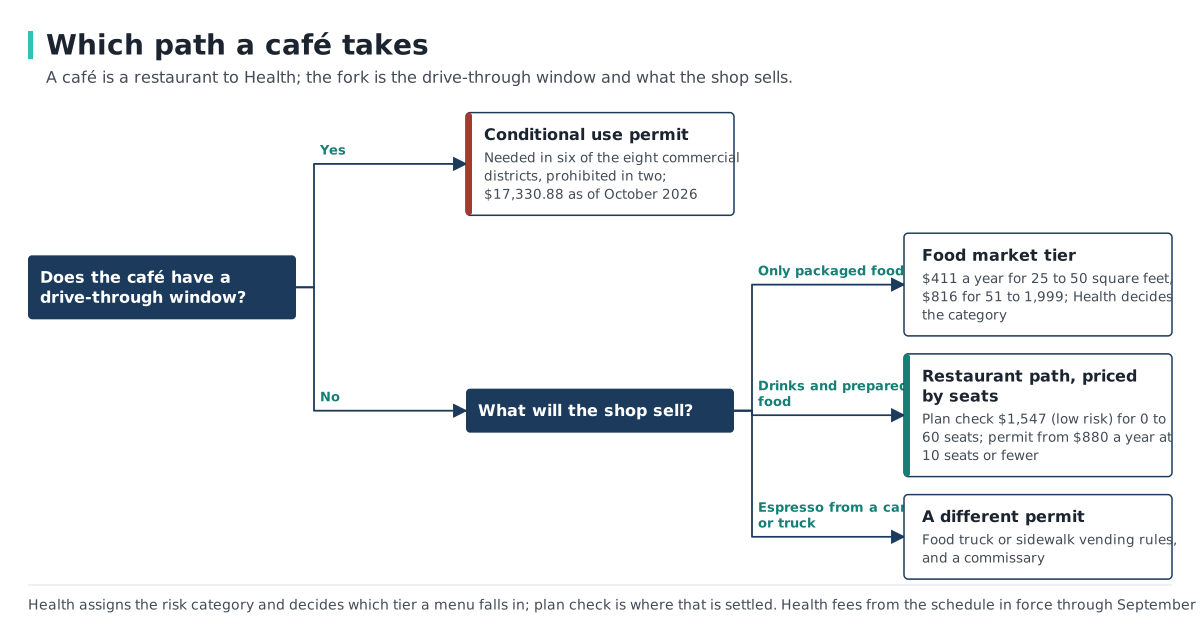
| Adding a drive-through window | Plan on a conditional use permit; see Conditional Use Permits in Long Beach4 |
| Selling only prepackaged food, no preparation | Ask Health about the Food Market Retail tier: $411 a year for 25 to 50 square feet, $816 for 51 to 1,9993 |
| Running espresso from a cart or truck | A different permit and a commissary; see Food Truck Permits in Long Beach and Sidewalk Vending in Long Beach |
A café is a restaurant to the city's Health Department
The Bureau of Environmental Health’s food-safety page defines retail food facilities as “restaurants, markets, bakeries, bars, cafeterias … coffee shops, and convenience stores”1. The Bureau is at 2525 Grand Avenue, Room 220, open Monday to Friday 8 a.m. to 4:30 p.m., (562) 570-41321.
Plan check may apply when a food facility requests a health permit, builds or remodels, installs or replaces equipment, or changes ownership of a closed facility; the Bureau’s page gives “examples of when a food facility owner may need to submit plans”. Those examples include “menu changes that result in equipment or structural modifications”, which matters for a café that starts with drinks and later adds a griddle2. The Bureau’s guide requires approval “before constructing, enlarging, altering, converting or remodeling any building for use as a food facility”, and “building permits for food facilities are not to be issued until plan approval has been obtained”9.
That sentence fixes the order: Health plan check, then the building permit, then inspections, then the health permit to operate, then the license. The restaurant page walks through each of those; a café repeats them all.
What changes at café size
Three prices are tied to size or type, and each one favors a small café.
The annual health permit. The schedule prices restaurants by seat count and by risk category, and a coffee shop is permitted as one13:
| Seats | Risk 1 (low) | Risk 2 (high) |
|---|---|---|
| 0 to 10 | $880 | $1,152 |
| 11 to 30 | $1,136 | $1,542 |
| 31 to 60 | $1,270 | $1,670 |
| 61 to 100 | $1,467 | $1,862 |
Source:3, fee year ending September 30, 2026. A reinspection costs $437 and a late payment adds 25 percent3.
Plan check. The restaurant plan-check fee is $1,547 (low risk) or $1,931 (high risk) for 0 to 60 seats, $2,363 or $2,598 for 61 to 200 seats. A minor remodel pays 50 percent of the fee and a “very limited” remodel 25 percent; expedited review doubles it, a plan revision is $408 and a menu or equipment review $763. The schedule does not define what makes a menu low or high risk, and Health assigns the category; the schedule does not say which applies.
The prepackaged-only tier. A shop that sells only packaged food and does no preparation is priced as a food market: an annual permit of $411 for 25 to 50 square feet, $816 for 51 to 1,999 square feet, and a plan check of $822 (10 to 50 square feet) or $1,355 (51 to 1,999 square feet)3. The same schedule prices food markets with food preparation at $1,371 a year for 51 to 1,999 square feet. Which category applies to a particular menu is Health’s call, and the plan check is where that gets decided.
The schedule also lists satellite or kiosk food facilities, with annual permits of $500 for prepackaged food and $619 for unpackaged food in up to 100 square feet ($715 above that)3. Its plan-check heading groups “satellite facility/kiosk” with restaurants, so ask Health whether the restaurant plan-check fee applies to a kiosk3.
Good to know The Bureau’s plan-check guide is headed “REVISED 2003”, and an August 2026 city memo says the Bureau oversees “approximately 2,907 permitted food facilities” with “two plan reviewers”79.
Zoning, drive-throughs and the lease
Before the lease, the zoning question is the same as for a restaurant. In the code’s commercial-district use table, a restaurant without a drive-through is permitted in all eight neighborhood, community and regional commercial districts; a drive-through needs a conditional use permit in six and is prohibited in two4. The Planning Bureau’s conditional use permit fee is $17,330.88 with surcharge ($15,474.00 base) as of October 202610. At that price, a drive-through coffee kiosk is a different project from a walk-in café, and the guide to the permit is Conditional Use Permits in Long Beach.
A walk-in café skips the entitlement step. Alcohol, if you add wine or beer later, brings the entitlement back; that is covered on the restaurant page.
The license and the timing
The business license comes last, after the final building inspection or certificate of occupancy. Its tax depends on the classification the Business License Division assigns. The 2026-27 table (July 1, 2026 to June 30, 2027) puts a retail storefront at $488.81 plus $12.66 per employee, and a services classification at $488.81 plus $25.36 per employee5. The full table, with the per-employee rule and penalties, is in What a Long Beach Business License Costs.
The Business License Division’s page says “In most cases a license can be issued upon receipt of the application and payment”; where inspections or investigations are required before it issues, “this takes two weeks or less” for most businesses, and some take longer and may need City Council approval6. The code lets the city issue a conditional license valid up to “one hundred eighty (180) days” while departments finish their reviews11.
The steps, in order
- Check the zoning and the building’s permit history before you sign. Planning’s line is (562) 570-6194; the restaurant page explains what each answer costs.
- Form the entity and get the state papers: an LLC’s articles, the EIN, a seller’s permit and, if the café’s name omits your surname, a fictitious business name. The restaurant page lists the fees and the county publication rule.
- Submit plans to Health for approval: three sets of detailed plans at a minimum scale of 1/4 inch to 1 foot9.
- Pull building and fire permits at the Permit Center, 411 West Ocean Boulevard, with Health’s approved plans.
- Book the preliminary and final health inspections: the preliminary when construction is “approximately 75% to 80% completed”, at least two weeks ahead, and the final “no less than five (5) working days prior” to opening9.
- Get the certificate of occupancy for any new building or major remodel; it must precede Health’s approval9. See Certificate of Occupancy and Change of Use in Long Beach.
- Pay for the health permit and file for the business license.
What a small café adds up to
For a 24-seat café in a space that was already a food business, with a low-risk menu, the city’s one-time health charge is plan check at $1,547 (half that for a minor remodel), and the recurring charges are the health permit at $1,136 a year and the license at $488.81 plus $12.66 or $25.36 for each employee (the owner of a sole proprietorship is not counted)35. A high-risk menu moves the plan check to $1,931 and the permit to $1,5423. The building and fire permit fees are not in these figures: both schedules were replaced on October 1, 2026, and the Permit Center gives the amounts for a specific project8.
Those city charges are the knowable part. The private costs the city does not set (the lease deposit, the espresso equipment, the general liability insurance a landlord asks for, the point-of-sale system) usually exceed them; the city’s numbers are the part you can fix before signing. The site earns a commission on some links to business services, which does not affect what is recommended.
Frequently Asked Questions
Do I need a different permit for a coffee shop than for a restaurant in Long Beach?
How much is the health permit for a small café in Long Beach?
In the fee year that ended September 30, 2026, $880 a year at low risk or $1,152 at high risk for 10 seats or fewer, and $1,136 or $1,542 for 11 to 30 seats3.
How much does plan check cost for a café?
$1,547 at low risk or $1,931 at high risk for 0 to 60 seats; a minor remodel pays half3.
Do I need a conditional use permit for a coffee shop?
Not for a walk-in café in a commercial district, where a restaurant without a drive-through is permitted by right. A drive-through needs one in six of the eight commercial districts4.
Can I open a coffee cart or kiosk instead?
Carts and trucks have their own permits. A kiosk is listed on the Health fee schedule as a satellite or kiosk food facility, with annual permits from $500 to $715 depending on food type and size3.
How long does the business license take?
The city says “In most cases a license can be issued upon receipt of the application and payment”; where inspections or investigations are required first, “this takes two weeks or less” for most businesses, and some may need City Council approval6.
Will these Health fees change?
Related Articles
Sources
- Food Safety Program — City of Long Beach, Bureau of Environmental Health. Accessed 2026-10-01.
- Plan Check — City of Long Beach, Bureau of Environmental Health. Accessed 2026-10-01.
- Environmental Health fees and charges, FY26 mid-year schedule (June 16, 2026) — City of Long Beach, Health and Human Services. Accessed 2026-10-01.
- Long Beach Municipal Code, Chapter 21.32 Commercial Districts (Table 32-1) — Municode. Accessed 2026-10-01.
- Business License Rates Effective July 1, 2026 – June 30, 2027 — City of Long Beach, Financial Management. Accessed 2026-10-01.
- Business License Application Instructions — City of Long Beach. Accessed 2026-10-01.
- Memo: Processes and Fees for Food Safety Program, August 25, 2026 — City of Long Beach, City Manager. Accessed 2026-10-01.
- Fee Schedules — City of Long Beach, Community Development. Accessed 2026-10-01.
- Food Facility Plan Check Guide — City of Long Beach, Bureau of Environmental Health. Accessed 2026-10-01.
- Planning Bureau Fee Schedule, revised October 1, 2026 (FY27 fees version) — City of Long Beach, Community Development. Accessed 2026-09-30.
- Long Beach Municipal Code, Chapter 3.80 Business License Tax — Municode. Accessed 2026-10-01.