In brief
The Mills Act in Long Beach is a property tax relief contract for a designated historic property, a property in a historic district or one eligible to become a landmark, with a “minimum 10-year-term”. The city’s page states: “The 2026 Application submittal period has closed. Next year’s application period will open early January 2027”. The Planning fee schedule in force from October 1, 2026 lists a Mills Act Application at $3,239 base, $3,627.68 with surcharge, while the program page gives $1,026.75 for 2026 and states no 2027 fee.
- Eligible: a property in a historic district, a designated landmark, or one “eligible to become a designated Historic Landmark”1.
- The contract “automatically renews each year on its anniversary date” and “transfer[s] to the new owners if a property is sold”1.
- The city’s page cites an average reduction “between 30% to 50% for new property owners”; owners of more than 10 years “are less likely to see any tax reduction”1.
- The 2026 processing fee was $1,026.75, due by 3 p.m. on March 20, 2026; the 2027 fee is not stated on the Mills Act page1.
- The state’s Office of Historic Preservation “is not a signatory” to a local contract4.
A Mills Act contract trades a long maintenance commitment for property tax relief, and in Long Beach it comes with one application window a year. This page covers who is eligible, when the window opens, what the city’s fee schedule lists as of October 2026 and how the ten-year contract runs. It does not estimate a tax saving. The page belongs to the permits section, whose pillar is Permits in Long Beach; the review that historic properties need before exterior work is in Is My Property in a Long Beach Historic District?.
The short answer
| If you are… | What the city’s page says |
|---|---|
| Wanting to apply in 2026 | “The 2026 Application submittal period has closed”1 |
| Planning for the next window | It “will open early January 2027”; the page gives no exact dates1 |
| Owning a property in a district, a landmark, or a landmark-eligible property | You meet the eligibility test1 |
| A new owner | The page cites an average reduction “between 30% to 50% for new property owners”1 |
| An owner of more than 10 years | The page says such owners “are less likely to see any tax reduction”1 |
| Selling a property under contract | The contract “transfer[s] to the new owners if a property is sold”1 |
What the program is
The city describes the Mills Act as “property tax relief, in exchange for property owners’ commitment to undertaking restoration, rehabilitation or maintenance of a designated historic property pursuant to the terms of a Mills Act contract”. Its examples of projects are foundation repairs, removing knob-and-tube wiring, sewer replacement, repainting, roof repairs and removing non-period alterations1.
The state’s Office of Historic Preservation “is not a signatory”, and each locality sets its own limits4.
Who qualifies
The page’s test: the property is in Long Beach and is in a historic district, is a designated landmark, “Or eligible to become a designated Historic Landmark”1. The city lists 18 designated historic districts and counts “over 150” landmarks56.
The district list, with ordinance dates, is in Is My Property in a Long Beach Historic District?. To check an address, the city points to its Historic Districts & Landmarks map5.
The Planning fee schedule carries a “Request for Designation of a Historic Landmark” line at $4,069 base, $4,557.28 with surcharge, as of October 2026, and a “Mills Act/Landmark Combination Request” line, “100% of the largest fee and 50% of other fees”2. The Mills Act page does not connect those two lines to its eligibility test, so this page does not describe how they apply together.
The January application window
The city’s page states: “The 2026 Application submittal period has closed. Next year’s application period will open early January 2027.” No exact opening date or closing date for 2027 appears on the page1.
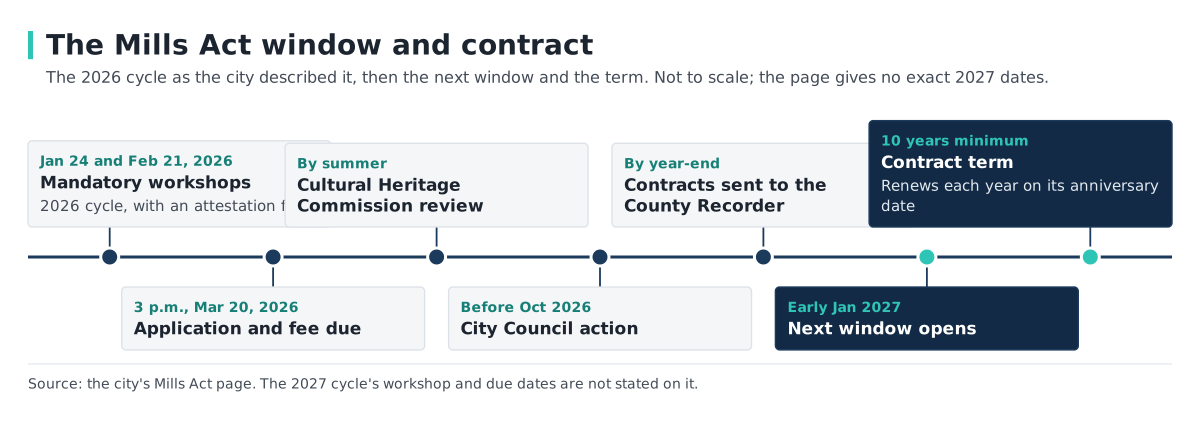
The 2026 cycle shows the shape the city has used1:
| Stage | 2026 cycle, as the page described it |
|---|---|
| Pre-application workshops | Two mandatory workshops, January 24 and February 21, 2026, with an attestation form |
| Application and fee due | By 3 p.m., Friday, March 20, 2026 |
| Cultural Heritage Commission | Review by summer |
| City Council | Action “before October 2026” |
| County Recorder | Contracts sent by year-end |
Source:1. The page gives no 2027 schedule; the table shows the 2026 sequence only.
The fee
The 2026 processing fee, on the Mills Act page, was a “non-refundable processing fee of $1,026.75”1.
The Planning Bureau fee schedule, revised October 1, 2026 and marked “FY27 fees version”, lists these Mills Act lines. The schedule adds a 12.0% surcharge and says “Fee with surcharge applies”2:
| Fee line | Base fee | With 12% surcharge |
|---|---|---|
| Mills Act Pre-Application | $959.00 | $1,074.08 |
| Mills Act Application | $3,239.00 | $3,627.68 |
| Mills Act Inspection | $1,500.00 | $1,680.00 |
| Mills Act, Additional Deed (per signature) | $75.00 | $84.00 |
Fees as of October 2026. Source:2. The city’s fee page confirms the new schedule took effect on October 1, 20263.
The schedule says a project’s fees are “based on the fee schedule in effect at the time the application submittal is completed”, and that the fiscal year begins on October 12. The Mills Act page does not say which fee a January 2027 submittal will pay.
Official pages disagree The Mills Act page gives the 2026 processing fee as $1,026.751. The fee schedule that took effect October 1, 2026 lists a Mills Act Application at $3,239 base, $3,627.68 with surcharge2. The Mills Act page states no 2027 fee and does not say whether the schedule’s line replaces the 2026 figure. Planning, at 562.570.6194, is the office the schedule names for fee questions.
The ten-year contract
“Mills Act contracts are for a minimum 10-year-term.” The contract “automatically renews each year on its anniversary date”, so the remaining term is always the full length. The contract “transfer[s] to the new owners if a property is sold”1.
A contract holder reports each year by email to [email protected]1. The Planning schedule lists a Mills Act Inspection at $1,500 base, $1,680 with surcharge, as of October 20262.
What the savings claim says
The page states a “Possible reduction in property taxes”, with “average between 30% to 50% for new property owners”. Owners of more than 10 years “are less likely to see any tax reduction”1. The page poses the question “Will I see a substantial reduction in property taxes?” and gives the figures above as its answer.
Where the Mills Act meets other rules
A contract property is still an old building under every other rule. Exterior work in a district needs a Certificate of Appropriateness; work without a permit is covered in Legalizing Unpermitted Work in Long Beach, and the thresholds for a permit are in What Needs a Building Permit in Long Beach, and What Is Exempt.
Frequently Asked Questions
What is the Mills Act?
When is the Mills Act application due in Long Beach?
The 2026 window has closed; its applications were due by 3 p.m. on March 20, 2026. The next window “will open early January 2027”1.
How long is a Mills Act contract?
A “minimum 10-year-term”, renewing automatically each year on its anniversary date1.
How do I know if my property is eligible?
Will I see a substantial reduction in property taxes?
The page cites an average reduction “between 30% to 50% for new property owners”, and says owners of more than 10 years “are less likely to see any tax reduction”1.
How much does the application cost?
Where do I turn in annual reporting?
By email to [email protected]1.
Related Articles
Sources
- Mills Act Property Tax Abatement Program — City of Long Beach, Community Development. Accessed 2026-10-02.
- Planning Bureau Fee Schedule, fees effective October 1, 2026 — City of Long Beach, Community Development. Accessed 2026-10-02.
- Fee Schedule Information for October 1, 2026 — City of Long Beach, Community Development. Accessed 2026-10-02.
- Mills Act Program — California Office of Historic Preservation. Accessed 2026-09-30.
- Historic Districts — City of Long Beach, Community Development. Accessed 2026-09-30.
- Historic Landmarks — City of Long Beach, Community Development. Accessed 2026-09-30.