In brief
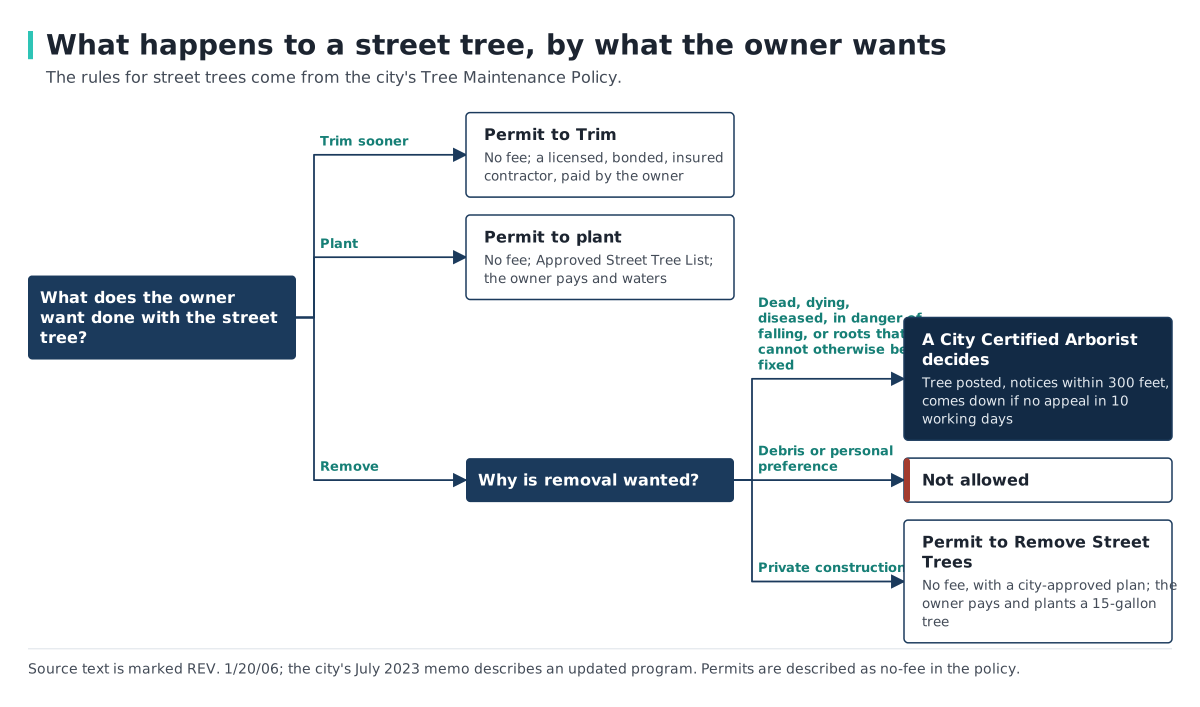
Removal of a street tree in a Long Beach parkway is governed by the city’s Tree Maintenance Policy, which says that in general the city will only remove it, or allow removal, when it is “dead, dying, diseased, uprooted, damaged and in danger of falling”, or when root-damaged sidewalk and curb “cannot otherwise be safely corrected”. Permits to trim, plant and remove are described as no-fee.
- Public Works “cares for approximately 94,000 City public trees, and trims roughly 20,000 trees each year”1.
- The policy “will not allow removal of a tree solely because of leaf, flower, berry debris, or personal preference”; a City Certified Arborist decides and the tree is posted for appeal2.
- If a private tree damages a sidewalk, the policy makes repair “the responsibility of the abutting property owner”, after a Street Improvement Permit from the Engineering Bureau2.
- The policy PDF is marked “REV. 1/20/06”; a July 2023 memo describes a replacement program of about one tree for each tree removed, “subject to feasibility”25.
- Sidewalk reports start an inspection, then “grinding or asphalt patching”; replacement waits for a roadway or ADA project3.
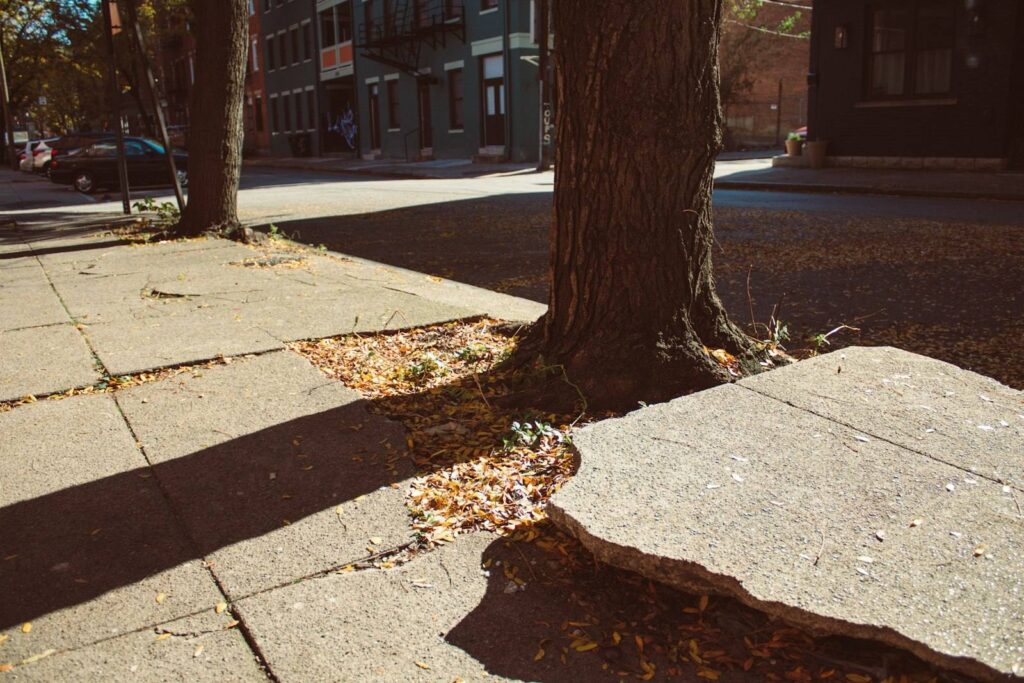
The strip between the curb and the sidewalk looks like part of the front yard, and the tree in it is not. The city treats it as public property with its own permit rules, and a separate set of rules decides who pays when roots lift the pavement. This page sets out what the city’s pages say about both, in the order an owner meets them. It belongs to the permits section, whose pillar is Permits in Long Beach.
The short answer
| If you are… | Do this |
|---|---|
| Wanting a street tree trimmed sooner than Public Works gets to it | Take out a no-fee Permit to Trim and pay a licensed, bonded, insured contractor2 |
| Wanting to plant on the parkway in front of the property | A permit is required, issued “on a no-fee permit basis”; the tree must be on the Approved Street Tree List and the owner pays and waters2 |
| Wanting a street tree removed because it is dead, diseased or dangerous | A City Certified Arborist decides; the tree is posted and neighbors within 300 feet are notified2 |
| Wanting a street tree removed for leaf, flower or berry debris, or preference | The policy does not allow it2 |
| Removing a street tree for a private construction project | A no-fee Permit to Remove Street Trees, with a city-approved plan; the owner pays for removal and replacement2 |
| Seeing a lifted or cracked sidewalk | Report it through the Go Long Beach app or (562) 570-2700, option 23 |
What the city says it maintains
Public Works “cares for approximately 94,000 City public trees, and trims roughly 20,000 trees each year.” Applications for planting and trimming permits go by email to [email protected]. To report a tree, call (562) 570-2700, option 4, or use the Go Long Beach app1.
The rules sit in the Tree Maintenance Policy, which administers Chapter 14.28 of the municipal code2.
Good to know The Tree Maintenance Policy PDF is marked “REV. 1/20/06”, which dates the text to January 2006. A City Manager memo of July 24, 2023 describes an updated tree maintenance program and a street tree replacement program, and the city’s pages do not say which sentences of the 2006 policy the memo replaced25. The policy’s distances, time limits and the $75 figure are as printed in the text marked 2006.
Trimming and planting
Public Works trims the city’s street trees. An owner who wants a faster trim may take out a no-fee Permit to Trim and pay for a licensed, bonded, insured contractor2. Checking a contractor’s license is covered in Checking a Contractor in Long Beach.
An owner who wants to plant on the adjacent parkway “shall obtain a permit”, issued “on a no-fee permit basis”. The owner bears all costs and must water the tree. The tree must be on the city’s Approved Street Tree List, and the policy sets minimum spacing2:
| Rule | Distance |
|---|---|
| From another tree | No closer than 25 feet |
| From a utility pole | No closer than 15 feet |
| From a fire hydrant or meter | No closer than 5 feet |
| Planting strip width | None in a strip under 30 inches wide |
Source:2, policy marked “REV. 1/20/06”.
The Office of Climate Action and Sustainability offers a free parkway tree on request, according to the 2023 memo5.
When a street tree can come out
The policy’s rule is short: “In general, the City will only remove or allow removal of a street tree if it is dead, dying, diseased, uprooted, damaged and in danger of falling, or where tree root-damaged sidewalks and curbing cannot otherwise be safely corrected.” The policy also says: “The City will not allow removal of a tree solely because of leaf, flower, berry debris, or personal preference”2.
The process the policy describes:
- A City Certified Arborist decides. The decision is the city’s, not the owner’s2.
- The tree is posted and notices go out. Notices go to owners within 300 feet2.
- The appeal window runs. The tree comes down if no appeal is filed “within 10 working days”2.
Removal for private construction
A separate permit covers the case where the owner is building. The policy describes a no-fee Permit to Remove Street Trees, available with a city-approved plan showing that the tree directly affects the project. The owner then carries the cost of the removal, repairs any damage to hardscape, and replaces the tree with an approved 15-gallon tree. The owner also pays “the equivalent of one (1) 15-gallon tree (approximate cost: $75)”, for a tree planted elsewhere; the $75 is the figure printed in the policy text marked 2006. A contractor, a bond and notices apply2.
What needs a building permit is in What Needs a Building Permit in Long Beach, and What Is Exempt.
What the city replaces
The July 2023 memo gives the scale: Public Works removes about 1,000 to 1,100 street trees a year, about 300 on capital projects and 700 to 800 on maintenance. It states a commitment to one-to-one replacement “subject to feasibility”. In the Coastal Zone, trimming and removal follow a nesting-survey regime with October to September windows and surveys within 300 feet5. Whether a property is in that zone is in Is My Property in the Long Beach Coastal Zone?.
Who repairs the sidewalk
The tree policy answers one version of the question. “If a private tree, shrub or other plant material causes damage to public property including sidewalks, curbs, gutters, streets and alleys, repair of damaged areas is the responsibility of the abutting property owner.” The owner must obtain a Street Improvement Permit from the Engineering Bureau before the repair2.
For damage from a city tree, the policy says the city “may require a temporary asphalt ramp”, followed by permanent repair “as funds become available”2.
Where to check The owner’s duty for sidewalk damage that tree roots did not cause is not stated in the city pages read for this page. The Public Works sidewalk page and the August 24, 2026 memo describe city programs for maintenance, rehabilitation and ADA work, and in the parts read neither states a general owner-repair rule34. Public Works, at (562) 570-2700, option 2, is the office the sidewalk page names for sidewalk reports.
The city's sidewalk program
The city describes more than 1,200 miles of sidewalk and 12,000 curb ramps. A report, through Go Long Beach or (562) 570-2700, option 2, leads to an inspection, and the usual response is “grinding or asphalt patching”. Full replacement is deferred to a roadway or ADA project3.
The page gives the scale of the backlog. The city’s ADA plan found about “$631 million” in needs, and “only about 6% of measured sidewalk lifts exceeded one inch”3. The August 24, 2026 memo adds that a 2017 settlement requires about 4,500 new curb ramps and $125 million for other non-compliant facilities over 30 years, and describes funding for an in-house Concrete Crew4.
The sidewalk page’s own questions include “Why doesn’t every sidewalk get replaced or on a request basis?” and “How does the City prioritize improvements?”3.
Where a sidewalk or tree problem meets other rules
The fence rules are covered in Fences and Walls in Long Beach: Permit vs. Zoning. A Code Enforcement case is a different track, described in Code Enforcement in Long Beach.
Frequently Asked Questions
Do I need a permit to remove a parkway tree in Long Beach?
The policy says that in general the city removes a street tree, or allows removal, only in the listed cases, and for removal tied to private construction it describes a no-fee Permit to Remove Street Trees with a city-approved plan2.
Can I remove a street tree because of leaves, berries or flowers?
No. The policy states the city “will not allow removal of a tree solely because of leaf, flower, berry debris, or personal preference”2.
Who is responsible for a sidewalk damaged by a tree?
For a private tree, the policy makes the abutting property owner responsible, after a Street Improvement Permit from the Engineering Bureau. For a city tree, it describes a temporary asphalt ramp and permanent repair “as funds become available”2.
How do I report a damaged sidewalk?
Through the Go Long Beach app or at (562) 570-2700, option 2. The response is an inspection, then “grinding or asphalt patching”3.
How many street trees does the city have?
Public Works cares for approximately 94,000 city public trees and trims roughly 20,000 each year1.
Does the city replace a street tree that is removed?
A July 2023 memo states a commitment to one-to-one replacement “subject to feasibility”, and says the Office of Climate Action and Sustainability offers a free parkway tree on request5.
Is the tree policy current?
Related Articles
Sources
- Public Trees — City of Long Beach, Public Works. Accessed 2026-10-02.
- Tree Maintenance Policy (marked REV. 1/20/06) — City of Long Beach, Public Works. Accessed 2026-10-02.
- Sidewalks — City of Long Beach, Public Works. Accessed 2026-10-02.
- Public Sidewalk Maintenance and Improvement Programs, memo of August 24, 2026 — City of Long Beach, City Manager. Accessed 2026-10-02.
- Citywide Street Tree Replacement Program and Updated Tree Maintenance Program, memo of July 24, 2023 — City of Long Beach, City Manager. Accessed 2026-10-02.