In brief
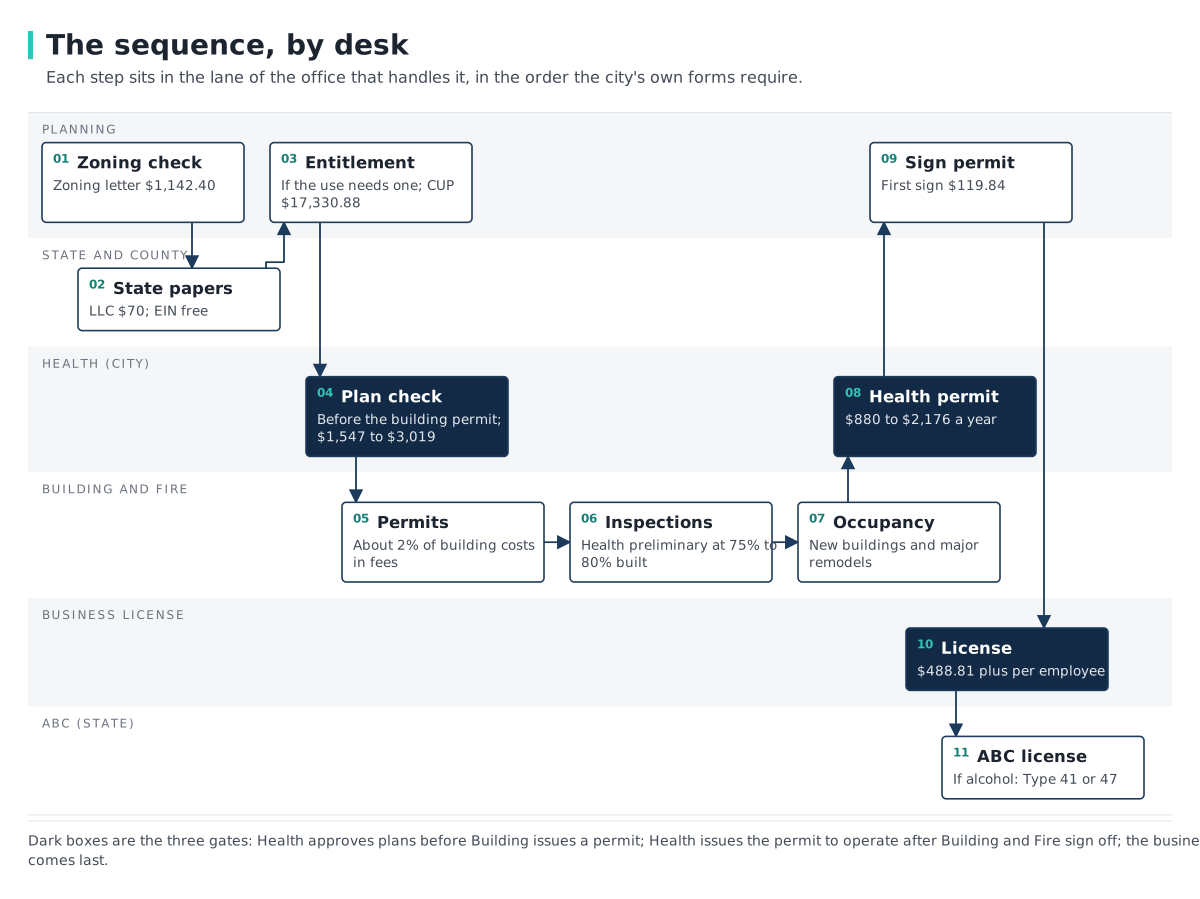
Opening a restaurant in Long Beach runs through four city departments in a fixed order: Planning confirms the zoning before you sign a lease, the city’s own Health Department approves your plans before Building will issue a permit, Building and Fire sign off before Health grants the permit to operate, and the business license comes last. The recurring city costs are the health permit ($880 to $2,176 a year by seats and risk), plus one-time charges for plan check ($1,547 to $3,019), a sign permit ($119.84) and the license ($488.81 plus a per-employee charge), with a conditional use permit at $17,330.88 only if your use or your alcohol plan needs one.
- Restaurants without a drive-through are allowed by right in the city’s eight commercial districts; alcohol adds a conditional use permit or the cheaper exemption89.
- Health plan check must be approved before a building permit is issued; three sets of plans at a quarter-inch scale2.
- The final health inspection is booked at least five working days before opening; new buildings and major remodels need the certificate of occupancy first2.
- Most licenses issue on receipt of the application and payment; where inspections or investigations are required, the city says this takes two weeks or less for most businesses, and the code allows a 180-day conditional license while departments review1031.
- Planning fees on this page are the schedule effective October 1, 20266; Health and Building fees are the schedule in force through September 30, 2026, and the city adopted new ones that take effect October 1, 202611.
Long Beach runs its own health department24. The city publishes each department’s rules well and the sequence between them poorly. This page puts the steps in the order the city’s own brochures and forms require, with the fee each step carries (Planning fees as of October 2026; Health and Building fees as they stood in the fee year that ended on September 30, 2026), and the waits the city publishes. For the lighter versions of this path, the section pillar How to Open a Food Business in Long Beach covers cafés, trucks, carts, home kitchens and cottage food.
The short answer
| If you are… | Do this |
|---|---|
| Taking over a space that was a restaurant last month | Confirm the zoning still allows it and that the previous build-out was permitted, then go straight to Health plan check for your changes; a minor remodel pays half the plan-check fee14 |
| Converting a shop or office into a restaurant | Expect the full path: plan check, building and fire permits, a certificate of occupancy for the change of use, then the health permit212 |
| Planning to serve beer and wine with meals | Ask Planning whether the alcohol exemption ($1,694.56) applies; it covers a restaurant that serves alcohol only with meals, keeps it to 30 percent or less of gross sales and has no fixed bar69 |
| Planning a bar, a drive-through, or alcohol without meals | Budget a conditional use permit ($17,330.88 with surcharge), a Planning Commission hearing and a multi-month timeline613 |
| Opening with ten seats or fewer | Health permit $880 a year at low risk, $1,152 at high risk, in the fee year that ended September 30, 2026; the plan-check fee is the same as for 60 seats4 |
Step 1. Check the zoning before you sign anything
The city’s restaurant brochure puts it first: “Check with the Planning Bureau to make sure that the proposed location allows (is zoned for) your proposed restaurant use before you sign a lease. Ask the Building and Safety Bureau if all building improvements have been permitted”1. The Planning and Zoning line is (562) 570-619414.
In the zoning code’s use table, a restaurant without a drive-through is permitted by right in all eight of the city’s neighborhood, community and regional commercial districts. A drive-through needs a conditional use permit in six of them and is prohibited in two. Outdoor dining is an accessory use, and in the coastal zone any dining on the public sidewalk needs both a coastal permit and an encroachment permit8. Downtown’s PD-30 district and the industrial zones have their own tables, which is one reason to ask rather than read.
Planning’s written answers cost money, as of October 20266. The written zoning answer is the Zoning Confirmation Letter, $1,020.00 or $1,142.40 with surcharge. The “Pre-Application” review is for land-use issues such as a conditional use permit where no new building area is proposed, at $2,290.40 with surcharge, and a formal “Classification of Use” is $16,916.48. A phone call to the Planning line is free, and so is the city’s online zoning map; what each tells you is in The Zoning Check Before You Sign a Long Beach Lease.
Good to know The code sets separate tests for alcohol. A restaurant that serves alcohol “only with meals” can use the exemption instead of the full permit, but “more than thirty percent (30%) of gross sales consisting of alcoholic beverages” takes the exemption away, and “any use with a fixed bar is not exempt”. An alcohol use that does need a conditional use permit “shall not be located within five hundred feet (500′) of a public school, or public park”, with exceptions downtown and for large grocers, and the city weighs the concentration of existing licenses and the crime rate of the reporting district; those tests belong to the permit, not to the exemption9.
Step 2. The state and county papers
The city asks for the seller’s permit and any ABC license at the license counter15; the rest are state and county steps a restaurant takes anyway.
- Form the entity. A California LLC’s articles cost $70 and its Statement of Information $20, due within 90 days and every two years after; a stock corporation’s articles are $100 with a $25 statement every year. Since August 1, 2026, statements are filed through the Secretary of State’s web user access1617.
- Get the EIN. Free from the IRS, which warns: “Beware of websites that charge for an EIN”18.
- Get the seller’s permit. Required to sell anything subject to sales tax. “The permit is free. However, we may require a security deposit under certain circumstances”19.
- File the fictitious business name if the restaurant’s name omits your surname. Los Angeles County requires a notarized affidavit of identity and publication “once per week for four consecutive weeks in an adjudicated newspaper in Los Angeles County”20.
- Register as an employer with the state within 15 days of hiring and paying more than $100 in wages in a quarter21.
Official pages disagree The county’s filing-requirements page says publication must begin “within 30 days of filing”; its publication page says “within 45 days of filing”3422. Start within 30 and both are satisfied.
Step 3. Planning entitlements, if your plan needs one
This step applies when the use table says “C” for your situation (a drive-through, alcohol beyond the exemption, certain locations).
| Item | Base fee | With the 12 percent surcharge |
|---|---|---|
| Conditional Use Permit | $15,474.00 | $17,330.88 |
| Administrative Use Permit | $6,789.00 | $7,603.68 |
| CUP exemption for alcohol sales | $1,513.00 | $1,694.56 |
| CEQA categorical exemption, filed with another application | $493.00 | $552.16 |
| County Recorder fee, set by the county | No amount printed | No surcharge |
| Public noticing, 300-foot radius | $488.00 | $546.56 |
Source:6, as of October 2026. Fees “are not official until staff sends a fee invoice”6.
The city’s own timeline for an entitlement, labeled “general estimates”: one to three weeks to submit and pay, two to five weeks of staff review, environmental review of “2 weeks to 15 months”, two to six weeks for the hearing, then an appeal period and final decision of two to eight weeks. “A public hearing is typically held within 60 days of the submittal of a complete application.” Intake is virtual only; “allow up to 10 business days for a virtual intake appointment”13. A conditional use permit is decided by the Planning Commission; an administrative use permit by the Zoning Administrator23. The code’s general rule is that the decision-maker “shall set the matter for decision within sixty (60) days of receiving a completed application”23. Approved permits carry an annual zoning compliance fee of $1,680.006. The full picture is in Conditional Use Permits in Long Beach.
Step 4. Health plan check, before the building permit
This is the step that orders everything else. The Bureau of Environmental Health requires plan approval “before constructing, enlarging, altering, converting or remodeling any building for use as a food facility”, and “building permits for food facilities are not to be issued until plan approval has been obtained”2. Submit “a minimum of (3) sets of detailed plans” at a “minimum scale of 1/4 inch = 1 ft”2. The Bureau is at 2525 Grand Avenue, Room 220, open Monday to Friday 8 a.m. to 4:30 p.m., (562) 570-413224.
| Plan check | Low risk | High risk |
|---|---|---|
| Restaurant, 0 to 60 seats | $1,547 | $1,931 |
| Restaurant, 61 to 200 seats | $2,363 | $2,598 |
| Restaurant, 201 seats and more | $2,742 | $3,019 |
| Minor remodel | half the fee | half the fee |
| Very limited remodel | a quarter of the fee | a quarter of the fee |
| Expedited review | double | double |
| Plan revision; menu or equipment review | $408; $76 | $408; $76 |
Source:4, the Health schedule for the fee year that ended September 30, 2026. Health assigns the risk category from the menu and the processes; the schedule does not define it.
Good to know The Bureau’s plan-check guide is headed “REVISED 2003”, and an August 2026 city memo says the Bureau oversees “approximately 2,907 permitted food facilities” with “two plan reviewers”211.
Step 5. Building and fire permits
With Health’s stamp on the plans, construction documents go to the Permit Center at 411 West Ocean Boulevard, where they are routed to Building, Electrical, Mechanical, Plumbing, Fire and Planning1. The Permit Center encourages appointments; walk-ins “are not accepted from 11:30 a.m. to 1 p.m. or after 3:30 p.m.” Minor storefront alterations are reviewed over the counter; a kitchen build-out is a submitted plan review25.
The city does not publish a single build-out cost. Its rule of thumb: “you could expect to spend about 2% of your building costs on plan checks, permits, inspections and other agency fees”, plus a $119.00 processing fee per application and two 6 percent surcharges26. The building and fire permit schedules themselves are being replaced on October 1, 2026, so get the current numbers from the Permit Center when you file11.
Fire’s involvement is two-fold. Its plan reviewers at the Permit Center check the construction documents, and “you will be required to obtain a Fire Inspection when your business produces conditions hazardous to life or property and when your business is a place of assembly (occupancy of 50 or more people)”27. The Fire Department’s FAQ says permit invoices are handled through Financial Management and that payments are not accepted at Fire headquarters (3205 Lakewood Boulevard)27. How the four departments hand off to each other, with what each needs, is in The Commercial Build-Out Sequence in Long Beach.
Step 6. Inspections, then the certificate of occupancy
Health asks for a preliminary inspection when construction is “approximately 75% to 80% completed”; the guide says it “should be scheduled for no less than two weeks prior to the proposed opening”, and that inspection requests are made “at least two (2) working days in advance”. The final inspection is booked “no less than five (5) working days prior” to opening. Final approval needs the Building and Fire sign-offs, working utilities and “a valid Public Health Permit prior to operating”2.
The certificate of occupancy sits between the two departments: “A certificate of occupancy must be obtained prior to health department approval for any new buildings or major remodels”2. A space that was not a restaurant before may be a change of use; the city publishes no trigger list, and the Fire Department notes that “many buildings are older and have changed use numerous times over the years”12. When a certificate is required and what it costs is in Certificate of Occupancy and Change of Use in Long Beach.
Step 7. The health permit to operate
The annual permit is priced by seats and by the risk category Health assigned at plan check4:
| Seats | Risk 1 (low) | Risk 2 (high) |
|---|---|---|
| 0 to 10 | $880 | $1,152 |
| 11 to 30 | $1,136 | $1,542 |
| 31 to 60 | $1,270 | $1,670 |
| 61 to 100 | $1,467 | $1,862 |
| 101 to 150 | $1,590 | $1,963 |
| 151 to 200 | $1,600 | $1,995 |
| 201 to 400 | $1,638 | $2,064 |
| 401 and more | $1,787 | $2,176 |
A reinspection costs $437 and a late payment adds 25 percent4. These are the amounts through September 30, 2026. An August 2026 city memo proposed new fees: “Under this proposal, no individual fee is increasing to over $100 per month, and the average increase across all adjusted fees is kept to 39 percent”, with temporary food, non-profit, school and senior-feeding fees exempt11. The council approved “proposed updates to the Master Fee and Charges Schedule” on September 8, 2026, and the new Health amounts are not posted11. Inspections, grades and what the Bureau checks are in Long Beach Health Permits for Food Businesses.
Step 8. The sign
“A sign permit is required to display, enlarge, modify, relocate or change in any way” an on-premises sign, unless the code exempts it; window signs covering up to 10 percent of the glass and any sign under three square feet are exempt28. As of October 2026 the first sign is $119.84 with surcharge and each additional sign $57.12; a temporary banner, allowed for 90 days once a calendar year, is $38.086. Wall signs are limited to one square foot per linear foot of wall, and an awning sign to 40 percent of the awning’s face28. Details in Business Signs and Awnings in Long Beach.
Step 9. The business license, last
The city’s own sequence ends here: “Upon receiving a final building inspection or Certificate of Occupancy, file for a business license”29. Eligible types apply online through the Business Portal; others file at 411 West Ocean Boulevard, second floor, where the counter closes from noon to 1 p.m.330. Bring the seller’s permit and, if you have one, the ABC license and its conditions15.
The tax depends on the classification the division assigns; the 2026-27 table puts a storefront base at $488.81 plus $12.66 (retail) or $25.36 (services) per employee, paid for the first year before the license issues7. The instructions page says “In most cases a license can be issued upon receipt of the application and payment of the applicable tax and permit fees”; where inspections or investigations are required, “For most businesses, this takes two weeks or less”10. The code lets the city issue a conditional license valid up to “one hundred eighty (180) days” while departments finish their reviews31. The whole table, with the per-employee rule and the penalties, is in What a Long Beach Business License Costs.
Step 10. Alcohol, if you serve it
The state license comes from the Department of Alcoholic Beverage Control: Type 41 for beer and wine at a “bona fide eating place”, Type 47 for a full bar with meals. On-sale licenses require Responsible Beverage Service certification for staff, and the annual fees are tiered by city population and rose on January 1, 2026, with another increase scheduled for January 1, 20273233. Long Beach is served by the Lakewood district office at 3950 Paramount Boulevard, Suite 25033. The city’s own layer has to be in place as well: the exemption (alcohol only with meals, no more than 30 percent of gross sales, no fixed bar) or the conditional use permit from Step 3. The 500-foot school-and-park buffer and the concentration and crime-rate tests apply to the permit, not to the exemption9; the zoning code says plainly that “the concentration of existing ABC licenses and the area crime rate are factors considered in reviewing applications for alcohol sales”8.
What it adds up to
For a 40-seat restaurant without alcohol in a space that was already a restaurant, the city’s recurring charge is the health permit, $1,270 or $1,670 a year in the fee year that ended September 30, 2026, plus the license at $488.81 with no employees or $526.79 with three retail employees. The one-time city charges are plan check at $1,547 or $1,931 (half that for a minor remodel), the sign at $119.84, and the building and fire permits the Permit Center quotes when you file467. Add a conditional use permit and the one-time total rises by about $18,400 (the permit, a categorical exemption and Tier 1 noticing, with surcharge) plus the county’s recorder fee, and the calendar by months613. The private costs the city does not set, such as the lease deposit, general liability insurance, the point-of-sale system and the equipment, are not in these figures; the city’s figures are the part you can know in advance. The site earns a commission on some links to business services, which does not affect what is recommended.
Frequently Asked Questions
Does Long Beach have its own health department for restaurant permits?
What comes first, the health permit or the building permit?
Health plan approval comes first: building permits for food facilities “are not to be issued until plan approval has been obtained”. The permit to operate comes last, after Building and Fire sign off2.
How much is the Long Beach restaurant health permit?
From $880 a year for a low-risk restaurant with ten seats or fewer to $2,176 for a high-risk one with more than 400 seats, in the schedule that ran through September 30, 20264.
Do I need a conditional use permit to open a restaurant in Long Beach?
How long does the business license take?
“In most cases a license can be issued upon receipt of the application and payment of the applicable tax and permit fees.” Where inspections or investigations are required, “For most businesses, this takes two weeks or less”; some types take longer and may need council approval. A conditional license can run up to 180 days while reviews finish1031.
Can I serve beer and wine without a conditional use permit?
If alcohol is served only with meals, does not exceed 30 percent of gross sales and the use has no fixed bar, the exemption applies, at $1,694.56 instead of $17,330.88. The 500-foot school-and-park buffer and the concentration and crime-rate tests belong to the conditional use permit, not to the exemption96.
When do the fees on this page change?
On October 1, 2026, according to the city’s fee page, which says the council approved “proposed updates to the Master Fee and Charges Schedule” on September 8, 2026. The August 2026 memo proposed keeping the average increase across all adjusted Health fees to 39 percent; the new Health amounts are not posted11.
Related Articles
Sources
- Restaurant Permitting Guidelines (brochure, November 2024) — City of Long Beach, Community Development. Accessed 2026-09-30.
- Food Facility Plan Check Guide — City of Long Beach, Bureau of Environmental Health. Accessed 2026-09-30.
- General Business License — City of Long Beach. Accessed 2026-09-30.
- Environmental Health Fee Schedule, FY26 — City of Long Beach, Health and Human Services. Accessed 2026-09-30.
- Food Safety Program — City of Long Beach. Accessed 2026-09-30.
- Planning Bureau Fee Schedule, revised October 1, 2026 (FY27 fees version) — City of Long Beach, Community Development. Accessed 2026-09-30.
- Business License Rates Effective July 1, 2026 – June 30, 2027 — City of Long Beach, Financial Management. Accessed 2026-09-30.
- Long Beach Municipal Code, Chapter 21.32 Commercial Districts (Table 32-1) — Municode. Accessed 2026-09-30.
- Long Beach Municipal Code, Chapter 21.52 Conditional Uses — Municode. Accessed 2026-09-30.
- Business License Application Instructions — City of Long Beach. Accessed 2026-09-30.
- Memo: Processes and Fees for Food Safety Program, August 25, 2026 — City of Long Beach, City Manager; and Fee Schedules — Community Development. Accessed 2026-09-30.
- Fire Code Enforcement — Long Beach Fire Department. Accessed 2026-09-30.
- Entitlement Process — City of Long Beach, Planning Bureau. Accessed 2026-09-30.
- Planning Bureau — City of Long Beach. Accessed 2026-09-30.
- Required Forms and Permits — City of Long Beach, Business License Division. Accessed 2026-09-30.
- Limited Liability Companies (California Domestic): forms and fees — California Secretary of State. Accessed 2026-09-30.
- Corporations (California Domestic): forms and fees — California Secretary of State; and Statements of Information. Accessed 2026-09-30.
- Apply for an Employer Identification Number (EIN) Online — Internal Revenue Service. Accessed 2026-09-30.
- Publication 73: Your California Seller’s Permit — California Department of Tax and Fee Administration. Accessed 2026-09-30.
- Fictitious Business Names — Los Angeles County Registrar-Recorder/County Clerk. Accessed 2026-09-30.
- Step 1: Register as an Employer — California Employment Development Department. Accessed 2026-09-30.
- Fictitious Business Name Publication — Los Angeles County Registrar-Recorder/County Clerk. Accessed 2026-09-30.
- Long Beach Municipal Code, Chapter 21.25 Special Procedures — Municode. Accessed 2026-09-30.
- Permitted Mobile Food Facilities (Bureau contact details) — City of Long Beach, Bureau of Environmental Health. Accessed 2026-09-30.
- Permit Center — City of Long Beach, Community Development. Accessed 2026-09-30.
- Fee Schedules — City of Long Beach, Community Development. Accessed 2026-09-30.
- Fire Department FAQs — Long Beach Fire Department. Accessed 2026-09-30.
- Long Beach Municipal Code, Chapter 21.44 Signs — Municode. Accessed 2026-09-30.
- Retail Permitting Guidelines (brochure, November 2024) — City of Long Beach, Community Development. Accessed 2026-09-30.
- Business Licenses — City of Long Beach. Accessed 2026-09-30.
- Long Beach Municipal Code, Chapter 3.80 Business License Tax — Municode. Accessed 2026-09-30.
- License Types — California Department of Alcoholic Beverage Control. Accessed 2026-09-30.
- License Fees — California Department of Alcoholic Beverage Control. Accessed 2026-09-30.
- Fictitious Business Name Filing Requirements — Los Angeles County Registrar-Recorder/County Clerk. Accessed 2026-09-30.