In brief
Every food business in Long Beach is permitted by the city’s own Bureau of Environmental Health, and the path depends on where the food is made: a restaurant or café goes through plan check, building permits and an annual health permit; a truck or cart through a mobile permit; a home kitchen through a MEHKO permit or a cottage food registration. In the fee year that ended September 30, 2026, the annual health permit ran from $124 for a Class A cottage food registration to $2,176 for a high-risk restaurant of more than 400 seats.
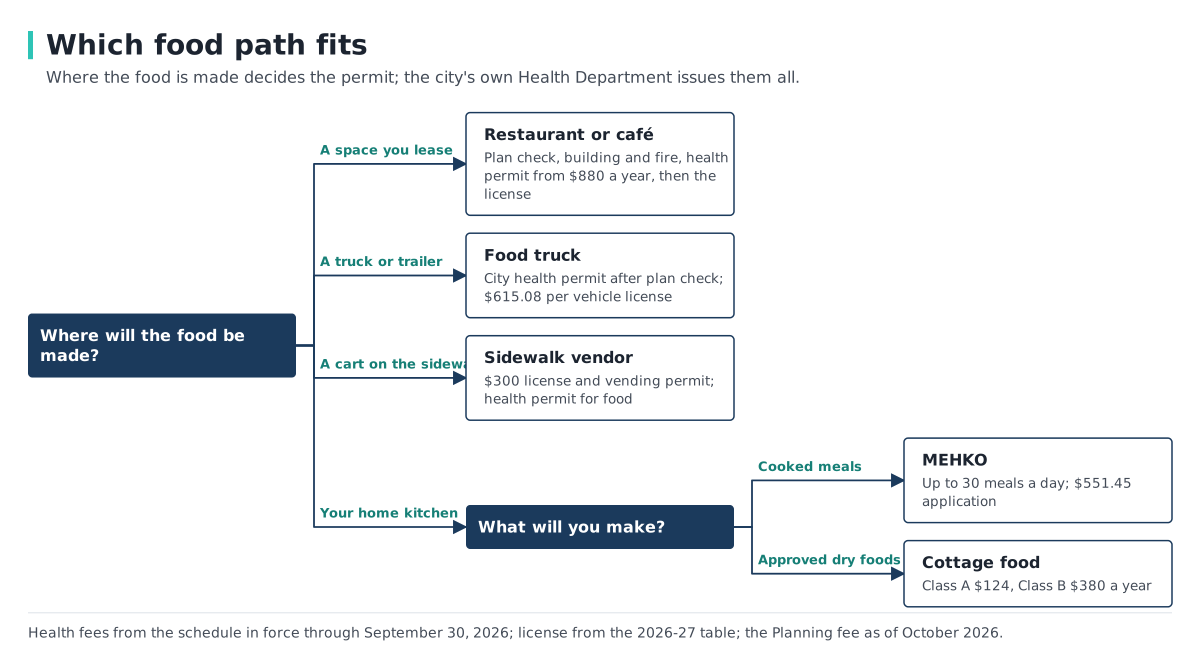
- Restaurants and cafés need Health plan approval before a building permit; plan check was $1,547 to $3,019 for a restaurant and the annual permit $880 to $2,17624.
- A food truck needs a city health permit ($1,051 a year if it prepares food) and a $615.08 per-vehicle license for 2026-274913.
- A cart that rolls on sidewalks needs a Sidewalk Vendor license, a vending permit and, for food, a health permit; the city’s FAQ puts the license at $3001718.
- A home kitchen is either a MEHKO (up to 30 meals a day; $551.45 application) or cottage food (Class A $124, Class B $380)423.
- The business license comes last on the build-out paths, and the Health fees shown here changed on October 1, 2026, with an average rise of 39 percent510.
A food business starts with one decision that the rest follows from: whether the food is made in a commercial space you lease, in a vehicle, on a cart, or in your own kitchen. Each of those has its own permit in Long Beach, its own fee and its own limits, and the city’s pages for them sit in different places. This page is the section pillar for the Food pages: a grid that routes you to the right path, one short section per path, the facts all of them share, and the list of guides. For the wider sequence that every Long Beach business follows, see How to Start a Business in Long Beach.
Health figures here are the schedule for the fee year that ended September 30, 2026; the city adopted new fees on September 8, 2026, effective October 1, and an August 2026 memo says “the average increase across all adjusted fees is kept to 39 percent”510. Planning fees are as of October 2026; the license tax is the 2026-27 table.
The short answer
| If you are… | Do this |
|---|---|
| Leasing a space to seat customers | The restaurant path: zoning, Health plan check, building and fire permits, health permit, license. See How to Open a Restaurant in Long Beach12 |
| Opening a counter-service café or coffee shop | The same path at a smaller price: the Health Department lists “coffee shops” as retail food facilities. See How to Open a Café or Coffee Shop in Long Beach3 |
| Selling from a truck or trailer | A city health permit after plan check, a Mobile Food Facility license, insurance. See Food Truck Permits in Long Beach13 |
| Selling from a cart on the sidewalk | A Sidewalk Vendor license and vending permit, plus a health permit for food. See Sidewalk Vending in Long Beach1718 |
| Cooking meals at home to sell directly, up to 30 a day | A MEHKO permit. See Selling Meals From a Home Kitchen in Long Beach23 |
| Making approved dry or low-risk foods at home | Cottage food, Class A or B. See Cottage Food in Long Beach26 |
| Not sure what the Health Department will classify you as | Start with the Bureau’s plan check; its guide covers the design and what needs approval. See Long Beach Health Permits for Food Businesses23 |
What every path shares
The same few facts hold across the paths.
The department is the city’s own. Long Beach runs its own health department: the Bureau of Environmental Health, not Los Angeles County, approves your kitchen plans and issues the permit to operate1. The Bureau is at 2525 Grand Avenue, Room 220, open Monday to Friday, 8 a.m. to 4:30 p.m., (562) 570-413212.
Plan check comes before the building permit. The Bureau requires plan approval “before constructing, enlarging, altering, converting or remodeling any building for use as a food facility”, and “building permits for food facilities are not to be issued until plan approval has been obtained”. It asks for “a minimum of (3) sets of detailed plans” at a “minimum scale of 1/4 inch = 1 ft”2. A truck or cart is covered too: the Bureau’s guide says “plan check approval prior to building, purchasing or leasing a truck or cart”14.
The business license comes last. The city’s sequence ends: “Upon receiving a final building inspection or Certificate of Occupancy, file for a business license”10. Most licenses issue on receipt of the application and payment; where inspections or investigations are required first, “for most businesses, this takes two weeks or less”11. For a home kitchen there is no build-out, and the license is the home-based category: $299.54 plus $12.66 per employee for 2026-279.
Zoning is the other check on the build-out paths. A restaurant or café without a drive-through is permitted by right in the city’s eight neighborhood, community and regional commercial districts; a drive-through needs a conditional use permit in six of them and is prohibited in two7. A conditional use permit is $17,330.88 with surcharge as of October 20266. Food on a home kitchen path runs through the home occupation rules instead2425.
The state sets the limits at home. Cottage food’s sales caps and approved foods list are California’s, adjusted each year; the city registers and inspects2627.
Path 1. A restaurant
A restaurant runs through four city departments in a fixed order: Planning confirms the zoning before the lease, Health approves plans before Building issues a permit, Building and Fire sign off before Health grants the permit to operate, and the license comes last1210. In the fee year that ended September 30, 2026, plan check was $1,547 to $1,931 for 0 to 60 seats, $2,363 to $2,598 for 61 to 200 and $2,742 to $3,019 for 201 or more, low and high risk; a minor remodel pays half4. The annual permit ran from $880 (ten seats or fewer, low risk) to $2,176 (more than 400 seats, high risk)4.
Alcohol is where restaurants most often meet an entitlement. A conditional alcohol use “shall not be located within five hundred feet (500′) of a public school, or public park”, and a restaurant that serves alcohol only with meals can use an exemption at $1,694.56 as of October 2026 instead of the $17,330.88 permit68. The first sign is $119.84 as of October 2026, and a storefront license starts at $488.81 plus a per-employee charge69. The full ten steps are in How to Open a Restaurant in Long Beach.
Path 2. A café or coffee shop
The Health Department lists “coffee shops” among retail food facilities, so a café goes through the same plan check, health permit and license as a restaurant; the savings come from size, not from fewer steps3. In the fee year that ended September 30, 2026, plan check was $1,547 (low risk) or $1,931 (high) up to 60 seats, and the annual permit $880 or $1,152 for 0 to 10 seats, $1,136 or $1,542 for 11 to 30, and $1,270 or $1,670 for 31 to 604. Health assigns the risk category from the menu, and plan check is still required for “change of ownership for owners taking over inactive/closed facilities”24. Details, including taking over an existing café space, are in How to Open a Café or Coffee Shop in Long Beach.
Good to know Plan check is one price from 0 to 60 seats, so a 12-seat café pays the same $1,547 as a 60-seat one4.
Path 3. A food truck
Municipal Code chapter 5.37 requires a business license, a Mobile Food Facility permit, a seller’s permit “to the extent required by law” and “a valid health permit from the City Department of Health and Human Services”13. The license is $615.08 per vehicle for 2026-27, and paying it “shall satisfy the fee for a Mobile Food Facility Business Permit”913. The code’s insurance minimums are $1,000,000 per occurrence, $2,000,000 general aggregate, workers’ compensation and $500,000 auto13.
In the fee year that ended September 30, 2026, plan check was $288, $512 or $1,339 by vehicle class (the top class covers unpackaged perishable food such as tacos), and the annual health permit $1,051 for a truck that prepares food or $496 for one that only sells it4. A taco truck’s recurring charges are therefore about $1,666 a year before insurance and commissary rent49.
Official pages disagree The code and the Bureau’s pages say the health permit is issued by the city1316. One city forms sheet says it comes from Los Angeles County15. Plan around the city permit; a truck holding a county permit can ask the Bureau about its plan check consultation1216.
The details are in Food Truck Permits in Long Beach.
Path 4. A sidewalk cart
Sidewalk vending has been under Municipal Code chapter 5.73 since February 26, 202422. A vendor needs a Sidewalk Vendor business license, a sidewalk vending permit issued with it and, if selling food, a Compact Mobile Food Operation health permit from the Health Department; the city’s FAQ puts the license at $300 (page updated September 15, 2024)1718. The Health schedule for the fee year that ended September 30, 2026 listed food-service cart permits at $325 without plumbing and $800 with it4.
A cart is limited to limited food preparation: it can slice and chop washed non-hazardous foods or reheat food made at an approved facility, but cannot thaw or cook hazardous foods for later use21. Stationary vendors keep set distances, such as 10 feet from a driveway or crosswalk and 5 feet from a bus stop; exclusively residential areas allow only roaming vending1920. The code exempts selling only prepackaged non-hazardous food or whole uncooked produce from 25 square feet or less from the health permit, though the license and vending permit still apply22. A cart that is a motorized vehicle is a food truck. See Sidewalk Vending in Long Beach.
Path 5. A home kitchen under a MEHKO
A Microenterprise Home Kitchen Operation lets an eligible resident cook and sell meals directly to consumers from a private home kitchen, with limits of 30 meals a day, 90 a week, annual gross sales up to $100,000 (adjusted annually for inflation), one full-time-equivalent employee, and food “prepared, cooked, and served the same day”23. Before operating you need a Public Health Permit from the Bureau, a business license, food safety certifications and a home kitchen inspection23. The Health schedule for the fee year that ended September 30, 2026 listed an application fee of $551.45 and an annual registration of $504.514. The home-based license is $299.54 plus $12.66 per employee9.
The Municipal Code lists MEHKOs among allowed home occupations and bars the city from requiring a rezone or charging zoning-related fees for one2425. The ordinance “was introduced and advanced by the City Council on April 14, 2026”23. A business over the limits is on the restaurant or commissary path. See Selling Meals From a Home Kitchen in Long Beach.
Path 6. Cottage food
Cottage food is the lightest food business the city regulates. Class A (direct sales only) is a $124 annual registration, Class B (direct and indirect sales) a $380 annual permit, and both pay a one-time application fee of $139.20, in the fee year that ended September 30, 2026426. The sales caps are set by state law and adjusted for inflation: $88,878 for Class A and $177,756 for Class B in 202627. Only foods on the California Department of Public Health’s approved list may be made28. Operators must complete the state’s training within three months of registration or permitting, and labels must say “Made in a Home Kitchen” in 12-point type29.
Cakes with cream cheese, cream or custard fillings are not on the approved list, and full meals are a MEHKO, not cottage food28. See Cottage Food in Long Beach.
Guides in this section
- How to Open a Restaurant in Long Beach: the ten steps across four departments, with a fee table at each.
- How to Open a Café or Coffee Shop in Long Beach: the restaurant path at small sizes.
- Long Beach Health Permits for Food Businesses: plan check, fees, inspections and what the public can see afterward.
- Food Truck Permits in Long Beach: vehicle classes, the license and the parking rules.
- Sidewalk Vending in Long Beach: licenses, cart rules and distances.
- Selling Meals From a Home Kitchen in Long Beach: the MEHKO permit and its limits.
- Cottage Food in Long Beach: Class A and B, caps and approved foods.
Cost and permit questions that cross every path are covered in What a Long Beach Business License Costs, Conditional Use Permits in Long Beach and The Commercial Build-Out Sequence in Long Beach. The planned guide on alcohol is Serving Alcohol in Long Beach.
What each path costs the city
The city’s recurring charges, side by side, in the fee year that ended September 30, 2026 for Health and the 2026-27 table for the license49:
| Path | Health permit, per year | License, 2026-27 |
|---|---|---|
| Restaurant or café, 0 to 10 seats | $880 (low risk), $1,152 (high) | $488.81 plus per employee |
| Food truck, prepares food | $1,051 | $615.08 per vehicle |
| Food truck, sells only | $496 | $615.08 per vehicle |
| Sidewalk food cart | $325 without plumbing, $800 with | $300 per the city’s FAQ |
| MEHKO | $504.51 registration | $299.54 plus per employee |
| Cottage food Class A | $124 | the city’s Health page sends applicants to the Business License Division for “possible additional requirements” |
Sources:4,9,18,23,26. The one-time charges differ more than the recurring ones: restaurant plan check is $1,547 or more, a truck’s $288 to $1,339, a MEHKO application $551.45 and cottage food $139.204. The private costs the city does not set, the lease, equipment, general liability insurance and the point-of-sale system, are the larger part of a commercial food business; the city’s figures are the part you can know in advance. The site earns a commission on some links to business services, which does not affect what is recommended.
Frequently Asked Questions
Does Long Beach have its own health department for food permits?
Yes. The city’s Bureau of Environmental Health permits food facilities, runs plan check and issues the annual permit;
What comes first, the health permit or the building permit?
Health plan approval comes first: “building permits for food facilities are not to be issued until plan approval has been obtained”. The permit to operate comes after Building and Fire sign off2.
How much is a food permit in Long Beach?
It depends on the path. In the fee year that ended September 30, 2026, a restaurant permit was $880 to $2,176 a year, a food truck’s $496 or $1,051, a Class A cottage food registration $124 and a Class B permit $3804.
Can I sell food from my home kitchen in Long Beach?
Do I need a business license for a food business?
Do food trucks need a permit from Long Beach?
Yes: a health permit from the city, a Mobile Food Facility license ($615.08 per vehicle for 2026-27) and the insurance the code requires13.
Do the fees on this page change?
Related Articles
Sources
- Restaurant Permitting Guidelines (brochure, November 2024) — City of Long Beach, Community Development. Accessed 2026-10-01.
- Food Facility Plan Check Guide — City of Long Beach, Bureau of Environmental Health. Accessed 2026-10-01.
- Food Safety Program — City of Long Beach, Bureau of Environmental Health. Accessed 2026-10-01.
- Environmental Health fees and charges, FY26 mid-year schedule (June 16, 2026) — City of Long Beach, Health and Human Services. Accessed 2026-10-01.
- Memo: Processes and Fees for Food Safety Program, August 25, 2026 — City of Long Beach, City Manager. Accessed 2026-10-01.
- Planning Bureau Fee Schedule, revised October 1, 2026 (FY27 fees version) — City of Long Beach, Community Development. Accessed 2026-10-01.
- Long Beach Municipal Code, Chapter 21.32 Commercial Districts (Table 32-1) — Municode. Accessed 2026-10-01.
- Long Beach Municipal Code, Chapter 21.52 Conditional Uses — Municode. Accessed 2026-10-01.
- Business License Rates Effective July 1, 2026 – June 30, 2027 — City of Long Beach, Financial Management. Accessed 2026-10-01.
- Retail Permitting Guidelines (brochure, November 2024) — City of Long Beach, Community Development; and Fee Schedules — Community Development. Accessed 2026-10-01.
- Business License Application Instructions — City of Long Beach. Accessed 2026-10-01.
- Permitted Mobile Food Facilities (Bureau contact details) — City of Long Beach, Bureau of Environmental Health. Accessed 2026-10-01.
- Long Beach Municipal Code, Chapter 5.37 Mobile Food Facilities — Municode. Accessed 2026-10-01.
- Food Trucks and Carts: A Guide Through the Permitting Process — City of Long Beach, Bureau of Environmental Health. Accessed 2026-10-01.
- Required Forms and Permits — City of Long Beach, Business License Division. Accessed 2026-10-01.
- Mobile Food Facility — City of Long Beach, Bureau of Environmental Health. Accessed 2026-10-01.
- Sidewalk Vending — City of Long Beach, Financial Management. Accessed 2026-10-01.
- Sidewalk Vending FAQs (updated as of 9/15/24) — City of Long Beach, Financial Management. Accessed 2026-10-01.
- Stationary Sidewalk Vending: Operating Distances — City of Long Beach, Business License Division. Accessed 2026-10-01.
- Sidewalk Vending operating conditions (Ver 1, 2/23/24) — City of Long Beach, Business License Division. Accessed 2026-10-01.
- Sidewalk Vending Enforcement Related FAQs (last updated October 7, 2024) — City of Long Beach, Financial Management. Accessed 2026-10-01.
- Long Beach Municipal Code, Chapter 5.73 Sidewalk Vending — Municode. Accessed 2026-10-01.
- Microenterprise Home Kitchen Operation (MEHKO) — City of Long Beach, Bureau of Environmental Health. Accessed 2026-10-01.
- Long Beach Municipal Code, Chapter 5.35 Microenterprise Home Kitchen Operations — Municode. Accessed 2026-10-01.
- Long Beach Municipal Code, Chapter 21.51 Accessory and Temporary Uses (section 21.51.235 Home Occupations) — Municode. Accessed 2026-10-01.
- Cottage Foods — City of Long Beach, Bureau of Environmental Health. Accessed 2026-10-01.
- Cottage Food Operation Adjusted Gross Annual Sales Limit — California Department of Public Health. Accessed 2026-10-01.
- Approved Cottage Foods (last reviewed April 2026) — California Department of Public Health. Accessed 2026-10-01.
- Class A cottage food registration and permitting form — City of Long Beach, Bureau of Environmental Health. Accessed 2026-10-01.
- General Business License — City of Long Beach. Accessed 2026-10-01.